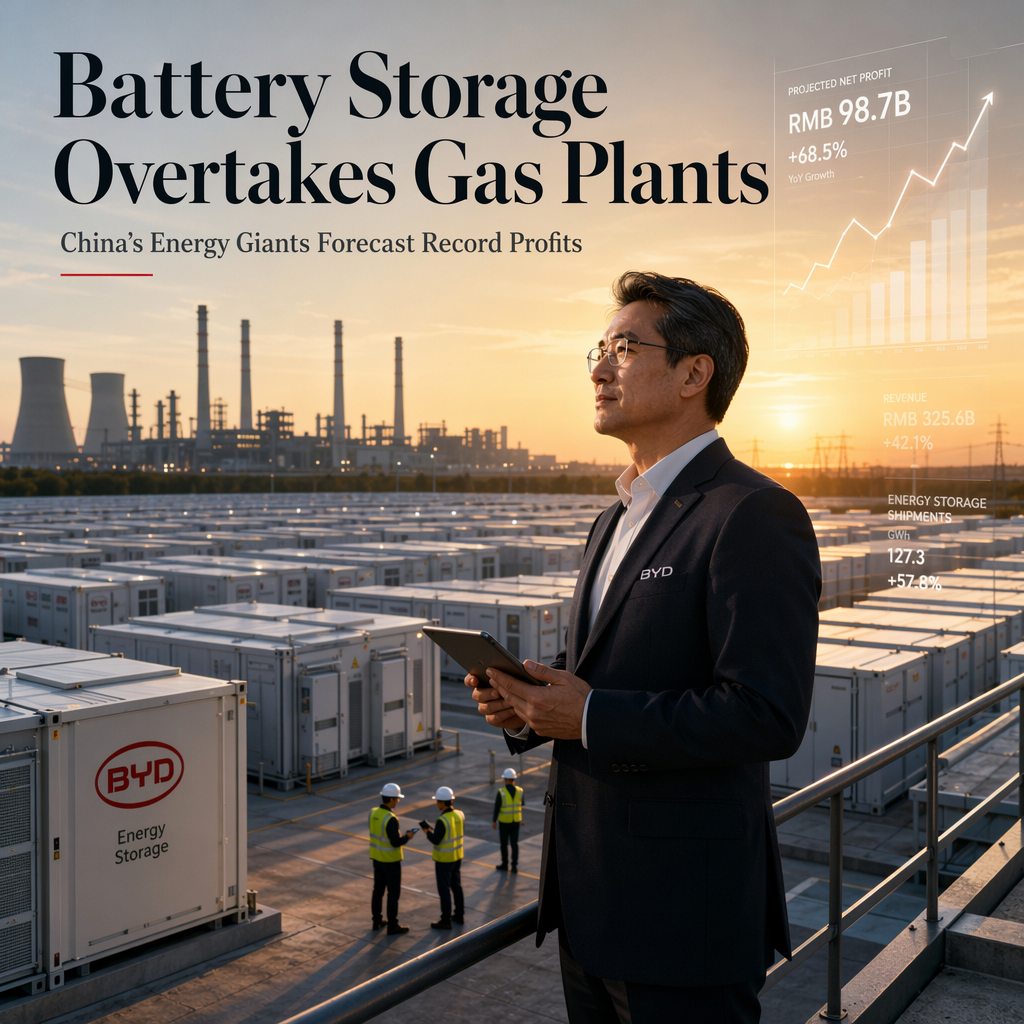
Battery storage station construction and operational costs have, for the first time, fallen below those of gas-fired power plants, driven by a 40% drop in battery prices in 2025 due to overproduction in China and a shift away from electric vehicles [1]. Major Chinese battery manufacturers, including BYD and CATL, are pivoting from automotive batteries to stationary storage, with BYD alone accounting for over 70% of the global automotive battery market [1]. This strategic shift is attributed to a slump in electric vehicle demand, resulting in oversupply and sharply reduced battery prices, while a turbine supply crunch is simultaneously increasing the costs of new gas-fired plants [1].
Industry analysts expect this cost advantage to accelerate global investment in battery storage projects, especially in regions aiming to boost grid reliability and integrate more renewable energy sources [1]. The market outlook suggests increased profitability for battery storage, with investors and developers monitoring price trends and supply chain dynamics closely [1].
Meanwhile, Chinese energy companies are reporting strong profit guidance for the first half of the year, with Eve Energy, a Shenzhen-listed lithium-ion battery manufacturer, projecting a net profit increase of 95% to 110% year-on-year [2]. Other major players, such as CITIC Resources, are also forecasting significant profit gains, primarily due to a surge in crude oil prices following the war in the Middle East, which has disrupted global supply chains and driven up energy prices [2]. Analysts believe elevated energy prices could persist for months, potentially extending the windfall for Chinese energy firms into the second half of the year [2].
Despite ongoing US-China tensions and American sanctions on some companies like Eve Energy, the fundamentals for China's energy sector remain strong, supported by global supply disruptions and resilient domestic demand [2]. Eve Energy's anticipated profit surge is seen as indicative of the broader transition toward batteries and renewable energy in China, with the company emphasizing plans to expand production capacity and capture new markets as the global energy mix shifts away from fossil fuels [2]. Investors are closely watching for further earnings updates and the impact of geopolitical risks on the sector [2].
CONCLUSION
The convergence of falling battery storage costs and rising gas plant expenses is reshaping the global energy landscape, with Chinese battery and energy companies poised to benefit from both market and geopolitical dynamics. Strong profit forecasts and strategic capacity expansions signal robust momentum for battery storage and renewable energy, despite ongoing international tensions.