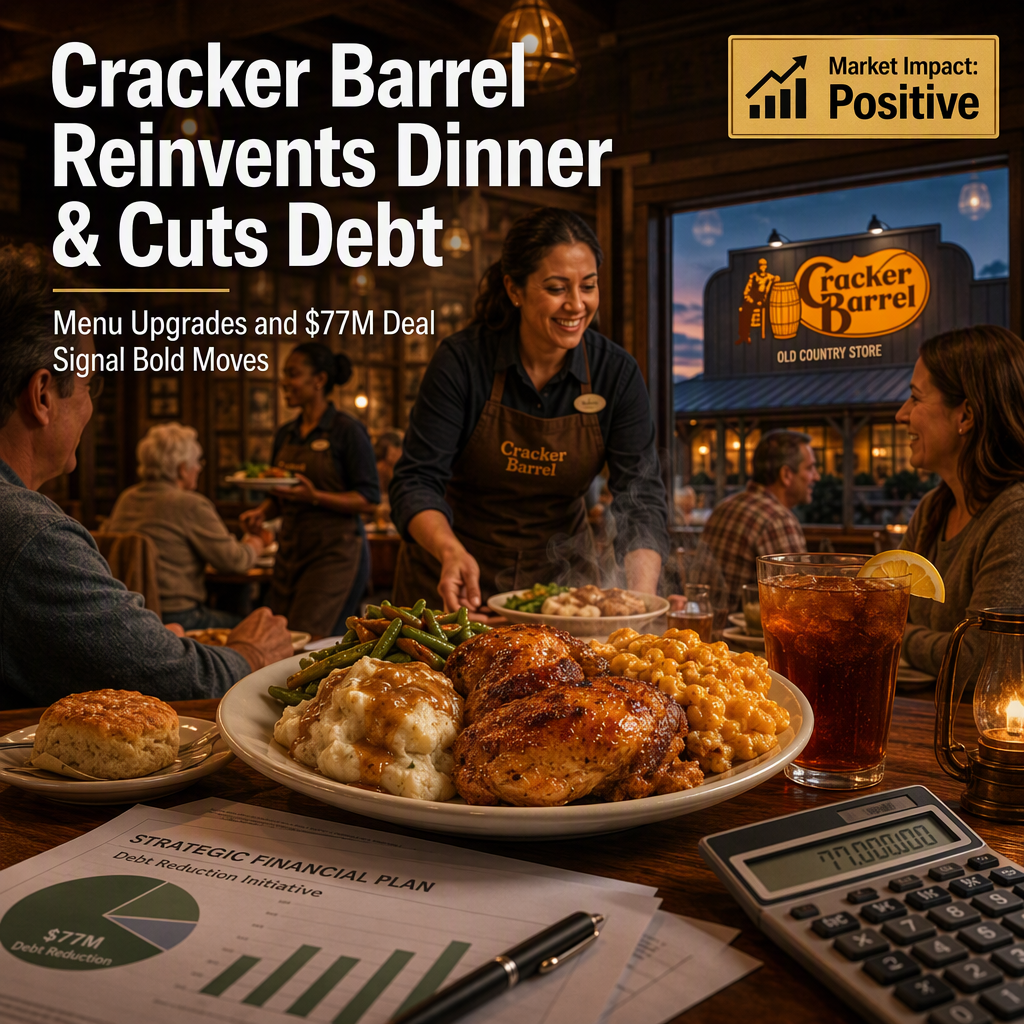
Cracker Barrel announced plans to upgrade three of its most popular dinner offerings—chicken, hamburger, and steak—as part of a broader strategy to improve guest satisfaction and capitalize on dinner as its 'biggest opportunity' for growth [1]. President and CEO Dave Deno emphasized the company's focus on enhancing food quality, guest experience, and employee retention, stating, 'We are making investments to improve food quality' and highlighting that these priorities are expected to drive improved traffic and profitability [1].
In addition to menu improvements, Cracker Barrel completed a sale-leaseback transaction involving 26 company-owned restaurants, generating approximately $77 million in net proceeds [1]. Chief Financial Officer Craig Pommells explained that these proceeds were used to pay down debt, partially offsetting the $150 million debt related to the 0.625% convertible senior notes that matured and were repaid in June. The quarter ended with total debt of $337.2 million, which is $147.4 million lower than the prior year [1].
Deno noted ongoing pressure among lower-income consumers, although customer trends have improved recently. Pommells highlighted the chain's value proposition, with the average guest check at about $16, suggesting that Cracker Barrel remains accessible for those feeling discretionary income pressure [1]. The company also indicated that higher freight costs, including fuel surcharges, are already accounted for in its fiscal 2027 outlook [1].
No analyst opinions or forward-looking statements beyond the company's own projections and management commentary were provided in the article [1].
CONCLUSION
Cracker Barrel is taking strategic steps to enhance its dinner menu and reduce debt through a significant real estate transaction. While the company faces some pressure from lower-income consumers, management remains optimistic about improved trends and the chain's value proposition. The market impact is medium, with a positive sentiment driven by debt reduction and menu upgrades.