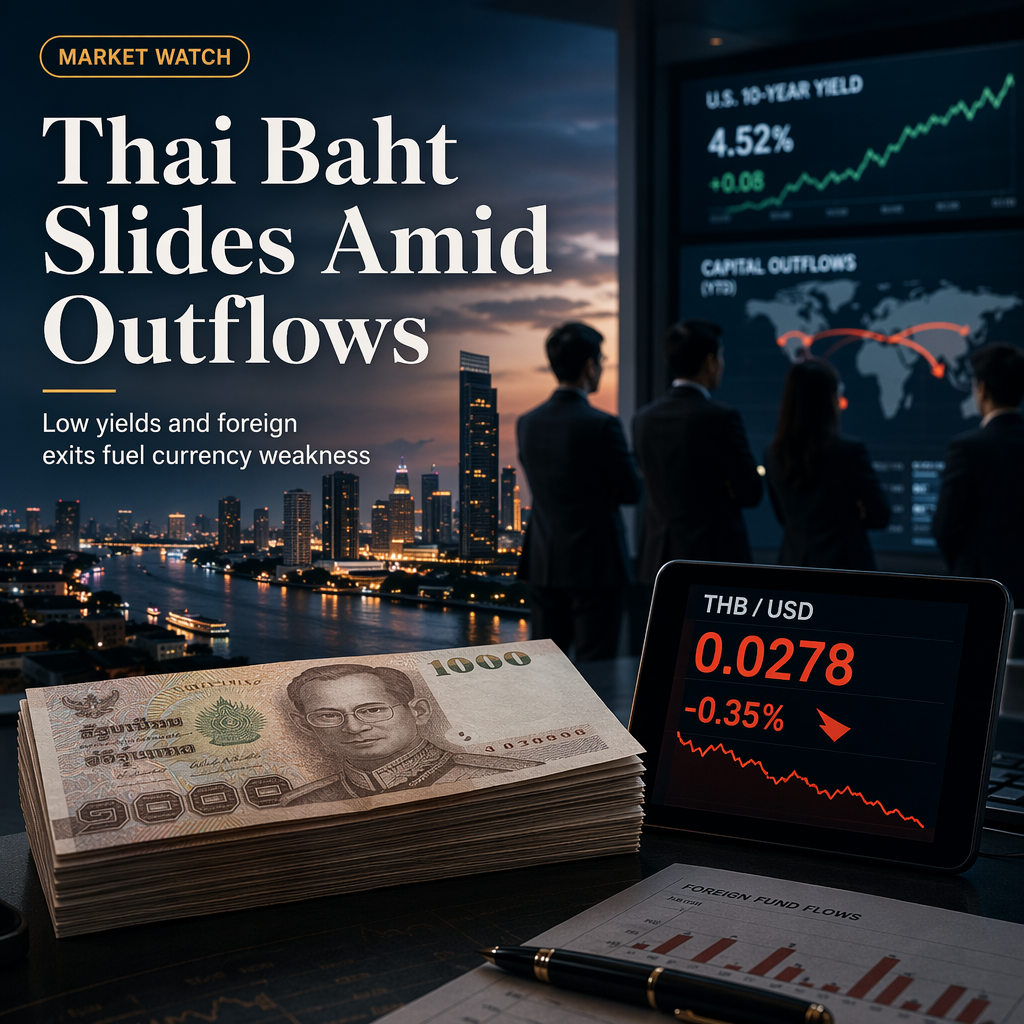
The Thai Baht (THB) has experienced notable weakness, despite a backdrop of lower oil prices, according to Lloyd Chan at MUFG. This decoupling from easing terms-of-trade pressures is attributed primarily to the baht's low-yield profile and the Bank of Thailand’s (BoT) growth-focused policy stance, which restricts the scope for monetary policy tightening [1]. Rising United States (US) yields have further exacerbated the situation, prompting a shift in Thai portfolio flows from net inflows to net outflows. Specifically, Thailand saw $379 million in net foreign outflows in June, compared to $680 million in net inflows in May [1]. These outflows have reinforced depreciation pressures on the baht, causing it to underperform other regional currencies against the US Dollar (USD) [1]. The market implication is that the baht remains vulnerable to further weakness as long as US yields stay elevated and the BoT maintains its accommodative stance. No forward-looking statements or analyst opinions beyond MUFG's assessment were provided in the source [1].
CONCLUSION
The Thai Baht's underperformance is driven by its low-yield profile and net foreign portfolio outflows, despite lower oil prices. Market sentiment remains negative, with depreciation pressures likely to persist unless there is a shift in either US yields or the Bank of Thailand’s policy stance.