
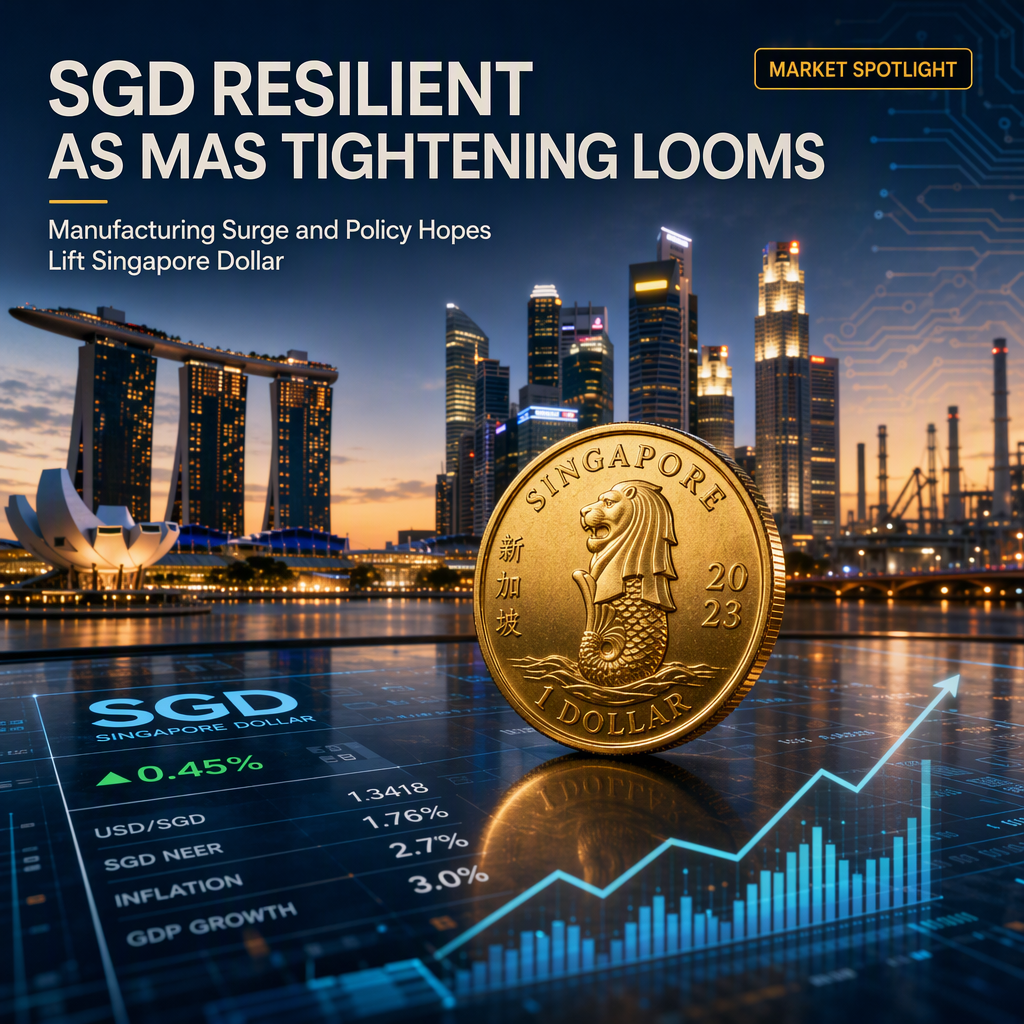
The Singapore Dollar (SGD) has demonstrated resilience, maintaining stability even as other Asian currencies have softened, with the USD/SGD pair trading around 1.2780 according to OCBC’s Christopher Wong [1]. This stability is attributed to robust economic data and expectations of further monetary tightening by the Monetary Authority of Singapore (MAS) [1]. Specifically, Singapore's August manufacturing output increased by 15.4% year-on-year, a significant rise from the revised 6.9% in July, driven by strong performance in electronics and precision engineering sectors, although there was a slight month-on-month decline of 0.5% [1].
OCBC notes that the resilient manufacturing activity, supported by AI-related demand, and persistent underlying price pressures have led to expectations that MAS will slightly steepen the S$ Nominal Effective Exchange Rate Index (S$NEER) slope at its mid-October policy meeting [1]. This anticipated policy adjustment follows recent CPI data indicating ongoing inflationary pressures [1].
In the near term, the USD/SGD pair is expected to be influenced by movements in the US dollar, interest rates, and the Chinese renminbi, but the prospect of further MAS tightening is likely to keep the SGD relatively resilient compared to higher-beta Asian currencies [1]. Technical analysis suggests that while bullish momentum for USD/SGD remains, there are signs of slowing, with the RSI easing lower, indicating a potential period of consolidation [1].
CONCLUSION
Singapore's strong manufacturing output and persistent inflation pressures have reinforced expectations for MAS to tighten policy at its upcoming meeting, supporting the SGD's resilience. Market participants are likely to watch for further MAS signals, with the SGD expected to remain steady against regional peers in the near term.