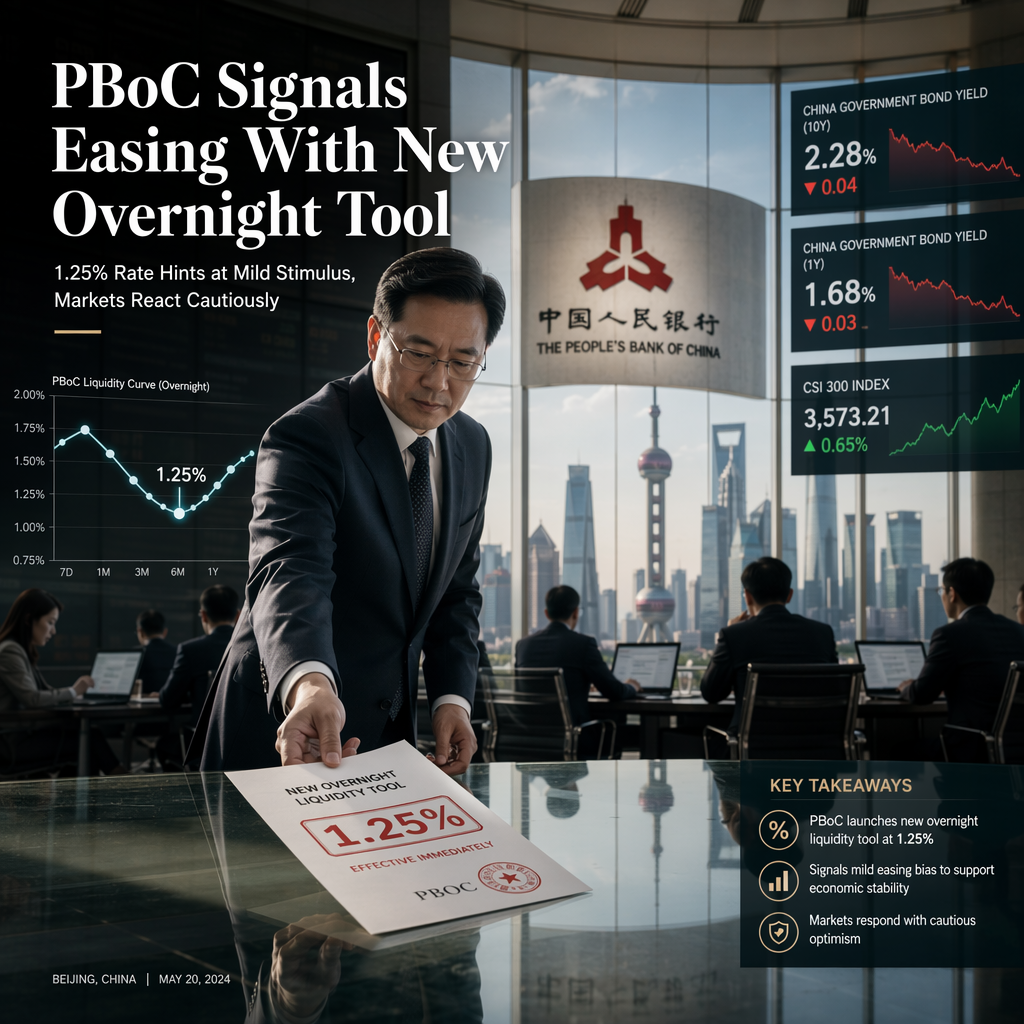
The People's Bank of China (PBoC) has introduced a new overnight liquidity tool, setting its rate at 1.25%, which is 15 basis points below the key seven-day reverse repo rate and also below the consensus range of 1.30-1.35% prior to the operation [1]. This move is interpreted as a mild dovish surprise and a de facto easing signal, aimed at smoothing short-end funding and reducing cash market volatility [1]. The facility marks the first use of this mechanism to manage liquidity, supporting a more market-oriented framework for short-term rate setting [1].
Geoff Yu at BNY notes that the weak round of economic data over the past month has increased the impetus for stimulus, and fiscal measures are expected to follow [1]. However, Yu cautions that such responses may be limited without fundamental changes in corporate 'involution,' referencing Beijing's summons to platform firms to improve profitability [1].
Market reaction to the announcement was modest. Government bond yields edged lower, with the 10-year Chinese government bond yield falling by 1.2 basis points to 1.714%. The CSI 300 index rose by 1.21% to 4927, while USD/CNY slipped by 0.106% to 6.7932 [1]. There was broad-based demand for sovereign bonds, particularly from the Eurozone, the U.K., and India, while selling was concentrated in Philippine, Colombian, and Japanese government bonds [1].
The PBoC also conducted ¥300bn of overnight reverse repurchase operations, while its seven-day reverse repo benchmark remained at 1.4% [1].
CONCLUSION
The PBoC's launch of a new overnight liquidity tool at a lower-than-expected rate signals a mild easing stance, prompting modest gains in Chinese equities and lower bond yields. While the move is seen as supportive for short-term funding conditions, analysts expect further fiscal measures amid ongoing economic weakness. The market response suggests cautious optimism, with increased demand for Chinese sovereign bonds.