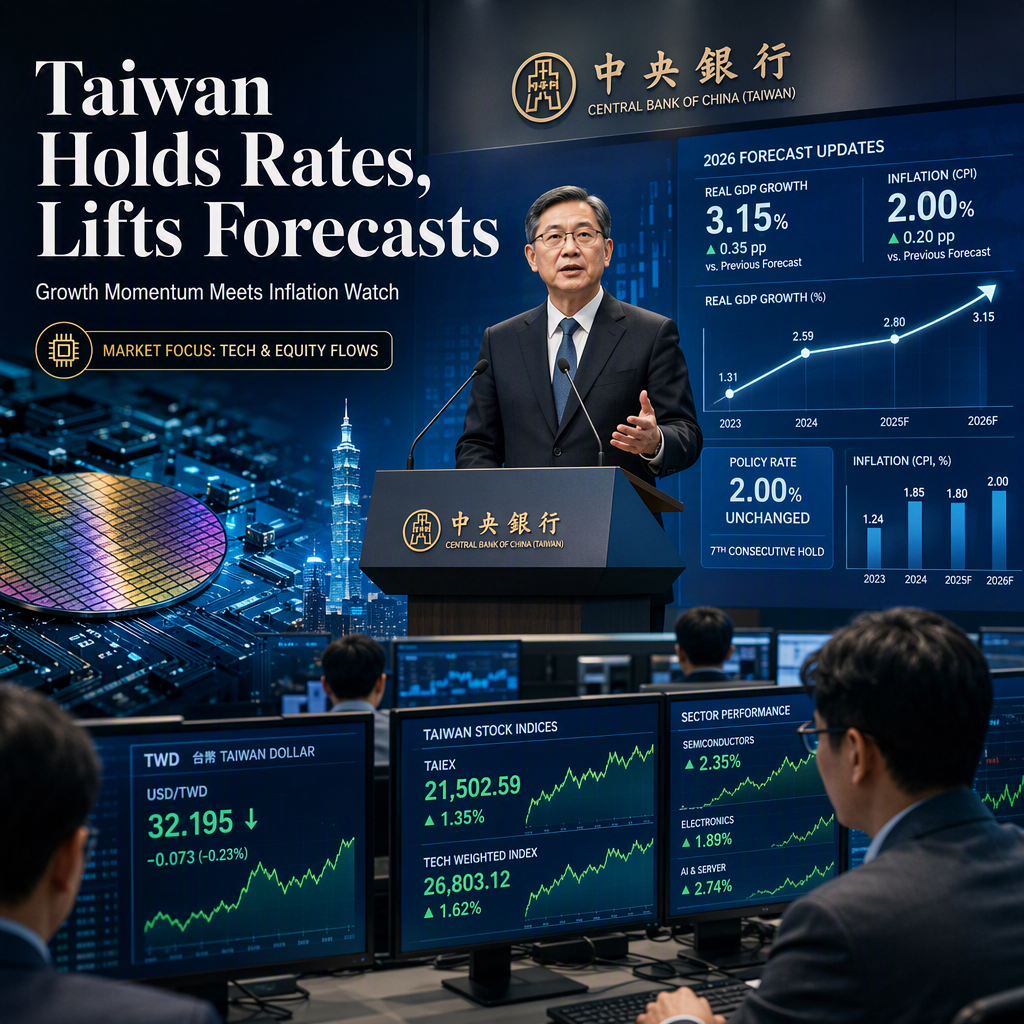
Taiwan's Central Bank (CBC) maintained its policy rate at 2.0% for the tenth consecutive quarter, adopting a mildly hawkish tone while refraining from signaling an imminent rate hike [1][2]. Both OCBC and Commerzbank analysts noted that the CBC sharply raised its 2026 GDP growth forecast—OCBC citing a figure of 11.48% [1], while Commerzbank reported an increase to 11.5% from a previous 9.5% [2]. The CBC also lifted its 2026 inflation forecast, with Commerzbank specifying a rise to 2.0% from 1.9%, and projected inflation to ease to 1.8% in 2027 [2]. The bank flagged persistent services inflation and cited strong AI-related semiconductor demand as a key driver of economic expansion, with the economy growing 14.2% in the first half of the year [2].
Despite the policy support, both sources emphasized that near-term movements in the Taiwan Dollar (TWD) are more likely to be influenced by foreign equity flows, technology sector sentiment, and broader US Dollar trends rather than monetary policy decisions [1][2]. OCBC highlighted that the TWD remained broadly steady even after post-FOMC USD strength, supported by a rebound in domestic equities and renewed foreign equity inflows following five sessions of outflows [1]. Technical analysis from OCBC suggests bullish momentum for TWD remains intact, though some consolidation or pullback is possible if broader risk sentiment stabilizes [1].
Commerzbank described the CBC's stance as patient and neutral, with little urgency to tighten policy at present. The bank suggested that policy could remain unchanged in December but may start hiking in Q1 2027 if inflationary pressures persist [2]. Strong growth momentum is expected to allow policymakers to focus on inflation risks in the coming months [2].
No direct market reaction data was provided, but both sources indicate that foreign equity flows and tech sentiment are currently the dominant factors for TWD direction, with policy changes playing a secondary role [1][2].
CONCLUSION
Taiwan's central bank maintained its policy rate at 2.0% and raised its 2026 growth and inflation forecasts, reflecting optimism about economic momentum but caution over inflation risks. However, analysts agree that foreign equity flows and tech sentiment will be the primary drivers of the Taiwan Dollar in the near term. The policy outlook remains neutral, with potential for tightening only if inflation pressures persist into 2027.