
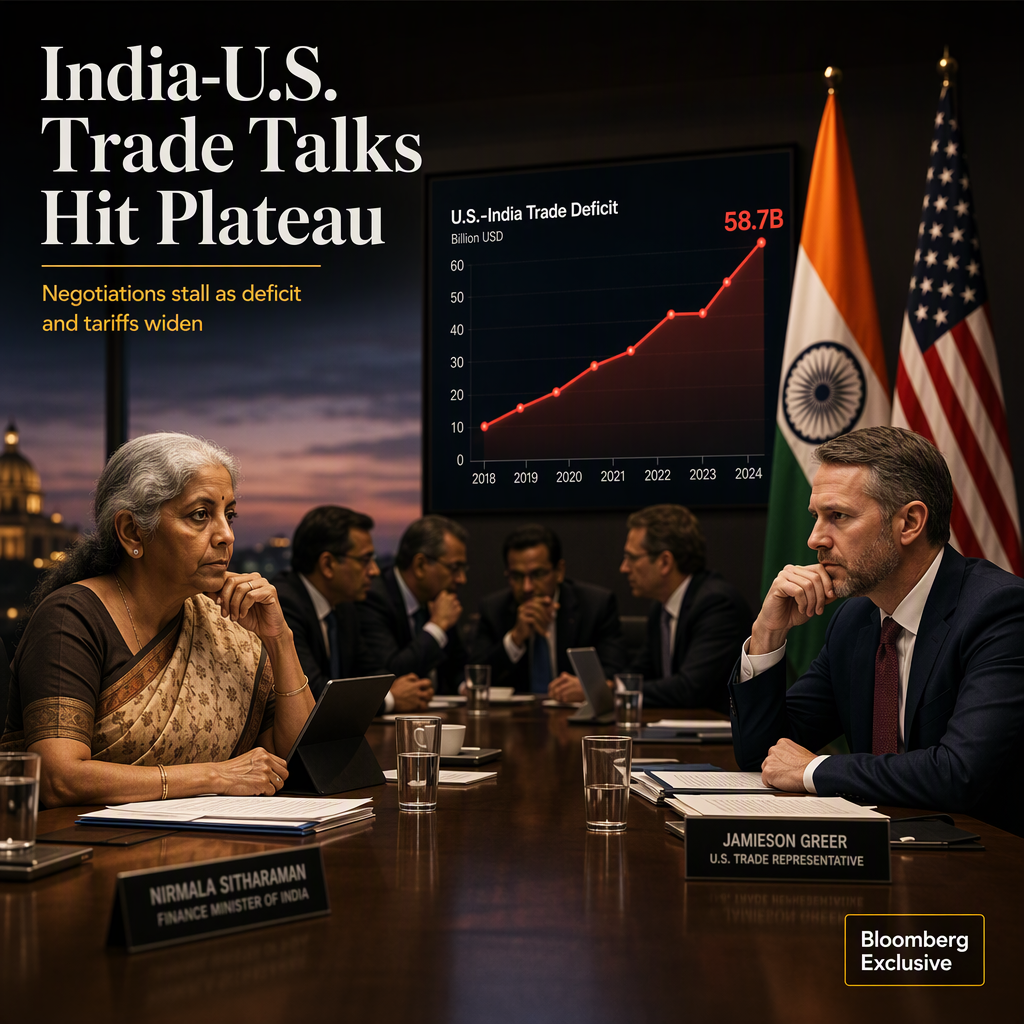
India's Finance Minister Nirmala Sitharaman confirmed that trade negotiations with the U.S. have reached a plateau, signaling significant challenges in finalizing a deal between the two countries. Speaking at the Munich Leaders Meeting in New Delhi, Sitharaman stated, 'Negotiations are still ongoing, although we'd like to believe that both sides have reached a plateau beyond which giving or taking might be very very difficult,' highlighting the difficulty in moving forward with talks [1]. This acknowledgment comes after U.S. Trade Representative Jamieson Greer noted last week that a trade agreement was not 'imminent,' despite ongoing negotiations [1].
A key issue in the talks is the U.S. desire to reduce its trade imbalance with India. The U.S. goods trade deficit with India reached $58.42 billion in 2025, marking a 27.8% increase ($12.7 billion) over 2024. For the first seven months of 2026, the deficit stood at $28.4 billion, according to U.S. data [1]. Both sides have reviewed bilateral trade, defense, energy, and critical technologies, with Indian Prime Minister Narendra Modi and U.S. President Donald Trump discussing these topics in a recent call described as 'constructive' by Greer and 'productive' by Modi, though Trump did not comment [1].
Earlier in February, Trump announced an interim trade deal, stating that India had agreed to 'BUY AMERICAN' at 'a much higher level.' India, meanwhile, has sought preferential tariffs to make its exports more competitive in the U.S. market [1]. Currently, Indian exports to the U.S. face a 10% tariff, following the USTR's investigation into forced labor practices in 60 countries. However, a substantial share of India's exports, such as generic pharmaceuticals and smartphones, remain outside the scope of this duty [1].
Mark Linscott, former assistant U.S. trade representative, warned that both countries stand to lose if no deal is finalized. He noted that U.S. exports face higher tariffs in India and cautioned that India could face even higher tariffs than other countries if a deal is not reached, which could be problematic given the importance of the U.S. market for India [1].
CONCLUSION
Trade negotiations between India and the U.S. have stalled, with both sides facing significant challenges in resolving issues related to tariffs and trade imbalance. The rising U.S. trade deficit with India and the threat of higher tariffs underscore the urgency for a deal, but skepticism remains high. Without progress, both economies risk losing out on critical market opportunities.