
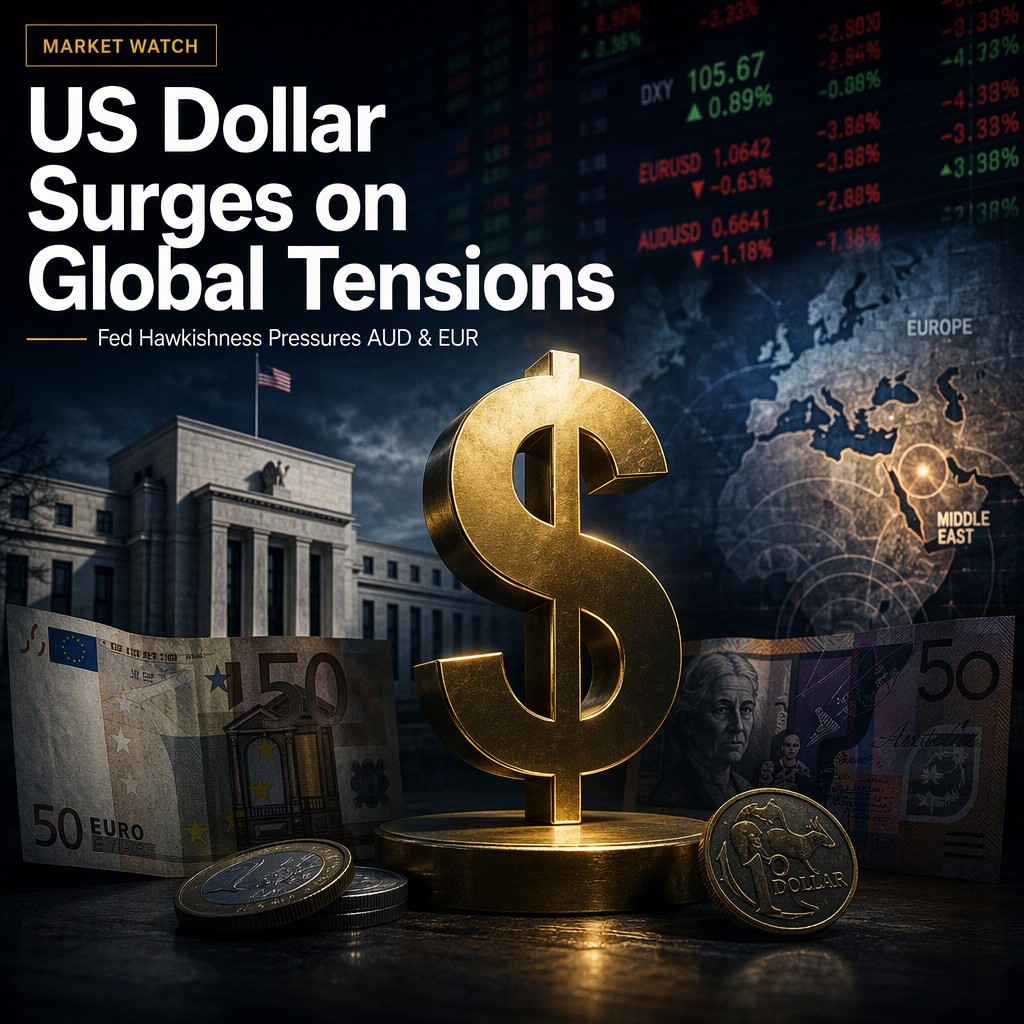
The US Dollar (USD) strengthened against major currencies on Monday, driven by persistent geopolitical tensions and expectations of further monetary tightening by the Federal Reserve (Fed) [1][2]. The Australian Dollar (AUD) retreated, with AUD/USD trading around 0.6965, down 0.24% at the time of writing, as the Greenback recovered from earlier losses following a pullback in US Treasury yields and optimism over a potential Russia-Ukraine energy agreement [1]. Similarly, the Euro (EUR) remained under pressure, with EUR/USD trading near 1.1178, close to 17-month lows, as the US Dollar Index (DXY) hovered around 102.35, a level last seen in April 2025 [2].
Geopolitical uncertainty, particularly in the Middle East, contributed to the US Dollar's safe-haven appeal. Over the weekend, Yemen's Iran-backed Houthi movement intensified attacks against Saudi Arabia, while US President Donald Trump raised the possibility of renewed military strikes against Iran, heightening concerns about a broader regional escalation [1]. These developments weighed on risk-sensitive currencies like the AUD and EUR [1][2].
On the monetary policy front, the Fed's hawkish stance continued to support the US Dollar. While investors have reduced expectations for a rate hike at the late-October meeting, the possibility of a 25-basis-point increase in December remains [1]. The Fed raised rates by 25 bps in September to 3.75%-4.00%, with most policymakers signaling that another hike could be appropriate this year [2]. Market participants are closely watching upcoming US inflation data, with the Producer Price Index (PPI) due Wednesday and the Consumer Price Index (CPI) on Thursday, as these releases could influence expectations for further Fed tightening [1][2]. The CME FedWatch Tool indicates an 80% chance the Fed will keep rates steady at the October 27-28 meeting [2].
In Europe, the Euro faced additional pressure from French political and fiscal uncertainty. French debt spreads remained near their widest, and Marine Le Pen's counter-budget proposal failed to reassure markets [2]. The French government's €43bn savings plan is set for parliamentary debate, but analysts expect little progress, with the possibility of the budget being passed by decree [2]. The European Central Bank (ECB) has raised rates twice this year, bringing the deposit facility rate to 2.50%, and with Eurozone inflation at 3.8% in September, expectations for another hike before year-end persist, though a pause is anticipated at the October 29 meeting [2].
Technical analysis for AUD/USD shows the pair trading with a bearish intraday tone, remaining below the 100-hour simple moving average and with a Relative Strength Index (RSI) at 39, indicating sellers retain the initiative [1].
CONCLUSION
The US Dollar's strength, fueled by Fed hawkishness and heightened geopolitical risks, has pressured both the Australian Dollar and Euro to multi-month lows. Market participants are focused on upcoming US inflation data and central bank meetings, which could further influence currency movements. Persistent uncertainty in Europe and the Middle East continues to support the Greenback's safe-haven status.