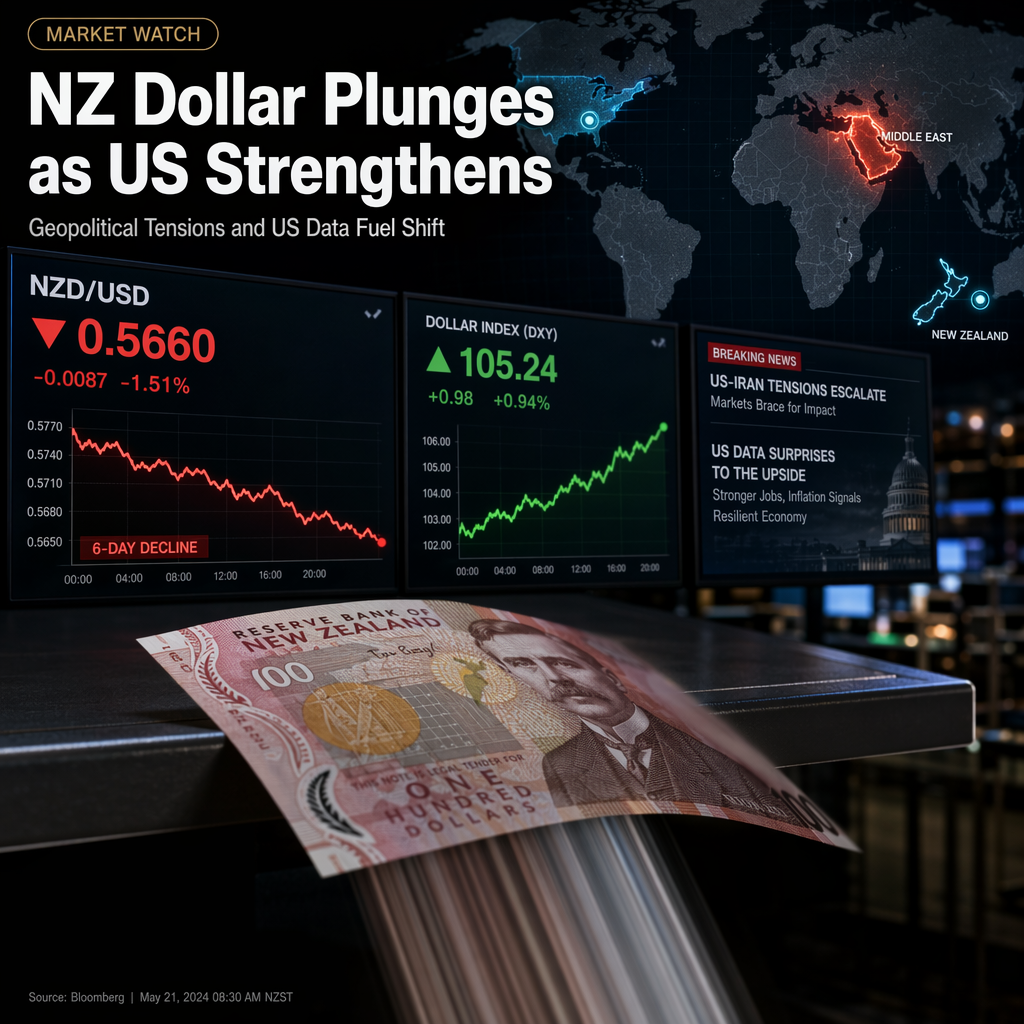
The New Zealand Dollar (NZD) continued its downward trajectory for the sixth consecutive day, with NZD/USD trading around 0.5660 during Asian hours on Wednesday as the US Dollar (USD) gained strength in a complex geopolitical environment [1]. The USD's rise was fueled by heightened Middle East risks and robust US macroeconomic data, which reinforced the narrative of 'US exceptionalism' [1].
Geopolitical uncertainty was heightened by conflicting signals regarding a potential US-Iran diplomatic breakthrough. US President Donald Trump claimed Iran had 'fully and completely' agreed to open its facilities to nuclear inspections, but Iranian Foreign Minister Abbas Araghchi countered that substantive nuclear negotiations had not actually begun. Additionally, Iran’s chief negotiator warned that the strategic Strait of Hormuz would remain under Iranian oversight and not return to its pre-war status. Meanwhile, diplomatic efforts progressed as Washington hosted new talks between Israel and Lebanon, aiming for a ceasefire with Iran-backed Hezbollah [1].
On the economic front, the US S&P Global Composite PMI for June rose to 52.2 from May's 51.5, signaling healthy business expansion. The US manufacturing sector's output increased to 55.7 from 55.1, surpassing forecasts of 54.8. The Services PMI also improved to 51.3 from May's 50.7, exceeding the consensus estimate of 51.0, indicating persistent demand in the service economy [1].
In contrast, the Reserve Bank of New Zealand (RBNZ) is widely expected to raise its Official Cash Rate (OCR) by 25 basis points to 2.5% in July, driven by persistent inflationary pressures. This expectation was reinforced after first-quarter Consumer Price Index (CPI) data remained steady at 3.1%, maintaining pressure on New Zealand policymakers [1].
CONCLUSION
The New Zealand Dollar's continued weakness reflects a combination of strong US economic data, rising geopolitical risks, and expectations of tighter monetary policy in New Zealand. While the RBNZ is anticipated to hike rates, the immediate market sentiment favors the US Dollar, given its recent outperformance and safe-haven appeal. Investors remain cautious amid ongoing geopolitical uncertainty and await further policy signals.