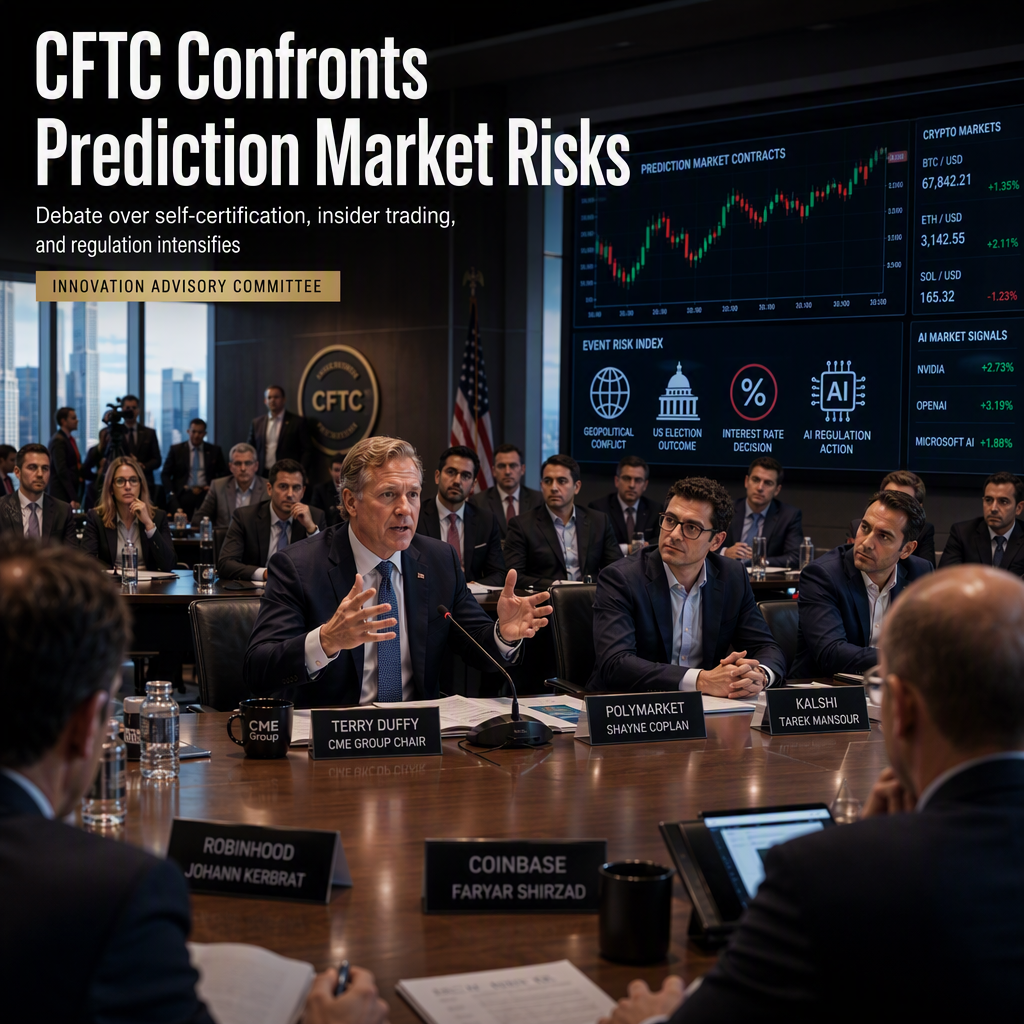
The Commodity Futures Trading Commission (CFTC) convened its first Innovation Advisory Committee meeting on Thursday to address emerging risks in prediction markets, with a particular focus on 'mention markets' and the process of self-certification for event contracts [1]. The committee, comprising over 30 members including executives from Polymarket, Kalshi, Coinbase, Robinhood, Nasdaq, and CME Group, discussed the regulatory landscape for crypto and artificial intelligence, but the most intense debate centered on prediction markets [1].
CME Group Chair and CEO Terry Duffy voiced strong concerns about the self-certification process, which allows prediction market platforms to propose, file, and certify event contracts without prior CFTC approval, potentially making these markets susceptible to manipulation [1]. Duffy highlighted that since January 2025, there have been 2,500 self-certifications, none of which have been opposed, and claimed that many of these products violate core principles [1]. Kalshi's co-founder Luana Lopes Lara defended self-certification for its ability to provide timely markets for users, while Duffy and Robinhood CEO Vlad Tenev both raised concerns about insider trading and manipulation, particularly in mention markets [1].
Specific cases of alleged insider trading were cited, including the April arrest of a U.S. soldier for betting on the capture of Venezuelan leader Nicolás Maduro and a teleprompter operator under federal investigation for bets related to statements made by President Trump [1]. While Tenev did not advocate for an outright ban on mention markets, he urged the CFTC to scrutinize them closely [1].
The committee also discussed the need for a regulatory roadmap for prediction markets, though detailed forward-looking statements or analyst opinions were not provided in the available content [1].
CONCLUSION
The CFTC's Innovation Advisory Committee meeting highlighted significant regulatory concerns around prediction and mention markets, particularly regarding self-certification and potential for insider trading. While industry leaders are divided on the best approach, there is consensus that increased scrutiny and a clear regulatory framework are needed to address emerging risks.