
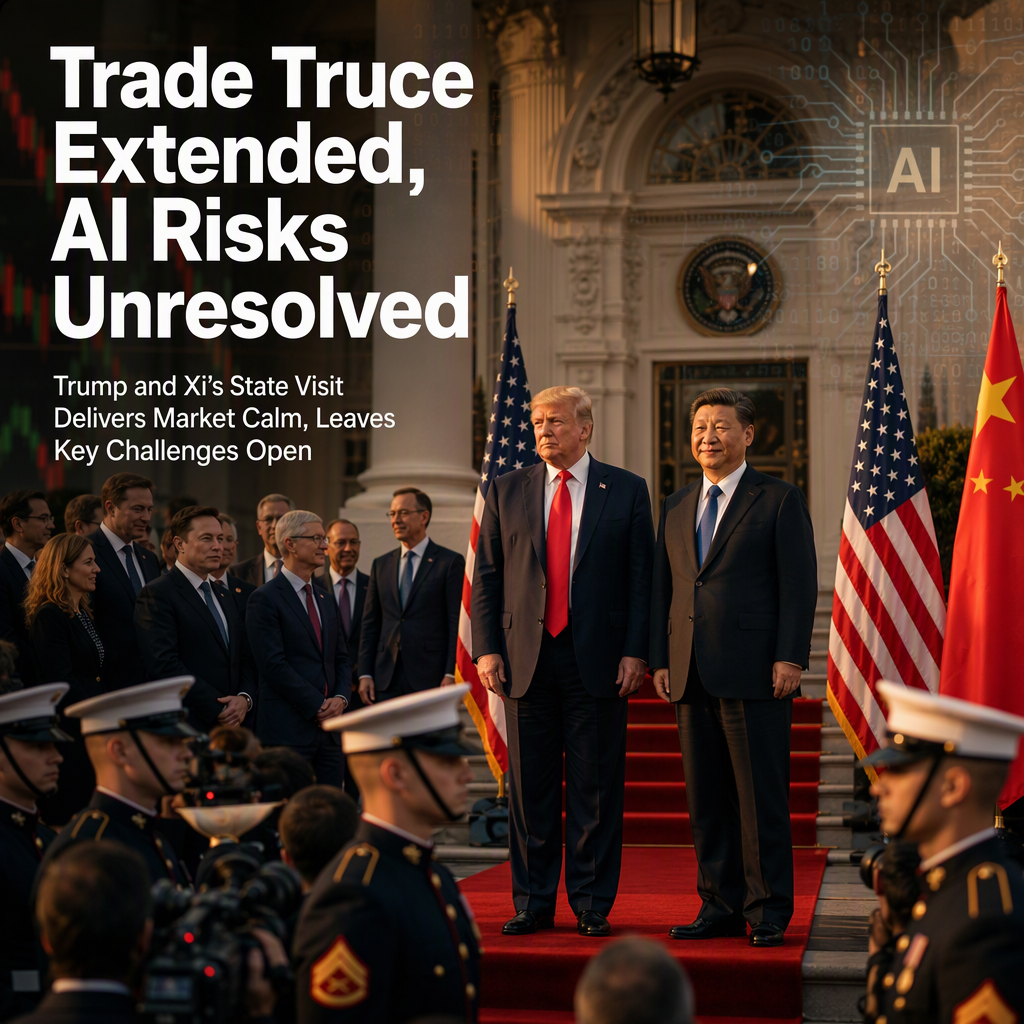
President Donald Trump and Chinese leader Xi Jinping concluded a highly anticipated three-day state visit in Washington, marked by ceremonial events but few substantive agreements [1]. The core outcome was an extension of the existing U.S.-China trade truce, which was set to expire in November. Treasury Secretary Scott Bessent announced that the truce will now continue until January 10, representing a two-month extension of the pact originally inked last year [1]. This agreement maintains lowered U.S. tariffs and suspends Beijing's controls on exports of rare earths and critical minerals, among other provisions [1].
The visit featured a rare tarmac greeting by Trump, a state dinner attended by CEOs from the tech and finance sectors, and a promise from Xi to send pandas to Atlanta. Despite the pageantry, no new commitments were made regarding purchases or addressing artificial intelligence risks, the war in Iran, or other global challenges [1]. The lack of progress on AI threats and other issues was noted as a missed opportunity for more substantive cooperation [1].
Market implications were discussed by Scott Kennedy, a senior advisor at the Center for Strategic and International Studies, who suggested that Trump's focus ahead of the midterms was to keep markets calm, especially with interest rates at record highs [1]. The shorter extension of the trade truce, rather than the expected six-month period, could slightly favor the U.S. by providing leverage in future negotiations [1]. Chinese observers described the visit as a success, with Hai Zhao of the Chinese Academy of Social Sciences noting the positive reception of Xi in Washington [1].
The event was highly televised in China but received limited coverage in the U.S. due to Trump's ban on three news outlets and the lapse of the broadcast press pool [1]. While the visit generated optimism among Chinese audiences, the lack of concrete progress on key issues leaves uncertainty for future talks between the two leaders [1].
CONCLUSION
The Trump-Xi summit delivered a short-term extension of the U.S.-China trade truce, maintaining current tariff and export controls but leaving major issues like AI risks unresolved. While the visit was celebrated in China, the absence of new substantive agreements and the shorter extension suggest ongoing uncertainty for markets and future negotiations.