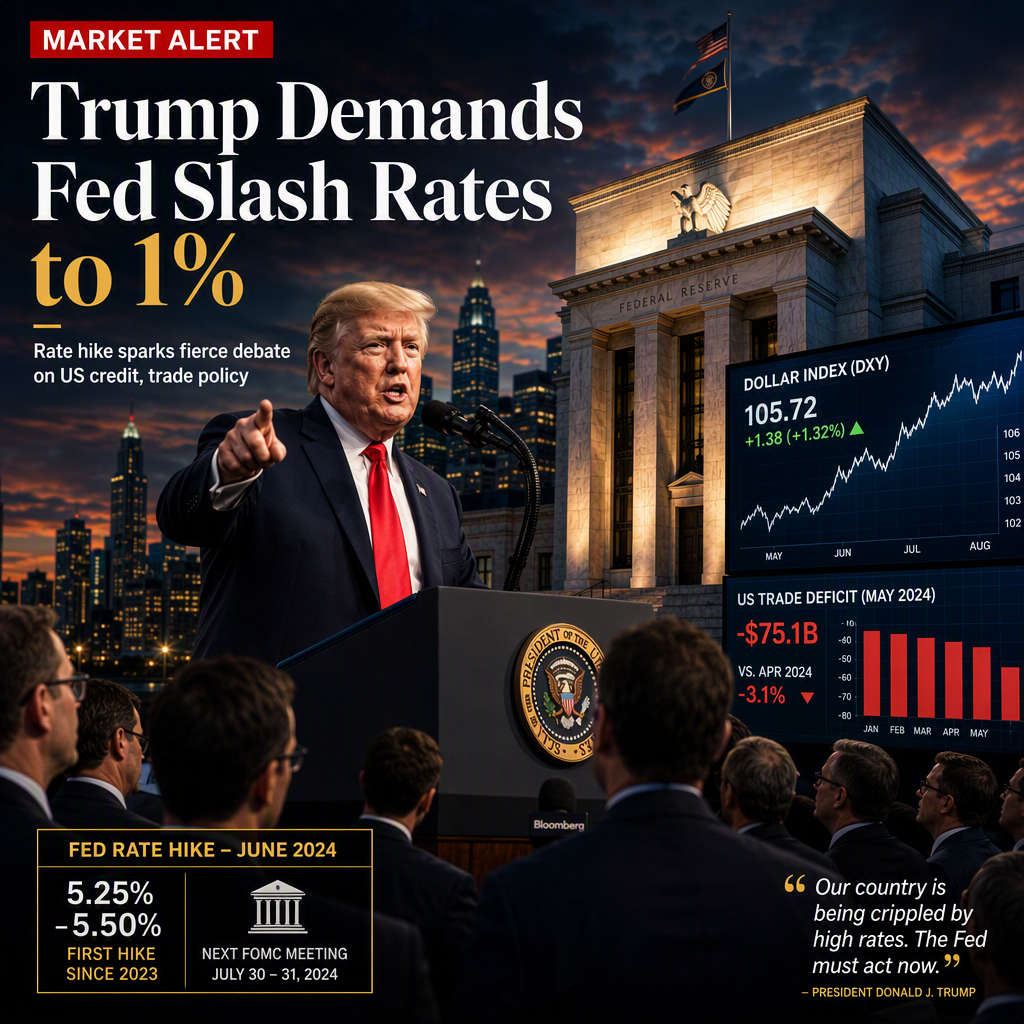
President Donald Trump demanded that the Federal Reserve lower US interest rates to 1% or less, just hours after the central bank implemented its first rate hike since 2023, raising the benchmark rate by a quarter percentage point to a target range of 3.75%-4% in a unanimous decision by the 12-member Federal Open Market Committee [2]. Trump, in a Truth Social post, argued that the US has the 'Best Credit in the World — BY FAR' and called for rapid action to reduce rates, stating, 'LOWER THE INTEREST RATES FOR THE UNITED STATES OF AMERICA, AND FAST!' [2]. The Fed, led by Chairman Kevin Warsh, justified the hike by noting that 'inflation remains elevated' [2].
Trump also claimed that if the US stopped trading with every country it has a deficit with, it would earn at least $1.5 trillion a year, referencing the $743 billion trade deficit in the twelve months to June [1][2]. He characterized the deficit as a loss and suggested that closing it would impact the Dollar Index, which surged above 100.00 shortly after the Fed's announcement, reaching a high just below 100.50 before stabilizing [1]. The Stochastic Relative Strength Index (Stoch RSI) reflected momentum shifts, but the Dollar Index remained near its post-hike high, unaffected by Trump's subsequent comments [1].
Trump's pressure campaign against the Fed has intensified, with threats to cut off trade with countries running surpluses against the US if rates are not reduced, a stance reiterated less than two weeks prior to the latest hike [2]. Despite this, White House spokesman Kush Desai affirmed that Trump 'absolutely' still believes in the independence of the Fed, emphasizing the president's right to speak out when he disagrees with policy decisions [2].
Fact-checkers have disputed Trump's claim that the US has gained $20 trillion or more during his second term, labeling the figures as false [2]. The last agency to rate US debt at the top withdrew its rating in May 2025, raising questions about the US's credit standing [1]. Market reactions were immediate, with the Dollar Index strengthening after the Fed's decision, but no further movement was observed following Trump's demands [1].
CONCLUSION
Trump's call for drastic rate cuts and threats to alter US trade policy have injected volatility and uncertainty into financial markets, especially following the Fed's rate hike and the Dollar Index's surge. While the Fed maintains its stance due to elevated inflation, Trump's rhetoric underscores ongoing tensions between fiscal policy and central bank independence, with potential implications for US credit and global trade relationships.