
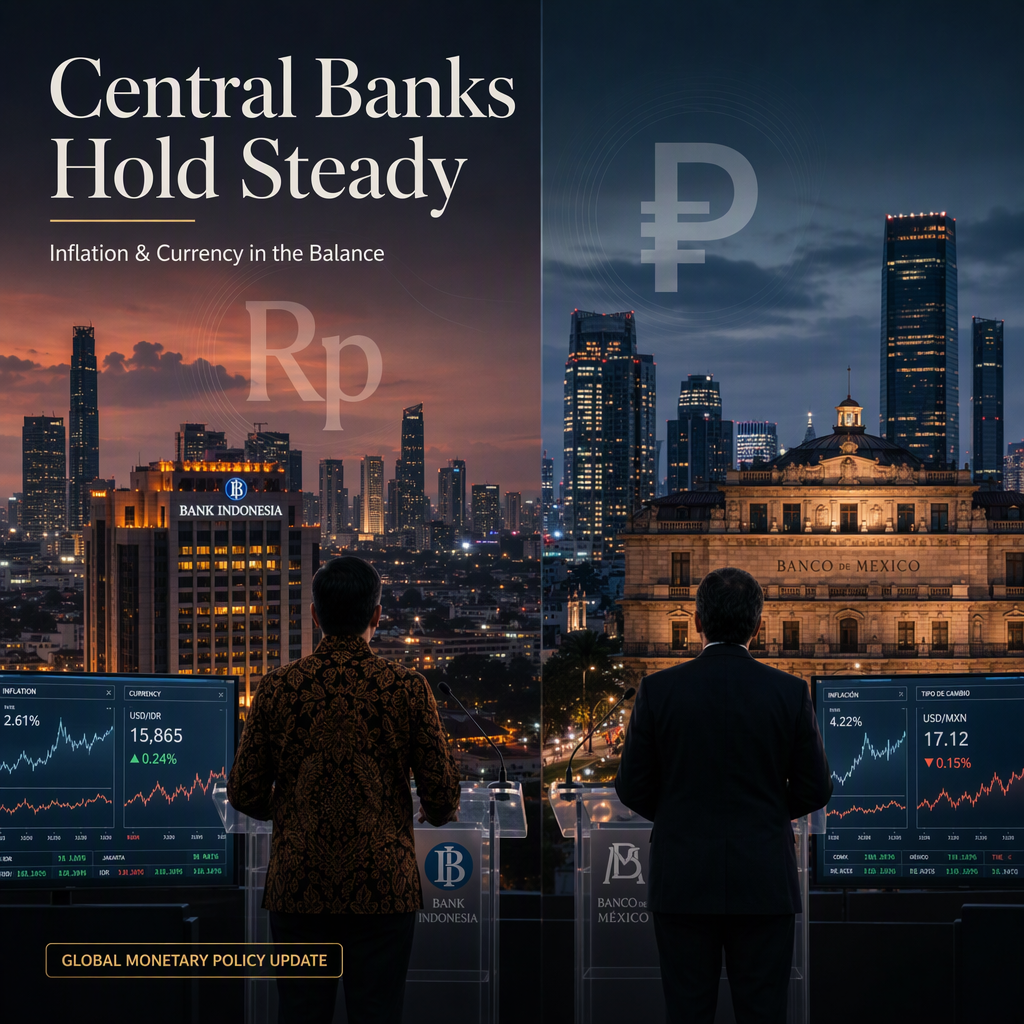
Bank Indonesia (BI) and Banco de México (Banxico) both opted to keep their respective policy rates unchanged in their latest meetings, prioritizing currency stability and inflation management. BI maintained its BI Rate at 5.75% for the third consecutive meeting, a move aligned with market expectations and aimed at balancing rising inflation risks with the need to support the Indonesian Rupiah (IDR) and economic growth. Newly appointed BI Governor Destry Damayanti emphasized the adequacy of the current rate to maintain stability and signaled a preference for non-rate tools, such as expanding FX hedging incentives, over further rate hikes. Specifically, BI increased the premium discount on conventional hedging swaps to 15% for 3-month, 20% for 6-month, and 25% for 12-month tenors to encourage portfolio inflows and support the IDR. Commerzbank expects BI to keep the rate unchanged for the rest of the year, unless renewed IDR depreciation or persistent inflation pressures arise, which could prompt further tightening [1].
Similarly, Banxico held its overnight policy rate at 6.50%, as anticipated by the market. However, the central bank notably softened its forward guidance, signaling a more flexible stance and decoupling its policy trajectory from that of the U.S. Federal Reserve. Banxico's statement highlighted that future decisions will consider the ongoing disinflation process, exchange rate pass-through, slack conditions, and inflation expectations, reaffirming its commitment to low and stable inflation. While the bank indicated that maintaining the current rate may not always be appropriate, it did not provide a strong directional signal. Rabobank analysts expect Banxico to hold at 6.50% going forward, though they note the balance of risks is tilted toward a potential hike. Inflation forecasts remain broadly unchanged, with minor upward adjustments to core CPI projections for the third and fourth quarters of the year. The bank also acknowledged that rising oil prices increase upside risks to inflation, while persistent slack in the Mexican economy exerts a deflationary effect. Overall, Banxico sees the balance of risks for inflation as biased to the upside [2].
Both central banks are navigating a challenging macroeconomic environment marked by global uncertainties, currency pressures, and inflation risks. BI is relying on incentive-based measures to support the IDR and maintain stability, while Banxico is adopting a more flexible approach to monetary policy, emphasizing domestic conditions over external influences. Neither institution signaled imminent rate changes, but both remain vigilant to evolving risks that could necessitate policy adjustments.
CONCLUSION
Bank Indonesia and Banxico have both chosen to keep their policy rates unchanged, focusing on currency stability and inflation control amid global uncertainties. While BI is enhancing FX hedging incentives to support the Rupiah, Banxico is adopting a more flexible stance, decoupling from U.S. policy moves and acknowledging upside inflation risks. Both central banks remain on hold for now but are prepared to act if inflation or currency pressures intensify.