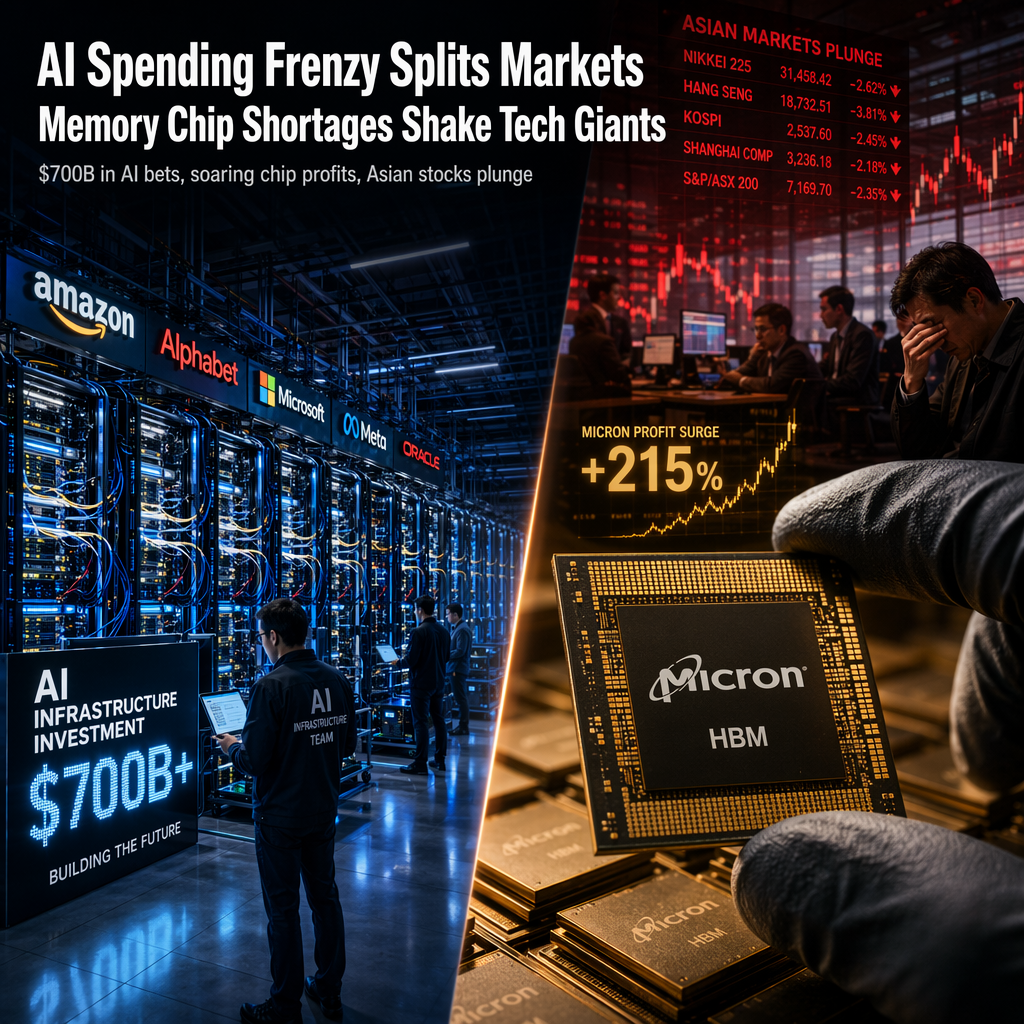
This week saw a dramatic split in the AI trade, with major technology hyperscalers committing to unprecedented levels of spending on AI infrastructure, while memory chip shortages triggered sharp declines across Asian stock markets [1][2]. Amazon, Alphabet, Microsoft, Meta, and Oracle collectively pledged $700 billion for AI infrastructure in 2026, with Amazon responsible for $200 billion and Alphabet tracking between $180 billion and $190 billion [1]. Despite this massive investment, the infrastructure currently generates only about $25 billion in direct revenue, highlighting a 28-to-1 spending gap that rattled investors and led to a four-day Nasdaq selloff [1]. Alphabet reported a 47% drop in free cash flow, and Amazon’s free cash flow slid 95% due to aggressive spending, prompting investor demands for clearer timelines on returns, which neither company could provide [1].
Meanwhile, Micron Technology, the sole American manufacturer of High-Bandwidth Memory (HBM) chips, reported quarterly earnings that exceeded all forecasts, with revenue at $41.46 billion (beating expectations of $35.7 billion) and gross margin soaring to 84.9% from 39% a year ago [1]. Micron guided for $50 billion in the upcoming quarter, supported by $100 billion in backlog orders stretching past 2027, and CEO Sanjay Mehrotra confirmed that HBM supply remains sold out well into next year [1].
The memory chip shortage has had immediate market repercussions. Apple announced it must pass on increased memory and storage costs due to an extraordinary surge in demand, warning, “We have never seen a component price increase this much, this quickly,” though device price hikes have not yet been implemented [2]. This warning raised global inflation concerns and dented earning projections for companies reliant on these chips [2]. Asian equity markets responded sharply: Nikkei 225 fell 4.3%, Shanghai dropped 2%, Hang Sang plunged 2.2%, and KOSPI suffered an 8.2% decline, with SoftBank also declining due to a delay in OpenAI’s IPO [2]. SoftBank’s investment in OpenAI is expected to reach $65 billion by October, and the delay weighed heavily on Japanese markets [2].
The surge in AI infrastructure spending and memory chip demand has created a bifurcated market, with chip suppliers like Micron benefiting from robust demand, while hyperscalers and device manufacturers face margin pressures and investor skepticism about the timeline for returns [1][2].
CONCLUSION
The AI infrastructure boom has triggered a split in market fortunes: chip suppliers are thriving amid shortages, while hyperscalers and device makers face investor concerns over spending gaps and margin pressures. Asian markets have reacted with steep declines, underscoring the high-impact nature of these developments. The ongoing imbalance between investment and revenue, coupled with supply constraints, is likely to keep market volatility elevated.