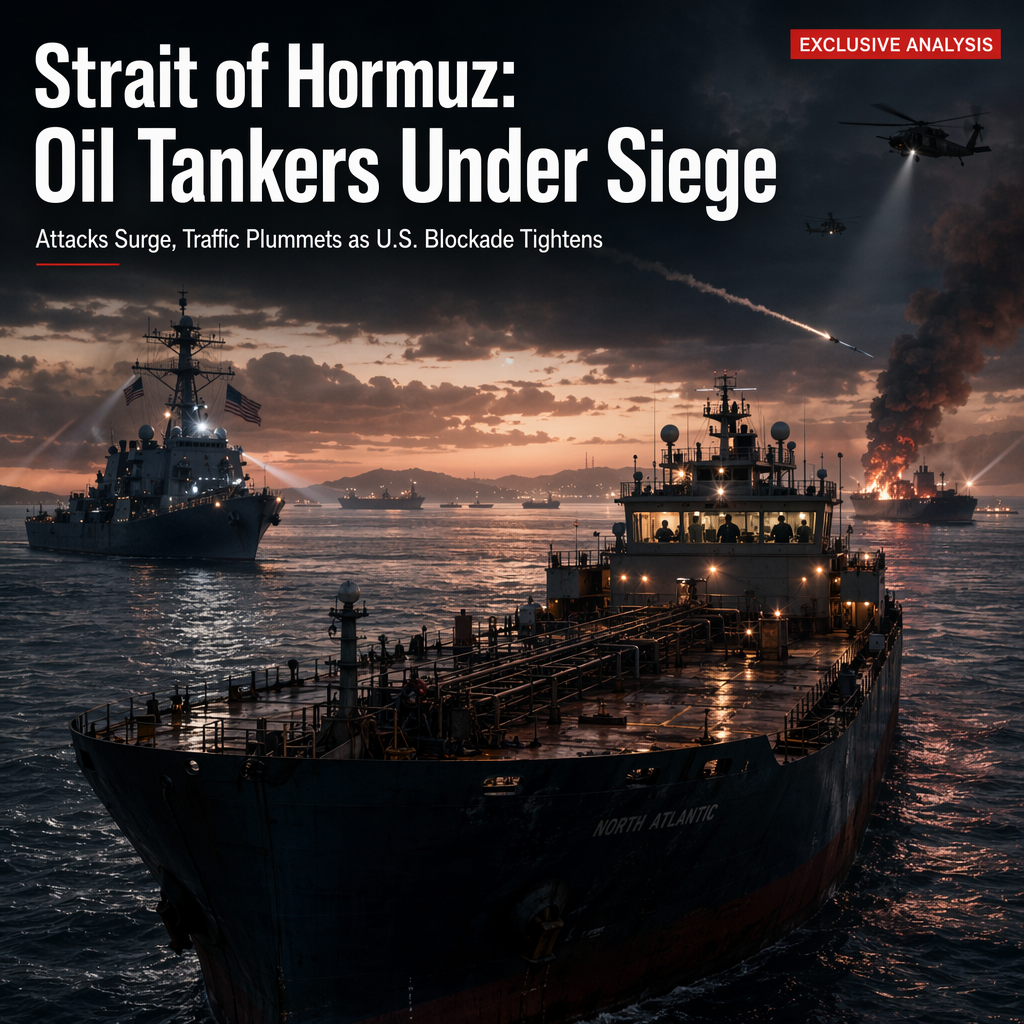
The security situation for oil tankers in the Strait of Hormuz has deteriorated to a 'worst-case scenario' as Iran has escalated attacks on ships in the region, according to Dimitris Maniatis, CEO of maritime risk service Marisks, during a Lloyd's List Intelligence briefing [1]. Since July 6, at least nine ships have been attacked as Iran attempts to force vessels to navigate through its territorial waters rather than the route along Oman's coast, which is protected by the U.S. military [1].
The International Maritime Organization (IMO) reported that one seafarer was killed and three were injured in an attack on the crude oil tanker Al Bahyah off Oman's coast on Tuesday, while eleven mariners were injured the same day in an attack on the Mombasa B, another crude oil tanker near Oman [1]. Jakob Larsen, chief security officer at BIMCO, stated that the Iranian attacks have involved anti-ship missiles, and the threat of mines has made the traditional traffic separation scheme through the middle of Hormuz too dangerous for ships [1].
The U.S. military disabled an unladen oil tanker, the Curacao-flagged M/T Belma, on Wednesday after reimposing its naval blockade against Iran this week. The vessel ignored multiple warnings as it transited international waters toward Iran's Kharg Island, according to U.S. Central Command [1]. President Donald Trump stated that the Strait of Hormuz is open to all ships except those of Iran following the reimposition of the U.S. naval blockade, emphasizing, 'It's open if people want to go through it... We're not opening it for Iran. That's the only one it's closed for. It's closed for Iran, both in and out, but it's open now' [1].
Ship tracking firms have observed a steep drop in traffic, with Hormuz described as 'largely closed again' [1]. Maniatis noted that crews are increasingly fearful, and 'nobody is willing to move,' highlighting that fear, rather than financial incentives, is now the primary factor in decision-making for mariners in the region [1].
CONCLUSION
The escalation of Iranian attacks has severely disrupted oil tanker traffic in the Strait of Hormuz, resulting in casualties and a significant reduction in maritime activity. The heightened risks and reimposed U.S. naval blockade have created a highly volatile environment, with market participants facing substantial uncertainty and operational challenges.