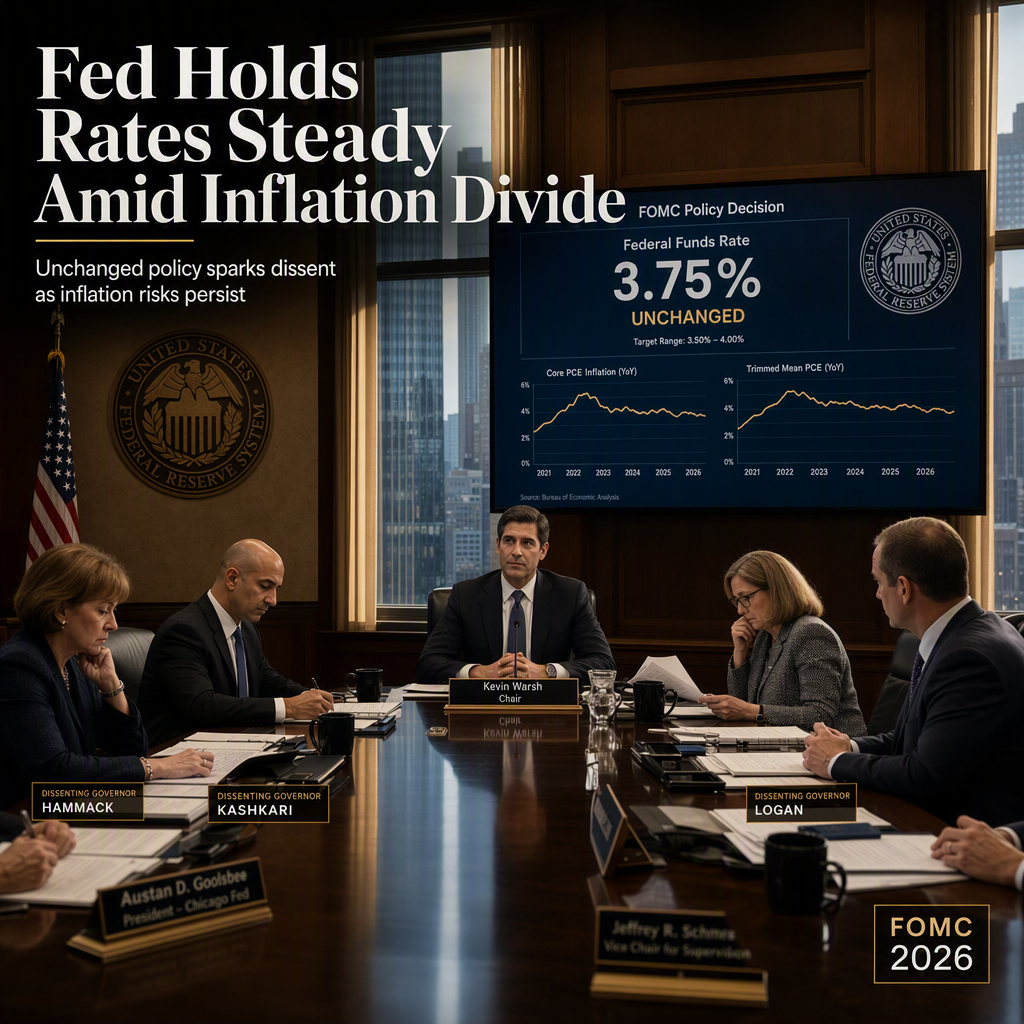
The Federal Reserve decided to keep its benchmark interest rate unchanged at a range of 3.5% to 3.75% during this week's Federal Open Market Committee (FOMC) meeting, despite three dissenting votes from Fed governors who advocated for a rate hike to address ongoing inflation concerns [1]. The FOMC voted 9-3 in favor of maintaining the current rate, which has remained at this level throughout 2026 so far [1]. The dissenting votes came from Cleveland Fed President Beth Hammack, Minneapolis Fed President Neel Kashkari, and Dallas Fed President Lorie Logan, all of whom expressed worries that inflation remains above the Fed's 2% target and stated they would have preferred a 25-basis-point increase in the federal funds rate [1].
Inflation, as measured by the personal consumption expenditures (PCE) index, was reported at 3.7% in June compared to a year ago, indicating that while inflation has trended lower, it remains elevated due to the energy price shock from the Iran war earlier this year [1]. Dallas Fed President Lorie Logan emphasized that inflation does not appear to be on track to sustainably reach the 2% target, warning that each month of above-target inflation adds strain to American households and businesses [1]. Logan also noted that, even after considering productivity gains and temporary supply shocks, inflation seems to be trending toward the mid-2% range, with risks skewed to the upside [1]. She further argued that the labor market is solid and possibly strengthening, and that current monetary policy is not restraining the economy, suggesting inflation could persist above target without further tightening [1].
Federal Reserve Chair Kevin Warsh, presiding over his second FOMC meeting, acknowledged the importance of returning inflation to 2% to restore price stability but described holding rates steady as 'especially prudent at these uncertain times' [1]. Warsh stressed that the Fed is committed to its responsibilities and will not waver in its efforts to bring inflation back to target, noting that the prolonged period of above-target inflation cannot be resolved quickly [1].
No specific market reactions or analyst forecasts were mentioned in the article. However, the presence of three dissenting votes highlights a division within the Fed regarding the appropriate path for monetary policy in the face of persistent inflation [1].
CONCLUSION
The Federal Reserve's decision to hold rates steady, despite notable dissent, underscores ongoing concerns about persistent inflation. With inflation still above target and some FOMC members advocating for tighter policy, the central bank faces continued pressure to balance price stability with economic growth. The outcome signals a cautious approach amid uncertainty, but divisions within the Fed suggest the debate over future rate moves is far from settled.