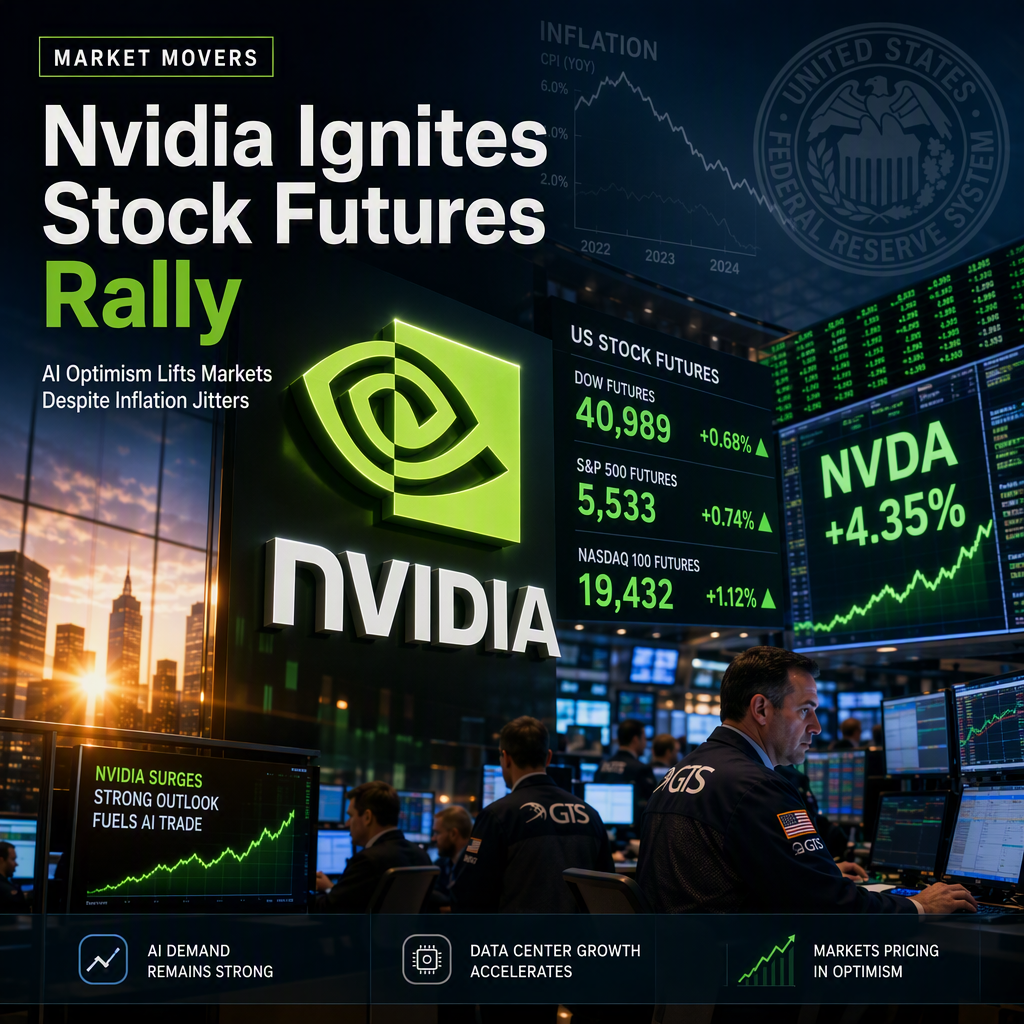
US stock futures advanced during European hours on Thursday, buoyed by a surge in Nvidia shares after the company issued a bullish sales outlook that signaled robust artificial intelligence demand through 2028 [1]. Dow Jones futures gained by 0.18% to around 53,620, S&P 500 futures rose by 0.41% to near 7,720, and Nasdaq 100 futures advanced by 0.89% to around 29,550 [1]. Nvidia shares jumped nearly 7% in extended trading after the company delivered better-than-expected second-quarter results and issued strong revenue guidance, reinforcing the view that corporate spending on AI infrastructure remains strong [1].
Despite the positive momentum in futures, Wall Street indexes closed lower in the regular US session on Wednesday due to hotter-than-expected inflation data. The July PCE price index accelerated to 0.2% month-on-month, surpassing the 0.1% consensus, while the annual rate held at 3.7% against forecasts of 3.6% [1]. This surprise uptick in inflation reinforced market expectations that the Federal Reserve could implement one final interest rate hike before year-end, resulting in the Dow Jones falling 0.21%, the S&P 500 slipping 0.02%, and the Nasdaq Composite declining 0.08% [1].
Looking ahead, market participants are focused on upcoming corporate earnings reports from companies such as Workday, Autodesk, and BestBuy, as well as key monetary policy signals from Fed Chair Kevin Warsh's speech at the Jackson Hole symposium on Friday [1]. Strategists at OCBC Bank highlight that the policy debate in Washington remains tilted toward the hawkish camp, with Fed officials arguing that elevated inflation requires higher interest rates likely to retain influence within the policy debate [1]. They emphasize that with inflation proving sticky and growth holding up, meaningful fiscal and monetary policy alignment appears unlikely, limiting the scope for coordinated efforts to cap yields or weaken the Dollar on a sustained basis [1].
CONCLUSION
Nvidia's strong outlook has lifted market sentiment and driven gains in US stock futures, even as persistent inflation and expectations of further Fed tightening weigh on investor confidence. The market remains attentive to upcoming earnings and central bank signals, with policy uncertainty and inflation risks continuing to shape the near-term outlook.