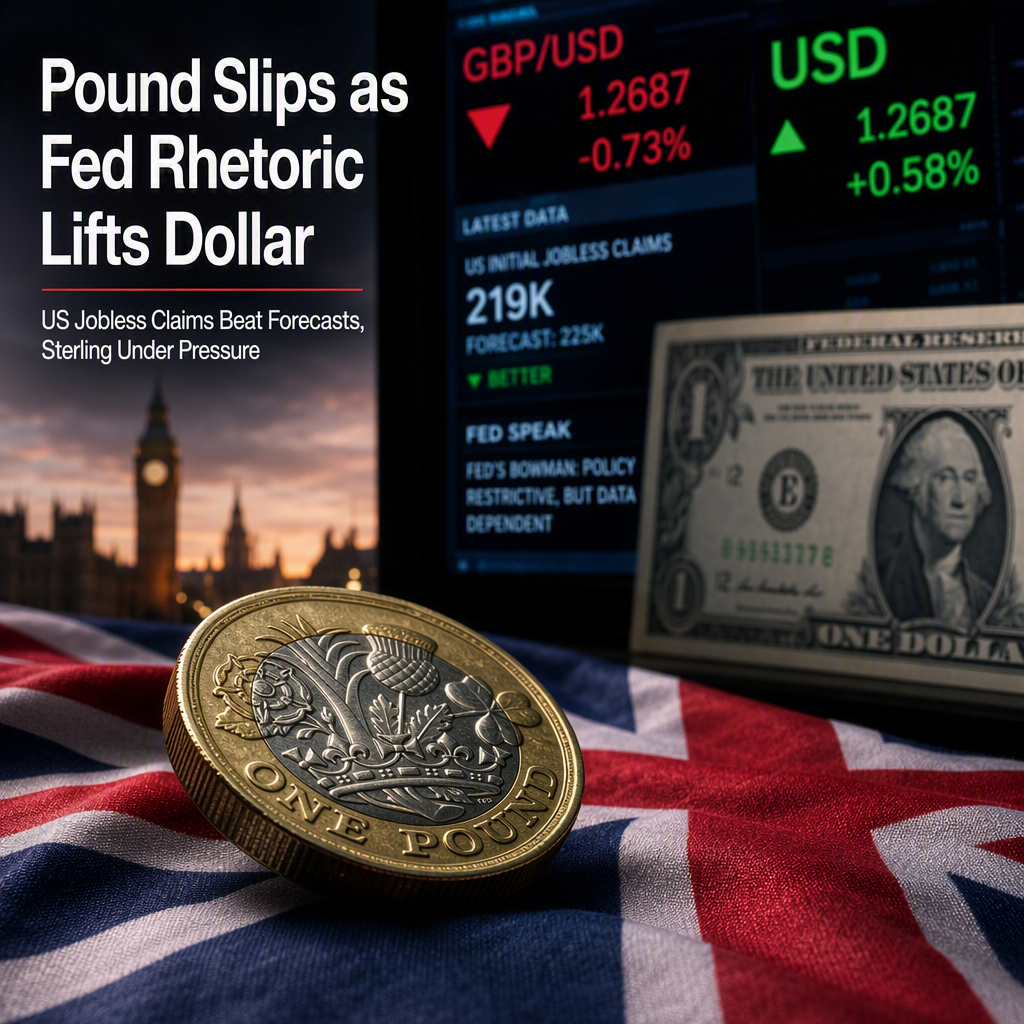
The British Pound Sterling (GBP) has experienced consecutive bearish sessions, declining approximately 0.05% over the last two days, as solid US economic data and hawkish commentary from Federal Reserve officials have strengthened the US Dollar. The GBP/USD pair is trading at 1.3588, after reaching a daily high near 1.3600, with the US Dollar Index (DXY) holding firm at 99.14 following the release of key data points over the past two days [1].
US Initial Jobless Claims for the week ending August 22 came in at 203,000, outperforming forecasts of 208,000 and indicating that layoffs remain low. Additionally, the US trade deficit widened to $118.8 billion in July from $101.4 billion in the previous month, marking the largest goods trade gap since March 2025 [1]. These data releases have reinforced the Greenback's strength, especially as Federal Reserve officials at the Jackson Hole Symposium have emphasized persistent inflation risks. Kansas City Fed's Jeffrey Schmid described inflation as 'still stubborn' and 'still sticky,' while Chicago Fed's Austan Goolsbee and Cleveland Fed's Beth Hammack echoed concerns about inflation and the need for action [1].
The combination of robust US labor market data and hawkish Fed rhetoric has increased expectations for further tightening by the Federal Reserve, putting additional downward pressure on GBP/USD. In contrast, the UK economic calendar is quiet, leaving Sterling largely influenced by US developments. Investors are awaiting domestic updates next week as the UK Parliament returns and the new Prime Minister, Andy Burnham, is expected to provide guidance on the Autumn Budget [1].
From a technical perspective, GBP/USD is trading around 1.3590, maintaining a constructive bullish tone above key support levels near 1.3417 and trend-line levels around 1.3393–1.3394 and 1.3488. The Relative Strength Index (14) is at about 60, indicating a positive bias, while the Fed Sentiment Index stabilizing near 132 suggests macro sentiment is not impeding the ongoing recovery. Immediate resistance is noted at 1.3631 and 1.3676, with initial demand seen at 1.3488 [1].
CONCLUSION
Solid US labor market data and hawkish signals from Federal Reserve officials have strengthened the US Dollar and pressured the British Pound lower. With the UK economic calendar quiet, GBP/USD remains sensitive to US developments, while investors await domestic policy signals from the new UK administration. Technical indicators suggest the pair retains a constructive tone above key support levels, but further Fed tightening could limit upside potential.