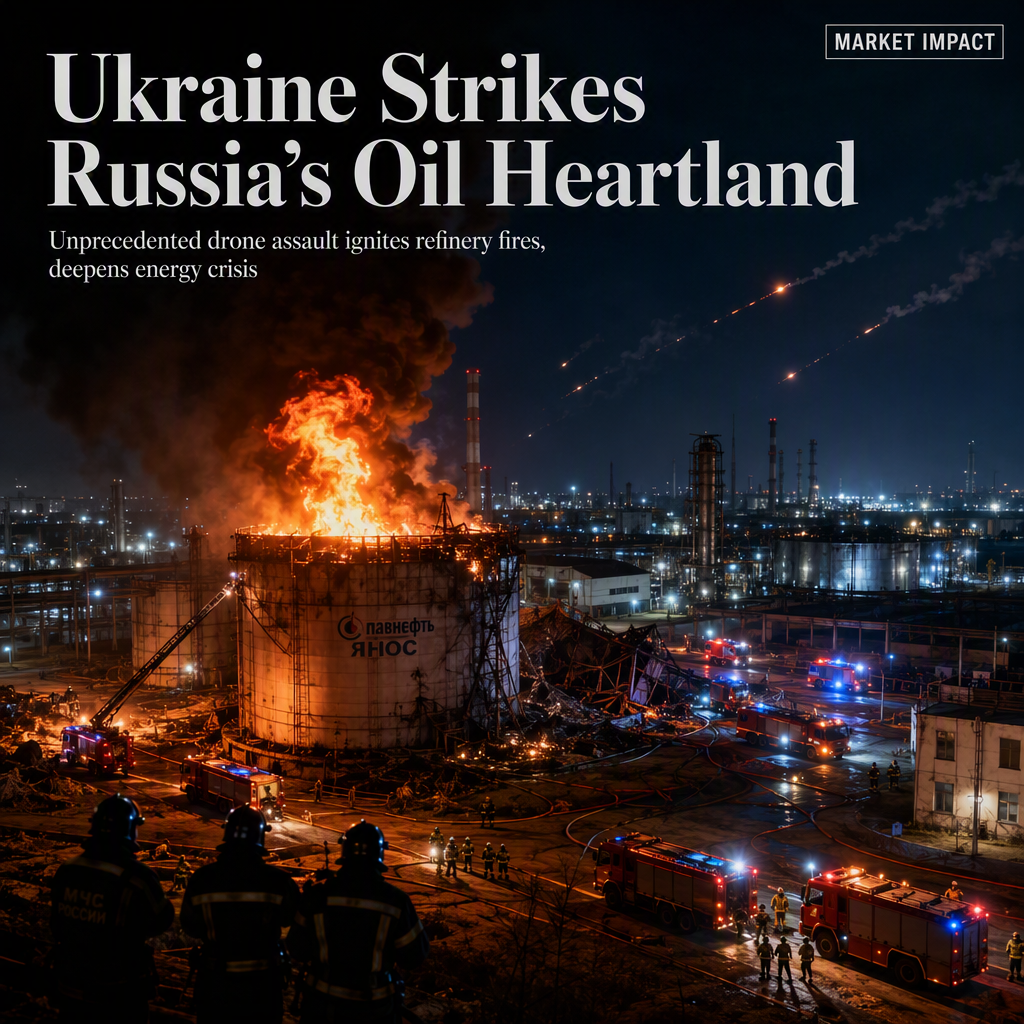
On August 6, 2026, Ukraine's military launched long-range drone attacks against two Russian oil refineries: Bashneft-Novoil in Bashkortostan and Slavneft-Yanos in the Yaroslavl region, according to Ukrainian President Volodymyr Zelenskyy [1]. Zelenskyy emphasized that these strikes were intended to limit Russia's oil revenues, which he claims are used to finance the ongoing war and the killing of Ukrainians [1]. The Slavneft-Yanos refinery, one of Russia's largest, employs over 3,500 people and processes approximately 15 million tons of crude oil annually, producing car fuel, jet fuel, and various oils [1]. This facility has been previously targeted by Ukrainian forces during the conflict [1].
Mikhail Evraev, governor of the Yaroslavl region, described the incident as the region's largest-ever drone attack, with air defense and electronic warfare units destroying 93 drones [1]. Falling debris from the attack struck the refinery's storage tanks, causing a fire that emergency services are working to extinguish. While there were no fatalities, four people sustained injuries [1].
The ongoing Ukrainian strikes on Russian refineries, depots, and logistics have prompted Russia, one of the world's largest oil producers, to impose restrictions on petrol sales across the country due to crimped domestic supply [1]. In addition to energy infrastructure, Ukraine has recently intensified attacks on Russia's retail giant Wildberries, aiming to pressure President Vladimir Putin by targeting a critical component of Russia's consumer economy [1].
Meanwhile, Russian forces have increased missile strikes on Ukrainian cities, likely attempting to exploit Kyiv's shortage of ballistic missile interceptors [1]. Ukraine also responded to Russian attacks on ships in the Black Sea by targeting two military patrol boats and shadow fleet vessels [1]. In a related incident, a Russian attack on a foreign-flagged ship carrying Ukrainian wheat in the Black Sea resulted in one death, three injuries, and the evacuation of the crew after a fire broke out [1].
CONCLUSION
Ukraine's drone attacks on major Russian oil refineries mark a significant escalation in efforts to disrupt Russia's energy revenues and supply. The strikes have led to domestic petrol restrictions in Russia and heightened tensions, with both sides increasing retaliatory actions. The market impact is high, given the direct targeting of critical energy infrastructure and the potential for further disruptions.