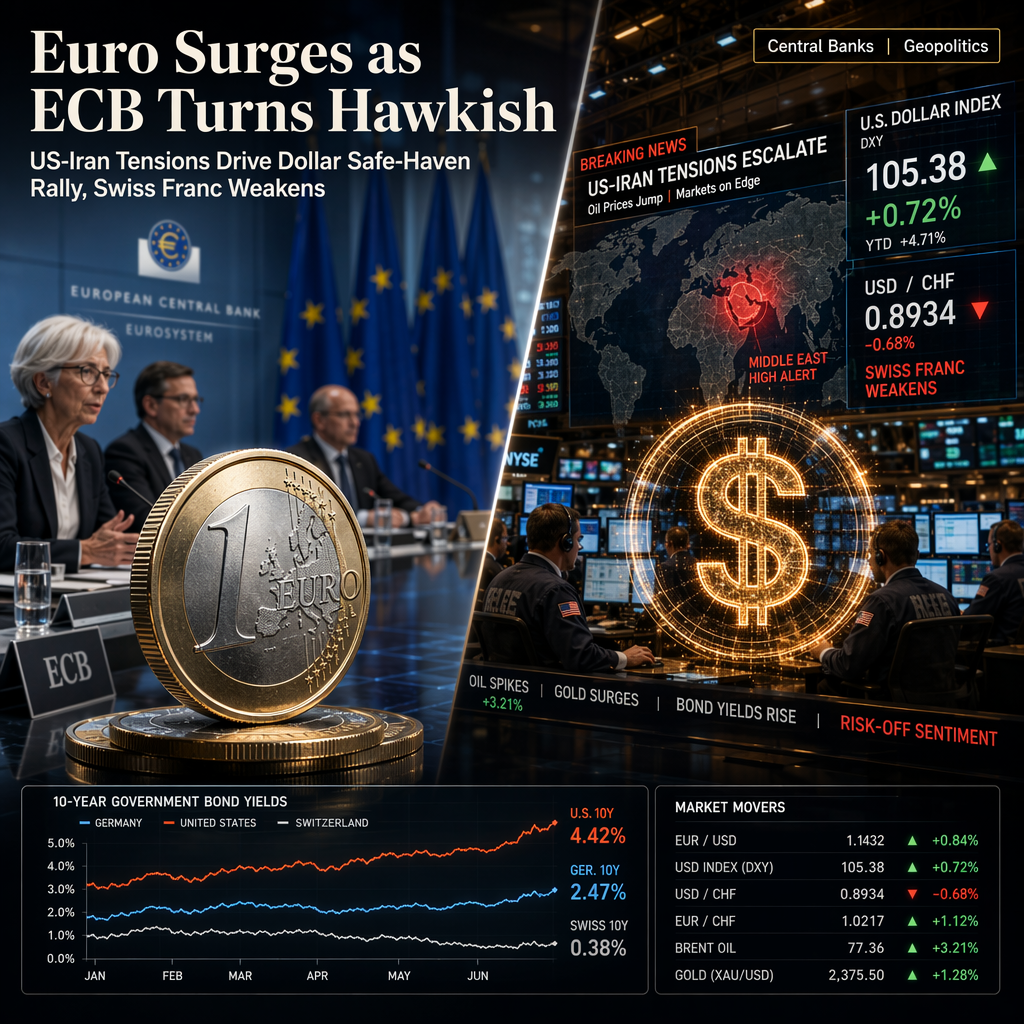
The Euro gained ground against the US Dollar, with the EUR/USD pair trading near 1.1410 during early European hours on Wednesday, supported by a hawkish tone from the European Central Bank (ECB) [1]. The ECB raised its key interest rates to 2.25% at its June policy meeting, and traders expect the deposit rate to remain steady at 2.25% at the upcoming July meeting on Thursday [1]. Money markets are pricing in a further increase, with the ECB deposit rate projected at 2.66% in December and 2.73% in February 2027, and a rate hike fully priced in for September, according to Reuters [1].
However, escalating military tensions between the US and Iran are influencing currency markets. The US launched strikes on Iran for the 11th consecutive day on Tuesday, and Iran's top joint military command warned it would expand strikes to target US and allied interests if the US attacks Iranian nuclear sites [1]. This geopolitical risk is supporting the US Dollar as a safe-haven currency and creating headwinds for the Euro [1].
The Swiss Franc, another traditional safe-haven, weakened as the USD/CHF pair extended its winning streak for the third day, trading around 0.8130 during Asian hours on Wednesday [2]. The US Dollar's strength is attributed to increased risk aversion stemming from the same US-Iran tensions, with US President Donald Trump downplaying the likelihood of immediate negotiations and pledging to respond to threats against Red Sea shipping routes [2]. Iran reiterated its warning to expand strikes if its nuclear facilities are targeted [2].
Switzerland's 10-year government bond yield is near two-month highs at 0.45%, reflecting market concerns over rising energy costs and inflation due to Middle East tensions [2]. Despite these pressures, the Swiss National Bank (SNB) kept its key policy rate at 0% in its latest meeting and projected that inflation will remain largely stable over the medium term [2].
CONCLUSION
The Euro's recent gains are underpinned by expectations of a more hawkish ECB, but ongoing US-Iran tensions are boosting the US Dollar and weighing on both the Euro and Swiss Franc. Market sentiment remains cautious, with safe-haven flows supporting the Greenback and bond yields reflecting inflation concerns. Central bank policy stances and geopolitical developments will continue to drive currency movements in the near term.