
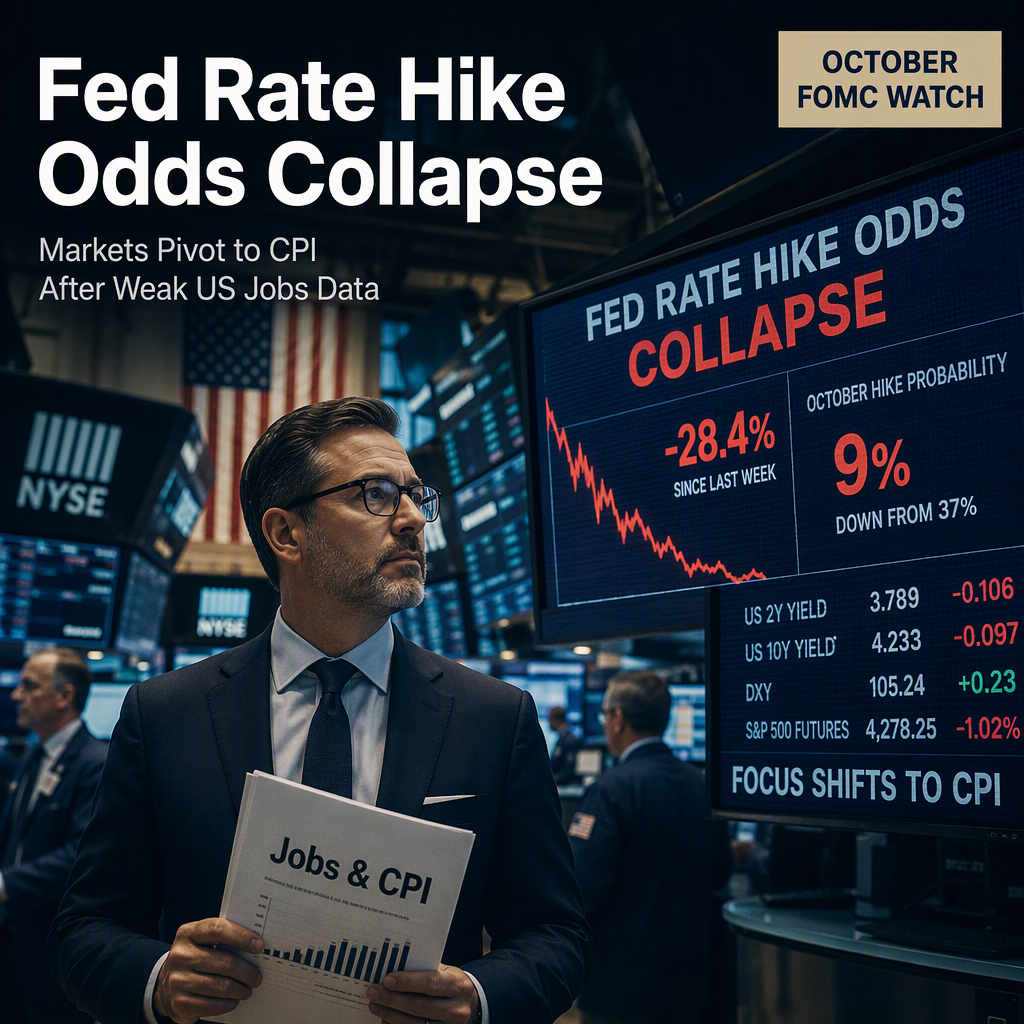
UOB’s Alvin Liew, as cited by FXStreet, reports that the US labor market showed signs of losing momentum in September, with weaker-than-expected payrolls and softer wage growth. This development has significantly reduced market expectations for a Federal Reserve rate hike at the October FOMC meeting, shifting attention to the upcoming September Consumer Price Index (CPI) release scheduled for October 14 [1].
According to Bloomberg WIRP data referenced in the report, the probability of a Fed rate hike in October dropped to below 20% as of October 5, compared to 64% on September 25, following the release of the softer jobs report. Despite this, markets are still fully pricing in a rate hike by the end of 2026 [1]. UOB has ruled out the possibility of consecutive rate hikes at the October FOMC meeting, which is set to occur less than a week before the midterm elections on November 3 [1].
Looking ahead, UOB projects two additional rate hikes, one in December 2026 and another in the first quarter of 2027, after which they expect the Federal Reserve to maintain rates through the rest of 2027 [1]. The report emphasizes that while the weak September Nonfarm Payrolls (NFP) report has dampened near-term rate hike expectations, the upcoming CPI data will be a crucial determinant for the Fed’s policy path [1].
CONCLUSION
The softer US jobs data has led to a notable decrease in expectations for an October Fed rate hike, with market focus now turning to the September CPI release. UOB anticipates further tightening in late 2026 and early 2027, followed by a prolonged hold, highlighting the importance of upcoming inflation data for future policy decisions.