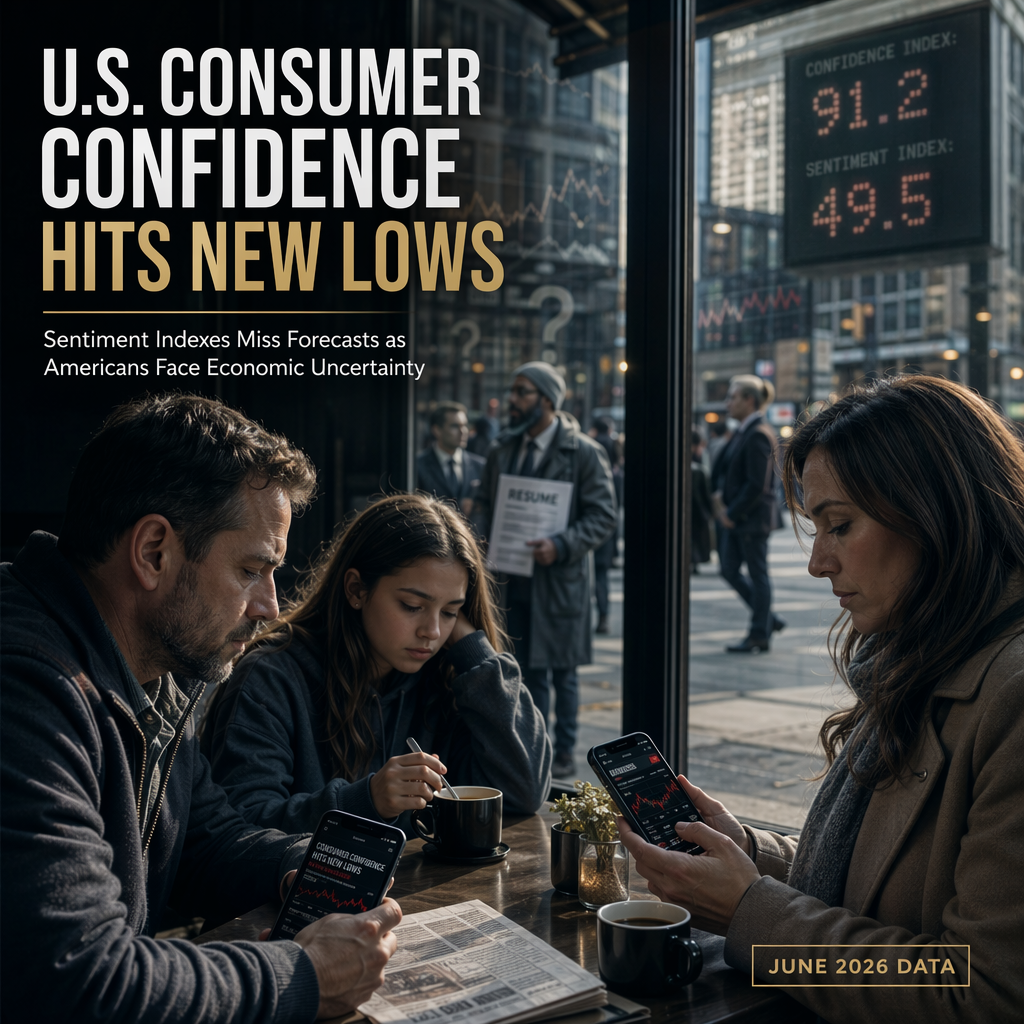
In June 2026, U.S. consumer confidence remained subdued, with both major sentiment surveys signaling persistent economic pessimism among Americans. The Conference Board’s Consumer Confidence Index (CCI) registered a reading of 91.2 for June, falling short of the 94.0 forecast and dropping below levels many analysts considered a floor for sentiment. This result underscores ongoing concerns about the labor market and future economic prospects, as the CCI heavily weighs current business conditions and job availability, as well as expectations for the next six months. The survey is based on responses from approximately 3,000 U.S. households each month [1].
Similarly, the University of Michigan’s Consumer Sentiment Index (MCSI) posted its second-lowest reading on record at 49.5 for June. While this marked a slight recovery from May’s all-time low of 44.8, the index remains 19% below its level from a year ago, highlighting the depth of consumer anxiety. The MCSI, which surveys around 500 households monthly, focuses more on household finances and inflation perceptions, including year-ahead and five-year inflation expectations—metrics closely watched by the Federal Reserve [1].
Both surveys are considered leading indicators, offering early signals about the direction of the U.S. economy. Economists, central banks, and forex traders monitor these indexes closely, as consumer confidence tends to drive consumer spending, which accounts for roughly 70% of U.S. GDP. Historically, stronger-than-expected consumer confidence readings have supported the U.S. dollar (USD), while weaker results, such as those seen in June, can weigh on the currency and signal potential headwinds for economic growth [1].
The June results suggest that consumers remain cautious, with sentiment still deeply negative compared to historical norms. This fragile mood could translate into restrained consumer spending, slower hiring, and muted business investment in the months ahead, according to the analysis provided [1].
CONCLUSION
June’s consumer confidence data from both the Conference Board and University of Michigan highlight ongoing economic fragility and persistent pessimism among U.S. households. With both indexes missing expectations and remaining near record lows, the outlook for consumer-driven growth appears subdued, potentially impacting the U.S. dollar and broader markets in the near term.