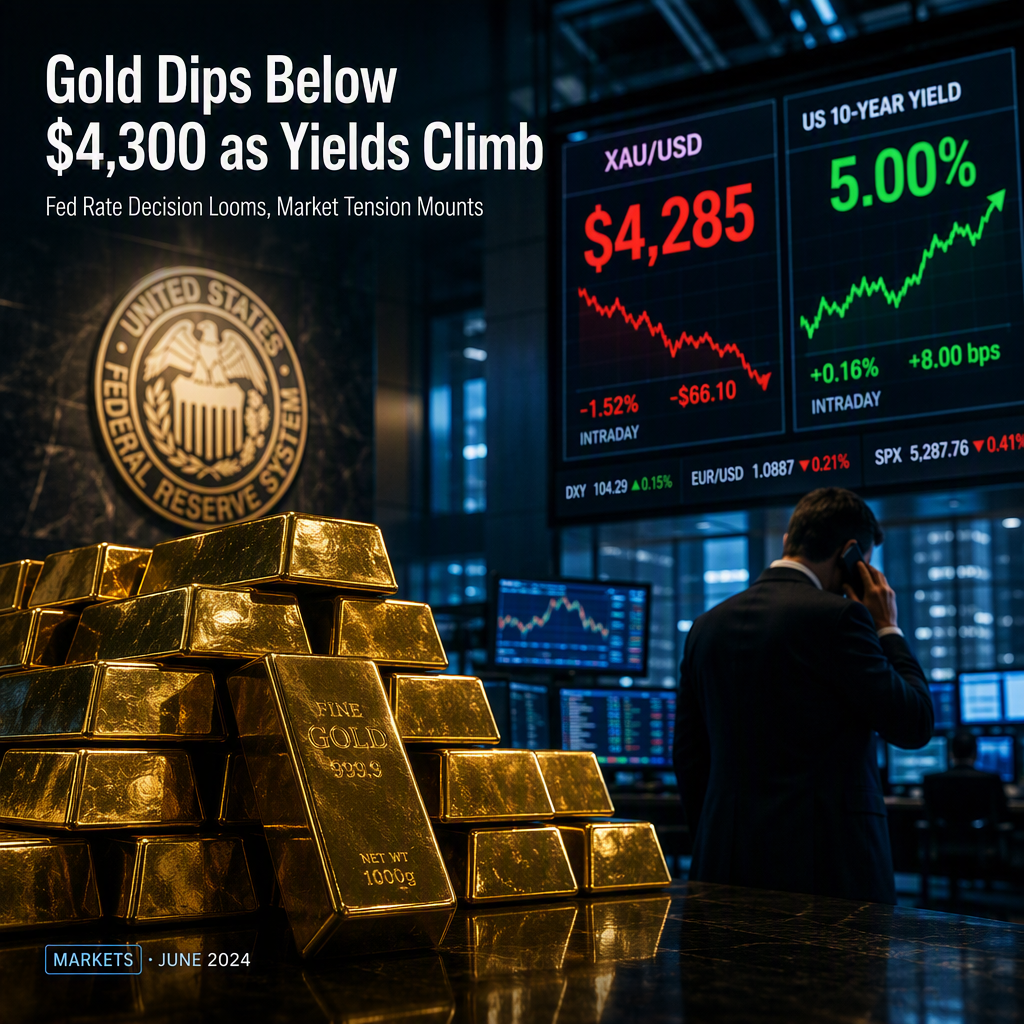
Gold prices (XAU/USD) declined to around $4,285 during the early Asian session on Wednesday, pressured by elevated US Treasury yields and rising inflation concerns fueled by surging crude oil prices [1]. The benchmark 10-year US Treasury yield reached its highest level since 2007, touching 5.041% before settling at 5.00%, up more than 3 basis points on the day [1]. Higher Treasury yields increase the opportunity cost of holding non-yielding assets like gold, contributing to the metal's recent weakness [1].
The rise in oil prices was attributed to Saudi Arabia's decision to shutter a key pipeline that bypasses the Strait of Hormuz, intensifying inflation worries and reinforcing expectations of further US Federal Reserve interest rate hikes [1]. Daniel Pavilonis, senior market strategist at StoneX, commented, 'Higher energy prices cause more inflation. More inflation could cause higher interest rates. That’s not good for gold ... gold is in kind of a range-bound area. It could actually sell off more if rates continue to move higher' [1].
Market participants are closely watching the upcoming Federal Reserve interest rate decision, with financial markets pricing in a 92.4% probability that the Fed will raise its benchmark overnight interest rate by 25 basis points to the 3.75%-4.00% range at its September policy meeting on Wednesday [1]. Analysts at Commerzbank warned that sustained yields above 5% would further tighten financial conditions, potentially exerting additional pressure on the broader market environment [1].
From a technical perspective, gold remains capped below the 100-day simple moving average (SMA) and the Bollinger middle band, with the Relative Strength Index (14) at about 44, indicating lingering downside pressure [1]. Initial resistance is seen at the 100-day SMA around $4,330, while the Bollinger lower band at approximately $4,225 offers the first notable support [1].
CONCLUSION
Gold prices are under significant pressure due to rising US Treasury yields and heightened inflation expectations ahead of the Federal Reserve's rate decision. With markets anticipating further tightening and technical indicators pointing to continued downside risk, gold may remain vulnerable if yields persist at elevated levels.