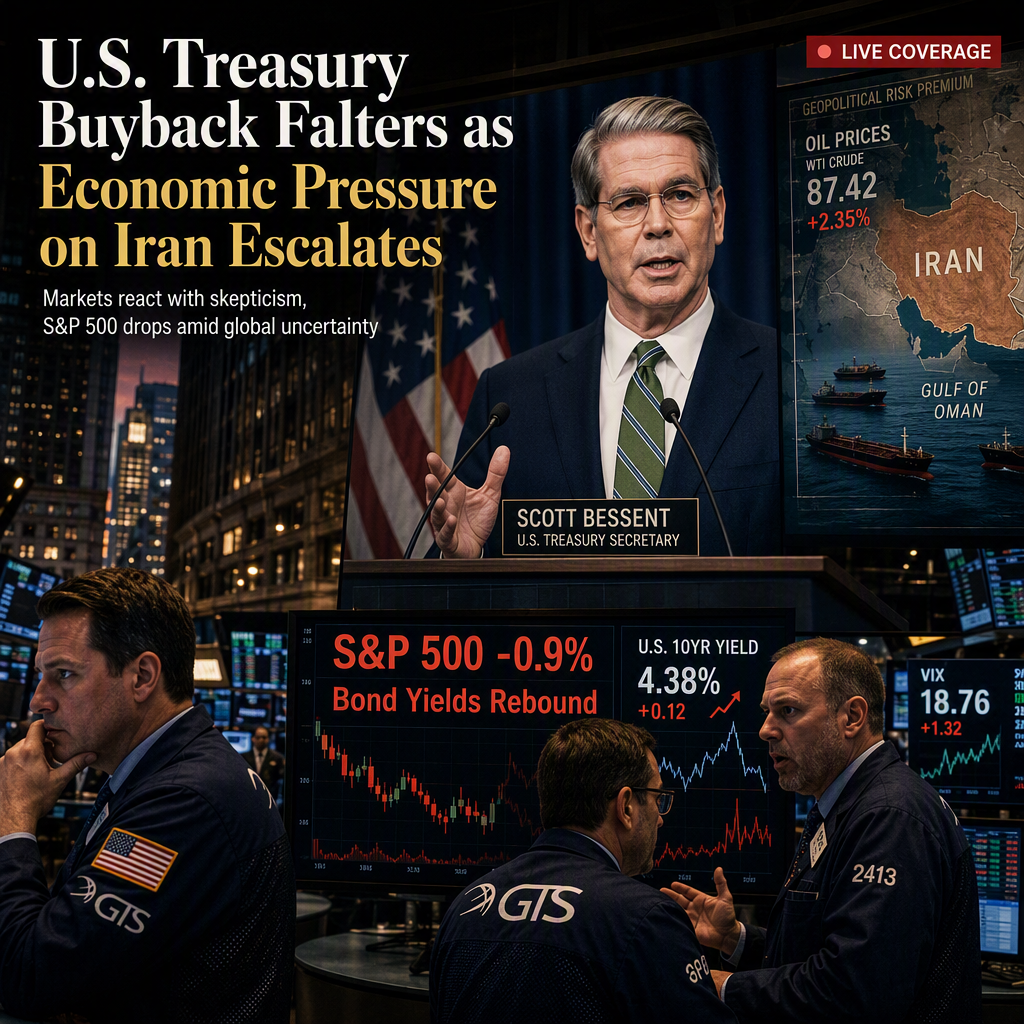
U.S. Treasury Secretary Scott Bessent announced that the Treasury is considering an accelerated buyback of government debt that could exceed $4 billion, aiming to stabilize the bond market and address concerns over the U.S. budget deficit, which reached $432 billion in July—the highest in over half a decade [1]. Despite Bessent's assurances that the deficit has 'a very good chance' of having peaked, the bond market reacted negatively, with yields rebounding and erasing the initial decline triggered by his intervention. This market response led to a 0.9% drop in the S&P 500, indicating skepticism among investors regarding the effectiveness of the Treasury's actions [1].
On the geopolitical front, President Trump declared 'economic D-day' on Iran, emphasizing a strategy of 'maximum economic pressure' through sanctions and a U.S. naval blockade in the Gulf of Oman, rather than renewed military conflict [1]. Bessent echoed this approach, describing it as 'the greatest coordinated economic isolation in the history of the world,' with further details to be announced at a news conference on Monday [1]. Trump asserted that Iran's economy is collapsing, with GDP likely contracting further during the ongoing war and inflation reaching historic highs. However, a former adviser to Iran's central bank contested this narrative, suggesting that while the economy is under strain, it is not as close to collapse as Washington claims. The United Arab Emirates' decision to sever trade ties with Iran is noted as a potentially significant blow to Tehran's economy [1].
Market participants remain cautious, as evidenced by little movement in futures early Thursday, reflecting uncertainty over whether the bond sell-off represents a temporary scare or the beginning of a more significant confrontation between the Treasury and the bond market [1].
CONCLUSION
The U.S. Treasury's attempt to stabilize markets through a $4 billion buyback failed to reassure investors, resulting in higher bond yields and a notable decline in the S&P 500. Meanwhile, escalating economic measures against Iran add to global uncertainty, with market participants awaiting further details and clarity on both fronts.