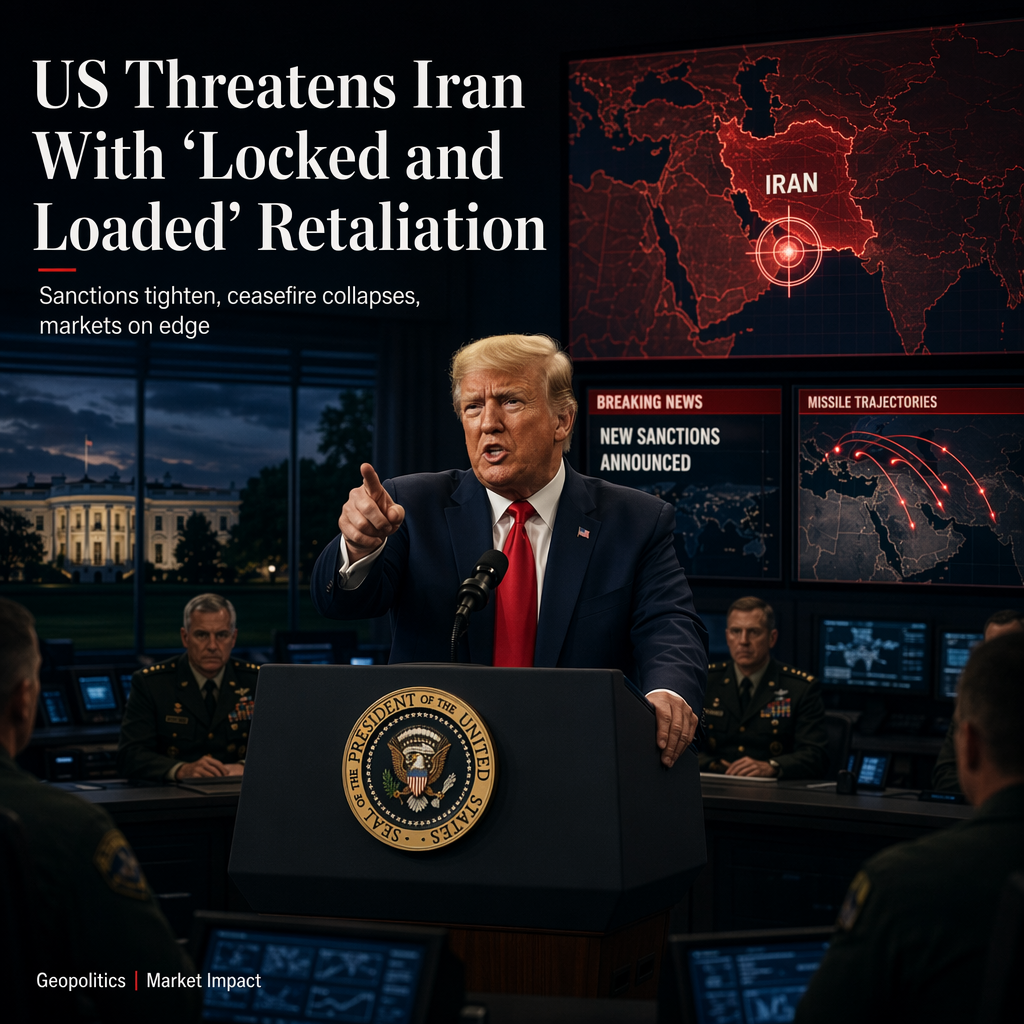
President Donald Trump issued a forceful warning to Iran, threatening to 'decimate and destroy' the country if Tehran acts on alleged threats to assassinate him. This statement was made as the U.S. Treasury Department imposed sanctions on an alleged Iranian financier, accused of supporting Mojtaba Khamenei, the new Supreme Leader and son of the late Ayatollah Ali Khamenei, who was killed in a U.S. airstrike early in the ongoing conflict [1]. Trump claimed that '1000 Missiles are Locked and Loaded and aimed at the Islamic Republic of Iran, with thousands of more to immediately follow,' emphasizing the readiness of the U.S. military for a one-year period, subject to extension [1].
The sanctions and military threats came after a fragile ceasefire, established by a preliminary deal last month, was scrapped. Iran criticized the new financial measures as a violation of the deal, while its foreign minister reportedly arrived in Oman for talks [1]. Trump stated that despite the breakdown of the ceasefire, both sides have agreed to continue peace talks, confirming reports that 'technical talks' will proceed and that both parties remain committed to finding solutions despite renewed hostilities [1].
The escalation followed intelligence reports, including from Israel, about an alleged Iranian plot to assassinate Trump. At the funeral of Iran's slain Supreme Leader, mourners carried banners reading 'We Will Kill Trump,' further fueling tensions [1]. The U.S. military responded to attacks on commercial vessels in the Strait of Hormuz with renewed offensive strikes against Iran, and the Treasury Department withdrew a waiver that had allowed Iran to sell its oil, intensifying economic pressure [1].
Market implications are significant, given the heightened risk of military conflict, disruption of international shipping in the Strait of Hormuz, and the imposition of new sanctions affecting Iran's oil exports. The ongoing uncertainty and threats of escalation are likely to impact global energy markets and geopolitical stability [1].
CONCLUSION
The breakdown of the ceasefire and renewed threats between the U.S. and Iran, coupled with fresh sanctions and military actions, have sharply increased geopolitical risks. The situation remains volatile, with both sides agreeing to continue talks but hostilities resuming. Markets are likely to react strongly to further developments, especially regarding oil exports and regional security.