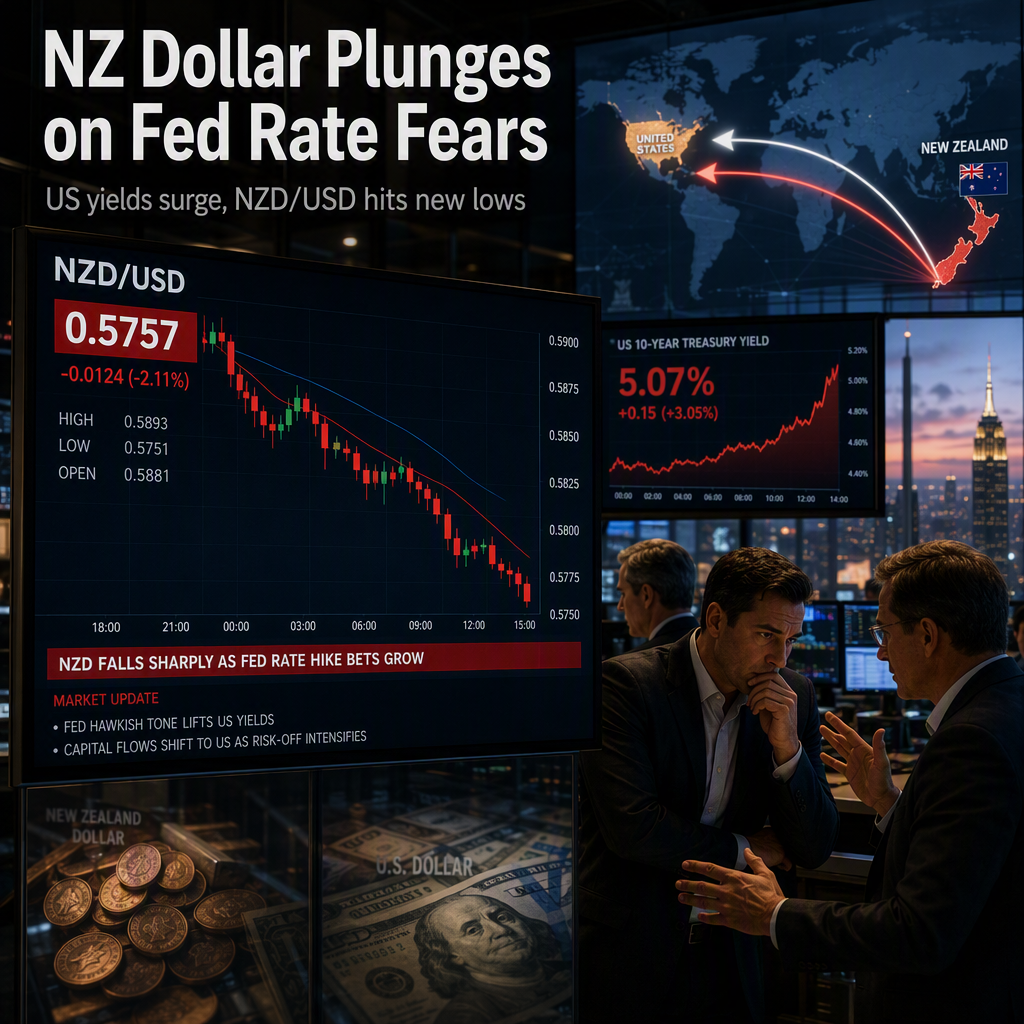
The New Zealand Dollar (NZD) continued its decline against the US Dollar (USD), with NZD/USD trading near 0.5757 and extending losses toward the lower end of its recent range [1]. This downward movement is attributed to a broadly stronger US Dollar, which has been buoyed by rising US Treasury yields and market expectations of a Federal Reserve (Fed) interest rate hike [1]. Specifically, the 10-year US Treasury yield has surged above 5%, reaching its highest level since 2007, as a more than 3% increase in oil prices has reignited inflation concerns [1].
Market participants are anticipating the Fed to raise rates by 25 basis points to a range of 3.75%-4.00% at its upcoming meeting, contributing to a risk-off sentiment that has weighed on growth-sensitive currencies such as the NZD [1]. In addition to external pressures, New Zealand's domestic outlook is also in focus, with Q2 Gross Domestic Product (GDP) data scheduled for release late on Wednesday. Market consensus expects a sharp slowdown in quarterly growth to 0.1%, down from 0.8% previously [1].
From a technical perspective, NZD/USD remains under clear downside pressure, trading below both the 20-period and 100-period Simple Moving Averages (SMAs), which cap the upside at 0.5787 and 0.5877, respectively [1]. The Relative Strength Index (RSI) is near 30, indicating stretched but persistent bearish momentum rather than a confirmed reversal [1]. Resistance levels are noted at 0.5787, 0.5877, 0.5907, 0.5930, and 0.5965, while the lack of nearby structural supports leaves the pair vulnerable to further declines unless buyers intervene [1].
CONCLUSION
The New Zealand Dollar is under significant pressure due to expectations of a Fed rate hike and surging US yields, compounded by concerns over slowing domestic growth. Technical indicators suggest persistent bearish momentum, with the NZD/USD pair at risk of further declines unless market sentiment shifts.