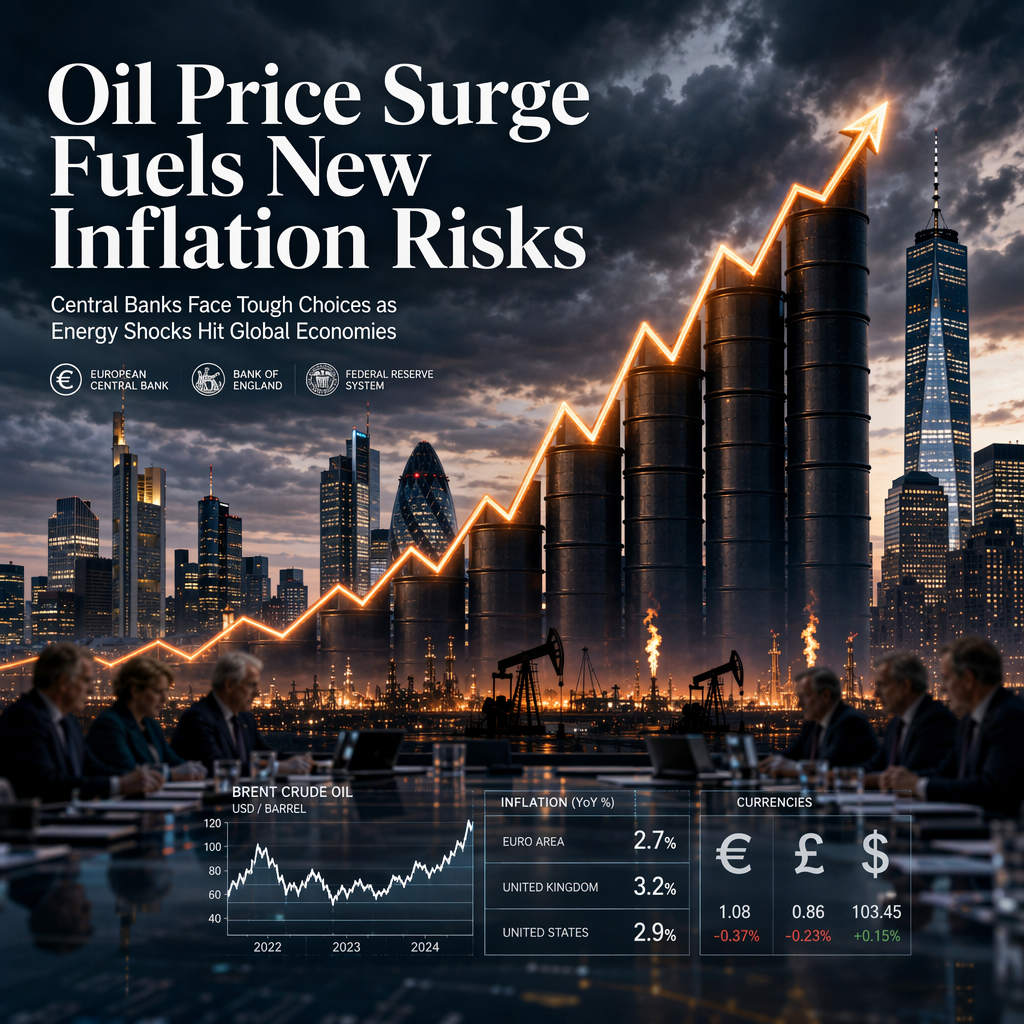
Recent developments across global central banks highlight mounting inflation risks driven by surging oil prices and energy supply disruptions. Commerzbank analysts note that ECB President Christine Lagarde has signaled the possibility of a September rate hike, emphasizing that inflation risks are once again pointing upwards and that some Council members considered hiking rates as early as this week. Lagarde stated that the current situation aligns with the ECB's baseline scenario, and sources confirm that euro area inflation must improve markedly to avoid further tightening, which appears challenging given current oil price dynamics. The ECB is also exploring options to mitigate financial losses, such as not paying interest to banks on some excess reserves or charging fees [1]. ECB officials, including Governing Council member Gediminas Simkus, have warned that inflation in the Eurozone could remain above the 2% target for an extended period due to global energy supply disruptions, with Simkus stating, '$100 Oil will have repercussions on inflation, and it is seen higher than target for a long time.' Lagarde reiterated that 'Risks to inflation tilted to the upside,' and expects energy shocks to keep inflation well above target into the first half of 2027. The ECB kept its key borrowing rates unchanged and did not commit to a pre-defined interest rate path, while ruling out the risk of second-round effects from the inflation shock [5].
In the United Kingdom, headline CPI fell to 2.6% in June, 0.5 percentage points below the MPC's April forecast, with broad-based downside surprises across food, core goods, and services. However, Rabobank's Stefan Koopman warns that renewed energy price increases and recurring shocks could push inflation back above 3%, suggesting that 3% may become the UK's de facto inflation norm in coming quarters. The Bank of England's Monetary Policy Committee (MPC) had previously warned that risks to its energy-price outlook were skewed to the upside, and economists expect the MPC to revisit its energy assumptions and present alternative scenarios for prolonged supply shocks. Despite these risks, a Reuters poll of 70 economists expects the BoE to keep its interest rate unchanged at 3.75% at its July 30 meeting, with the median forecast seeing rates remain steady through mid-next year. The British Pound showed little reaction to these developments, with GBP/USD hovering around 1.3315 [2][3].
Central and Eastern European (CEE) currencies have also been affected by the global rise in oil and gas prices, triggering a sharp hawkish repricing of policy-rate paths in Poland, the Czech Republic, and Hungary. Markets added one extra hike in Poland and the Czech Republic, taking implied tightening to 90bp and 70bp respectively, while Hungary priced out half a cut. ING economists are keeping their forecasts unchanged for now, but note that higher market rates offer some protection and help stabilize CEE FX despite a stronger Dollar and risk-off sentiment. Fair-value levels are estimated at 4.290-4.300 for EUR/PLN and 24.100-24.150 for EUR/CZK, though upside is limited in the current environment [4].
On the US front, the Dollar Index (DXY) rose to near 101.50, supported by surging Treasury yields and revived hawkish Fed rate hike expectations. The CME FedWatch Tool shows the odds of a Fed rate hike at 33.7% for the next policy meeting, up from 11.8% last week. Elevated oil prices, driven by energy supply disruptions in the Middle East, have boosted inflation expectations and prompted traders to increase hawkish Fed bets [5].
CONCLUSION
Surging oil prices and energy supply disruptions are fueling renewed inflation risks across major economies, prompting central banks like the ECB to consider further tightening and warning of prolonged inflation above target. While the BoE and CEE central banks are currently expected to keep rates steady, market repricing and elevated energy prices remain key risks. The overall market impact is high, with currencies and rate expectations responding to the shifting inflation outlook.