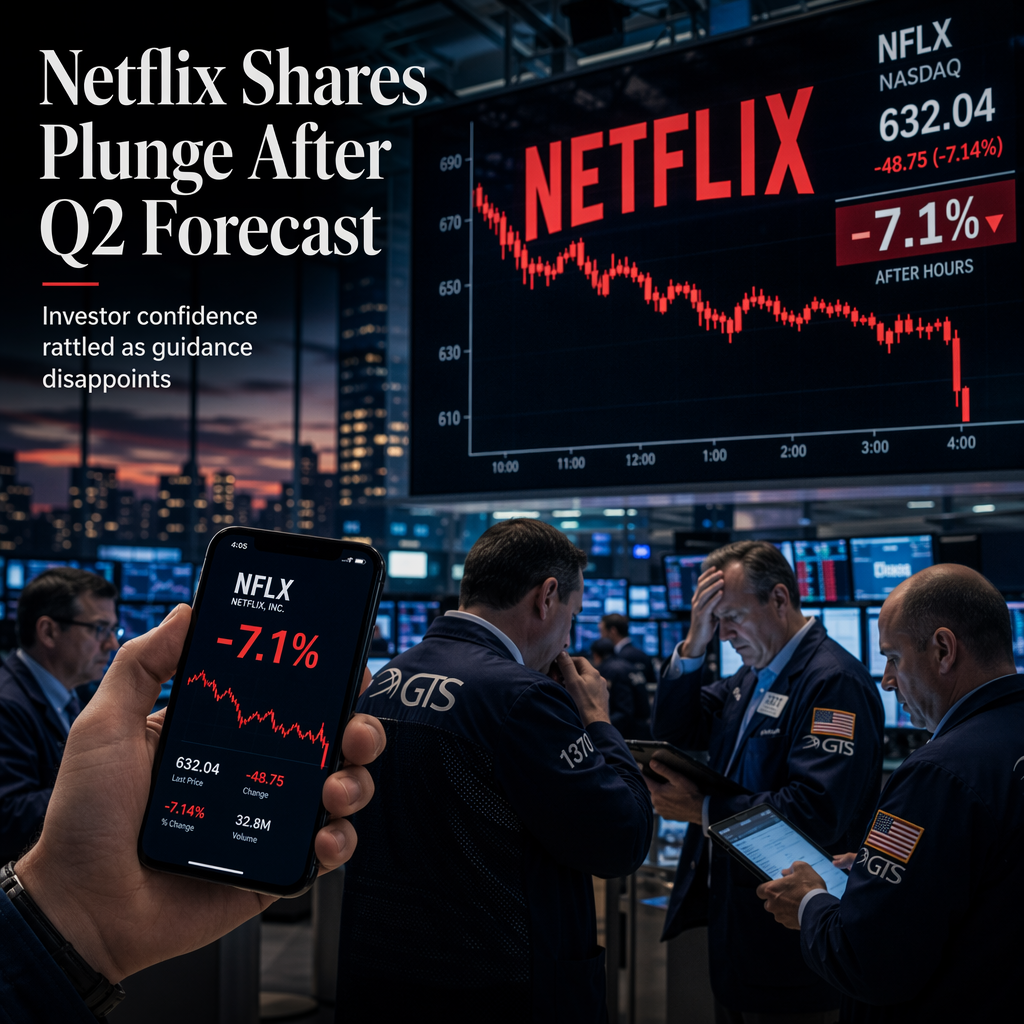
Netflix reported its second-quarter 2026 earnings and revenue, which were nearly in line with analyst estimates, but the company's stock fell more than 7% on Friday as investors reacted negatively to its earnings forecast and guidance updates [1]. For the quarter ended June 30, Netflix posted earnings per share of 80 cents, slightly above the 79 cents estimated by analysts polled by LSEG, and revenue of $12.56 billion, just below the $12.59 billion estimate. This represented a 13% year-over-year increase in revenue, attributed to membership growth, pricing adjustments, and increased advertising revenue [1].
The company recently raised subscription prices across all streaming plans, and stated that the results of these price hikes were consistent with prior changes and expectations. Net income for the second quarter was $3.40 billion, or 80 cents per share, compared to $3.13 billion, or 72 cents per share, in the same period last year [1]. Looking ahead, Netflix expects third-quarter revenue to grow by 12% and narrowed its full-year 2026 revenue guidance to a range of $51 billion to $51.4 billion, compared to its previous guidance of $50.7 billion to $51.7 billion [1].
Engagement metrics were a key focus during the earnings call, with Netflix describing member engagement as 'healthy.' The company reported that members watched more than 97 billion hours of content in the first half of 2026, with live events being a significant draw [1]. Co-CEO Greg Peters emphasized that there is not a linear relationship between viewing hours and revenue or profit, noting that 'all hours are not created equal.' Co-CEO Ted Sarandos addressed concerns about viewership drop-off between seasons, stating that there has been no material change and that season two fall-off has actually slightly improved this year compared to last year [1].
Netflix also announced it will reduce the frequency of its 'What We Watched' engagement reports, moving from semi-annual to annual publication starting in the first quarter of 2027. The company explained that this change is intended to keep the focus on financial metrics rather than engagement statistics [1].
CONCLUSION
Netflix's Q2 2026 results were largely in line with expectations, but a cautious earnings forecast and changes to engagement reporting led to a sharp decline in its stock price. Investors appear concerned about the company's forward guidance and transparency on engagement metrics, despite solid revenue and net income growth.