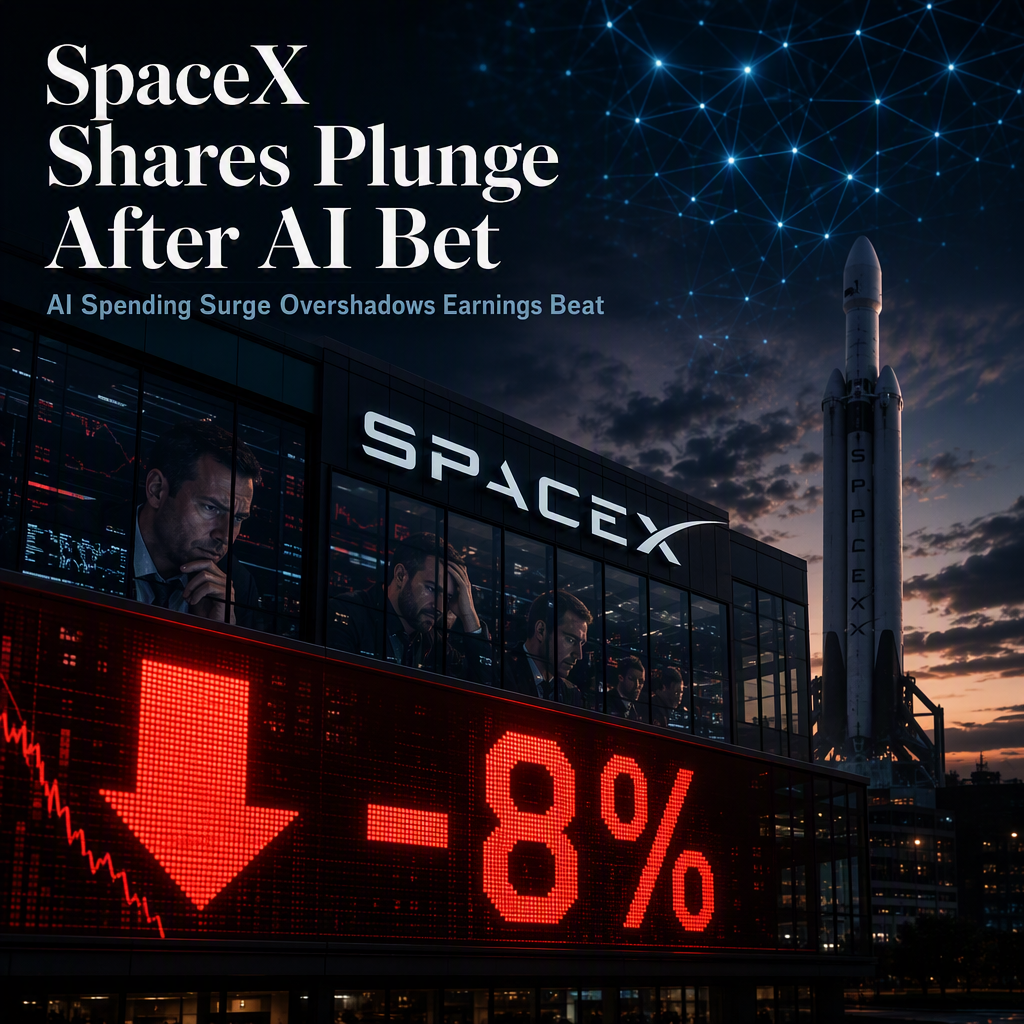
SpaceX shares dropped more than 8% in premarket trading on Wednesday following the company's first earnings report as a public company, which revealed a significant surge in capital expenditures, primarily driven by investments in artificial intelligence (AI) infrastructure [1]. The company reported that its capital expenditures jumped sixfold to $18.4 billion in the second quarter, a figure that exceeded analyst expectations and was largely allocated to AI spending [1]. Despite this, SpaceX managed to narrow its losses and delivered an earnings beat, but the sharp increase in spending rattled investors and overshadowed the positive results [1].
CEO Elon Musk attempted to reassure investors by projecting that SpaceX would reach $1 trillion in annual revenue by 2030, moving up the timeline from a previous forecast of 2031 [1]. CFO Bret Johnsen also addressed concerns, emphasizing the company's efficiency in capital deployment and stating that on the AI compute side, SpaceX is achieving less than a one-year payback on its investments [1]. The company's stock closed at just over $125 on Tuesday, below its $135 IPO price and well off its all-time high of over $200 reached shortly after its listing [1].
Market participants remain cautious, with ongoing concerns about whether large tech companies like SpaceX can demonstrate returns on their multibillion-dollar investments in AI [1]. While SpaceX's AI models are considered behind those of OpenAI and Anthropic, the company is positioning itself as an alternative cloud provider by renting out computing capacity built with Nvidia chips [1]. Steve Westly, founder of The Westly Group and a former Tesla board member, commented that investors are questioning how quickly SpaceX can grow and what the costs will be before the company achieves profitability [1].
Another potential market-moving event is on the horizon, as the expiration of insider lock-ups on Thursday will allow insiders to sell a portion of their shares, which could further impact the stock price [1].
CONCLUSION
SpaceX's significant increase in AI-related capital expenditures has raised investor concerns, leading to a sharp decline in its share price despite an earnings beat and optimistic revenue forecasts. The market remains wary about the company's ability to balance rapid growth with high spending, and the upcoming expiration of insider lock-ups could introduce additional volatility.