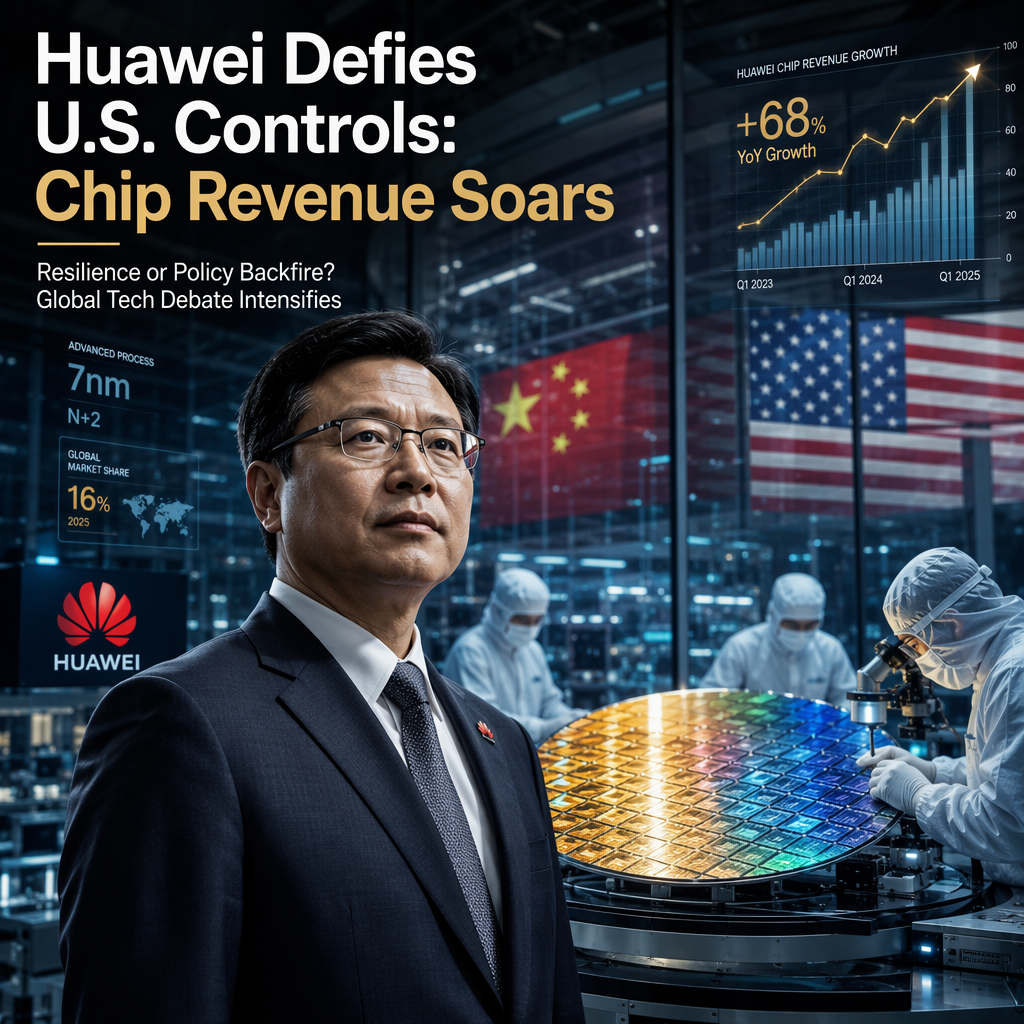
Huawei, China's largest technology company, is expected to post a 60% increase in chip revenue this year, defying U.S. export controls aimed at curbing its access to advanced semiconductor technology [1]. Analysts project Huawei will close 2026 with approximately $12 billion in chip revenue, up significantly from $7.5 billion in 2025 [1]. This growth follows a series of U.S. restrictions, beginning in 2019 and intensifying under both the Biden and Trump administrations, which included blacklisting Huawei devices, banning sales and imports, halting export licenses, and urging allies to adopt similar measures, all citing national security concerns [1].
In response to these restrictions, China directed state agencies to purchase from Huawei and provided substantial government support, with grants rising from 2.5 billion yuan (about $403 million) in 2021 to 7.3 billion yuan in 2023, before dipping to 3.9 billion yuan in 2025 [1]. The U.S. Department of Commerce stated that the export controls were intended to restrict China's ability to obtain advanced chips and manufacture semiconductors used in military and surveillance applications [1].
Despite these efforts, Huawei's strengthened position has fueled debate over whether the export controls have backfired by making the company more resilient and competitive, or whether they have successfully slowed China's progress in advanced semiconductors [1]. Nvidia CEO Jensen Huang described Huawei as "the single most formidable technology company in China," noting its success in every market it has entered [1].
The market implications are significant, as Huawei's resurgence challenges the effectiveness of U.S. policy and may influence global supply chains and technology competition [1]. Forward-looking statements from analysts suggest continued debate over the long-term impact of these measures, with some questioning whether the restrictions have achieved their intended goals [1].
CONCLUSION
Huawei's robust chip revenue growth, despite escalating U.S. export controls, highlights the company's resilience and the potential unintended consequences of American policy. The situation has sparked debate among industry leaders and analysts about the effectiveness of these measures and their impact on global technology competition. The market is closely watching how this dynamic will evolve in the coming years.