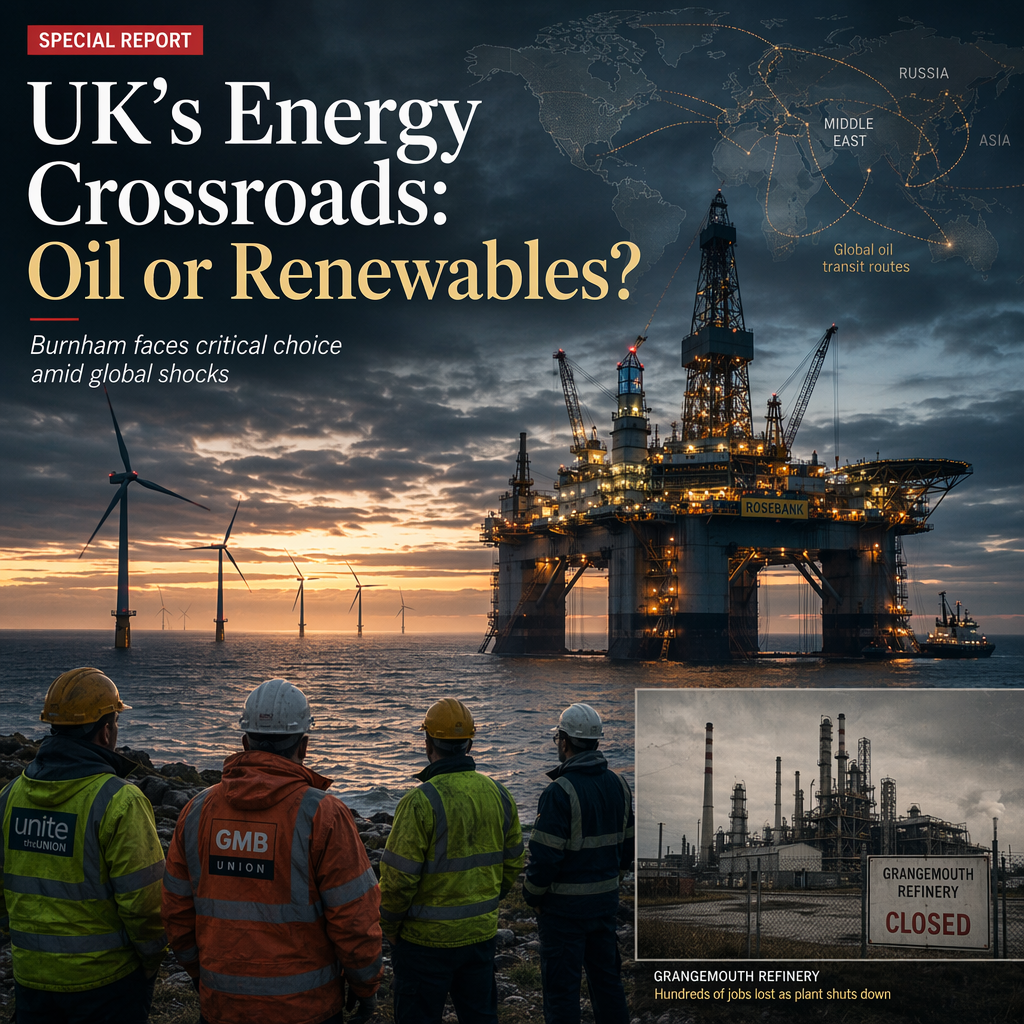
The United Kingdom is at a critical juncture regarding its energy policy as Andy Burnham, likely to become the next prime minister in July, faces mounting pressure to decide between expanding North Sea oil drilling or prioritizing renewable energy investments [1]. This debate has intensified due to ongoing energy security concerns linked to the Iran war, which has disrupted oil flows through the Strait of Hormuz, a vital global oil chokepoint, and the lingering effects of Russia’s war in Ukraine on fuel supply [1].
Central to the controversy are the Rosebank and Jackdaw oil fields in Scottish waters, which are seen as potential boosts to UK domestic supply but also as tests of the country's climate commitments [1]. Business leaders and two major trade unions, Unite the Nation and GMB, are advocating for new drilling, citing risks to jobs if projects are halted [1]. In contrast, political leaders are divided: Finance Minister Rachel Reeves is reported to privately support new drilling, while Energy Secretary Ed Miliband favors a stronger focus on clean energy [1].
The closure of the Grangemouth oil refinery in April 2025, which resulted in the loss of hundreds of jobs, has further heightened concerns about energy independence. Scottish First Minister John Swinney emphasized the economic risks of relying on imported jet fuel, especially as Middle East conflicts create uncertainty in supply chains [1]. Swinney stated, "We are going to have to utilize oil and gas for some years to come. If there is uncertainty about the security of supply, or security of supply is undermined because of exorbitant cost of the effects of the conflict in Iran, these are material factors that have got to be borne in mind" [1].
The market is closely watching Burnham’s impending decision, as it will signal the UK’s direction on energy security, job protection, and climate policy at a time of heightened geopolitical risk and domestic economic pressure [1].
CONCLUSION
The UK’s energy policy is at a crossroads, with the next prime minister facing immediate pressure to balance energy security, job protection, and climate goals. The outcome of this debate will have significant implications for the UK’s energy market and broader economy as global supply shocks persist.