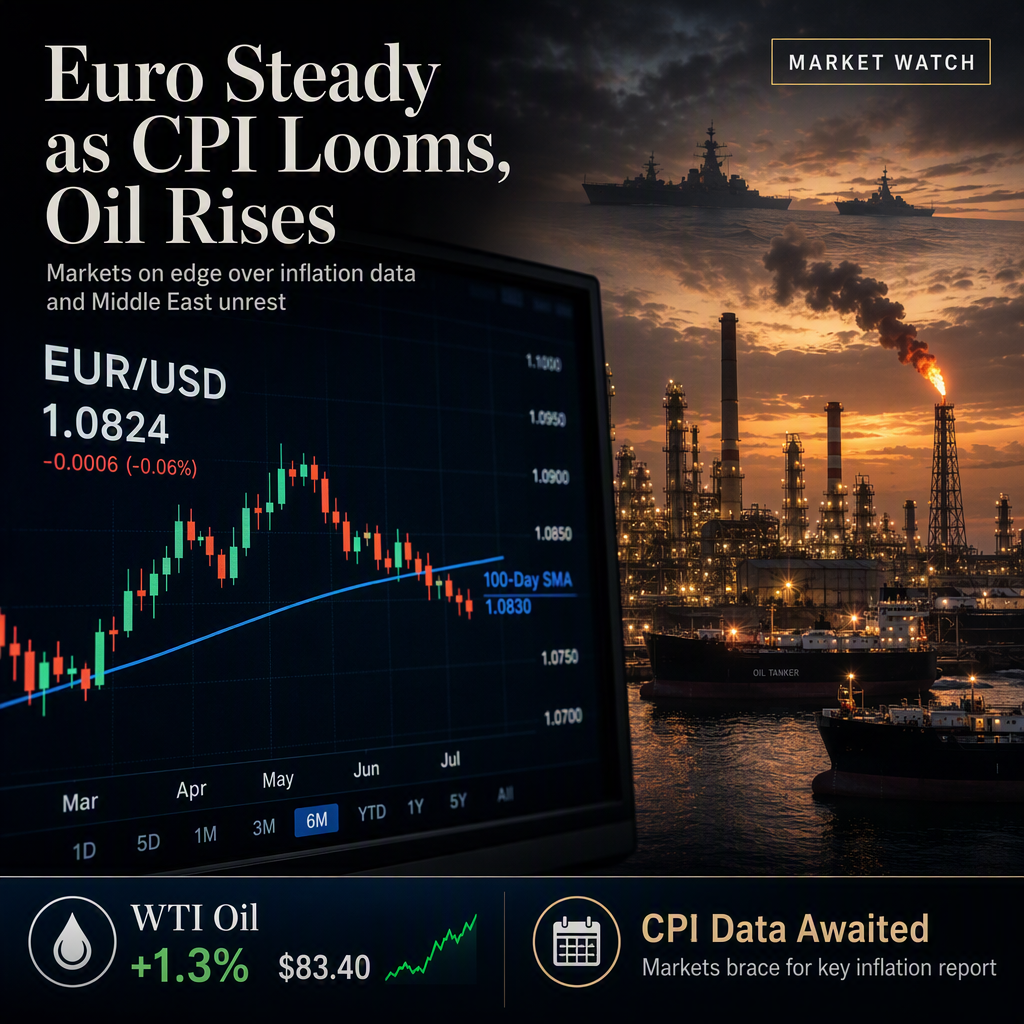
The euro registered minimal losses against the US dollar on Tuesday, with the EUR/USD pair trading at 1.1541, remaining below the 100-day Simple Moving Average (SMA) of 1.1567 as investors awaited the release of the US Consumer Price Index (CPI) on Wednesday. This data is seen as pivotal for determining the future direction of US monetary policy, with forecasts suggesting headline inflation will dip from 3.5% to 3.4% year-over-year, and core inflation is expected to decelerate from 2.6% to 2.5% for the twelve months to July [1].
Market sentiment was also influenced by ongoing tensions in the Middle East. The US reportedly fired on a ship breaking the blockade in Iran, while the Houthis claimed to have attacked a Saudi vessel carrying military equipment in the Strait of Bab El-Mandeb. These developments contributed to a rise in West Texas Intermediate (WTI) crude oil prices, which increased by over 1.30% to $83.40, amid concerns that a resolution to the conflict may be further away than anticipated [1].
In the US, economic data showed the ADP Employment Change 4-week average indicated the creation of 8.25K jobs, with the previous figure revised down by 4K to 11K. Additionally, US Existing Home Sales fell by 1.7%, attributed to rising prices linked to the Middle East conflict. Federal Reserve officials, including Chicago Fed President Goolsbee, emphasized that inflation remains the main economic issue, describing the labor market as stable but not strong, and highlighting the importance of a healthy consumer for economic stability [1].
Technical analysis indicates that EUR/USD is trading around 1.1542, above key support levels at 1.1517 and 1.1513, and above the 50/100/200-day SMA cluster at approximately 1.1468. The 14-day Relative Strength Index near 59 suggests bullish momentum that is not yet overstretched. Immediate support is seen at the reclaimed trend-line break near 1.1517 and the channel top at 1.1513, with further support at 1.1468 and 1.1339 [1].
Looking ahead, market participants are focused on the upcoming US CPI and PPI data, which could influence the Federal Reserve's interest rate decisions. In Europe, attention will turn to Germany’s Harmonised Index of Consumer Prices (HICP) for July, scheduled for release on Wednesday [1].
CONCLUSION
The euro remains steady against the dollar as markets await key US inflation data, which could shape the Federal Reserve's policy outlook. Middle East tensions are adding to market uncertainty, pushing oil prices higher. Technical indicators suggest a constructive near-term bias for EUR/USD, but upcoming economic releases will be crucial for direction.