
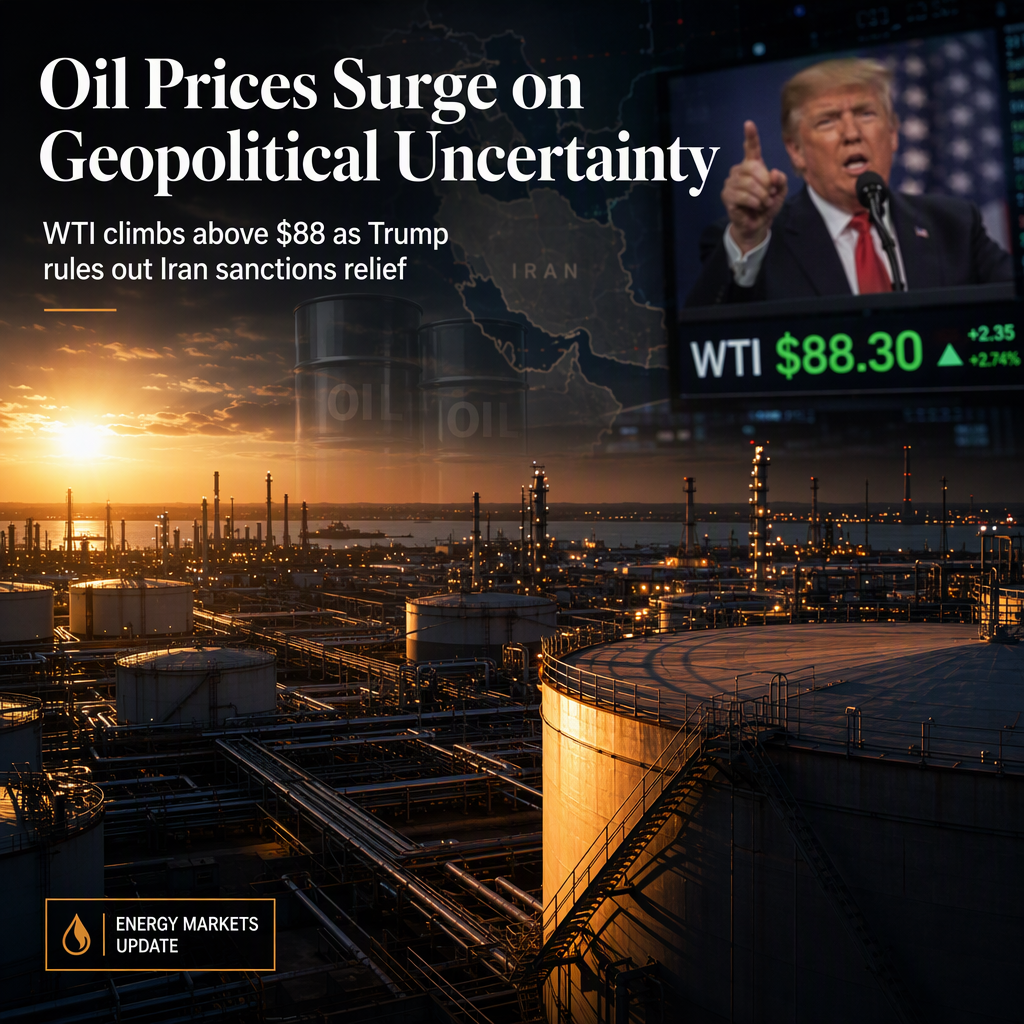
West Texas Intermediate (WTI), the US crude oil benchmark, traded around $88.30 during early European hours on Wednesday, edging higher after US President Donald Trump denied he would be willing to ease sanctions on Iran [1]. This denial followed an Axios report suggesting that Qatar's mediation efforts between the US and Iran had failed, with both sides unwilling to compromise, raising concerns about a potential escalation in tensions [1]. Trump also refuted claims that he provided Iran sanctions relief or released frozen Iranian funds in exchange for Iranian steps on the nuclear program [1].
Sugandha Sachdeva, founder of SS WealthStreet, noted that ongoing uncertainty over sanctions relief and negotiations is maintaining a geopolitical risk premium in oil prices. She added that while improving supplies could cap further gains, any renewed disruption or escalation in tensions could trigger another rally [1].
On the supply side, the American Petroleum Institute (API) reported that US crude oil inventories rose by 1.019 million barrels for the week ending September 25, compared to a 1.786 million barrel increase the previous week [1]. ING analysts observed that oil prices fell sharply on Wednesday, with Brent dropping below $99 per barrel and WTI trading near $89 per barrel, attributing the sell-off to expectations of rising Saudi crude exports, diplomatic progress between the US and Iran, and a larger-than-expected build in US crude inventories [1]. These factors have collectively eased concerns over Middle East supply disruptions [1].
ING further highlighted that Saudi Arabia has restarted operations at its East-West pipeline and could soon resume exports from the Yanbu terminal, a route with a capacity of around 7 million barrels per day that bypasses the Strait of Hormuz. This is expected to gradually restore lost export flows and potentially increase global crude supplies in the coming weeks [1]. Despite the recent correction, oil prices remain more than 60% higher year-to-date, with Brent experiencing its longest losing streak since August 2025, accumulating losses of more than 9.5% over six consecutive sessions [1].
Geopolitical developments remain central to oil price movements. ING noted that President Trump described recent discussions with Iranian officials as 'very productive,' raising hopes for further diplomatic progress and reducing fears of prolonged supply disruptions in the region [1].
CONCLUSION
WTI's rise above $88 reflects ongoing geopolitical uncertainty, particularly regarding US-Iran relations and sanctions policy. While increased US inventories and the resumption of Saudi exports have eased some supply concerns, the market remains sensitive to diplomatic developments and potential disruptions. Despite recent price corrections, oil remains elevated year-to-date, underscoring persistent volatility.