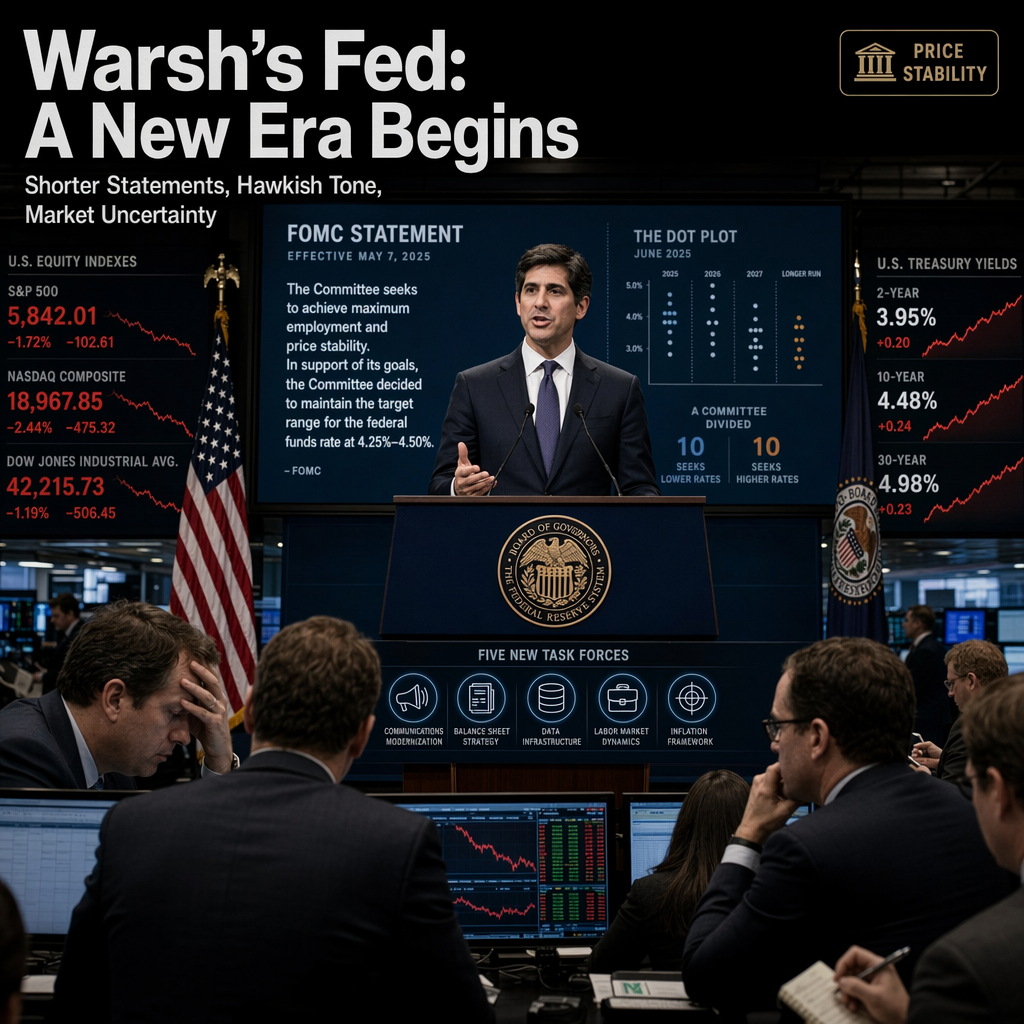
Kevin Warsh's first meeting as Federal Reserve Chairman marked a significant shift in both policy communication and the central bank's approach to inflation. On June 17, 2026, the Federal Open Market Committee (FOMC) voted unanimously to keep the federal funds rate steady at 3.5%-3.75% [2][3][4]. However, the 'dot plot' of projections revealed a split among committee members, with half expecting steady rates or a cut, and the other half anticipating at least one hike, resulting in the median projection pointing to a quarter-point increase later this year [2]. Warsh himself did not submit a projection, consistent with his long-standing criticism of forward guidance and the Summary of Economic Projections (SEP) [2][3][4].
Warsh's press conference and the FOMC statement signaled a new era for the Fed. The post-meeting statement was dramatically shortened to about 130 words, compared to over 300 in previous meetings, and omitted forward guidance and detailed voting records [2][4]. Warsh emphasized that the statement was intended to provide only the facts, stating, 'It's a bit shorter, a bit simpler and it dispenses with some older language' [4]. He reiterated the Fed's commitment to price stability, using the term 'price stability' repeatedly and describing the committee's resolve to control inflation as 'unambiguous and unanimous' [1][2][3]. Warsh stated, 'We recognize that inflation has been running well ahead of the Fed’s long stated inflation goal of 2 percent. That’s been going on for more than five years. Persistently high prices are a burden for the American people,' and pledged, 'this committee will deliver price stability' [1].
A centerpiece of Warsh's new approach is the creation of five task forces focused on communications, the Fed's balance sheet, data sources, productivity and jobs, and the inflation framework. These groups will include both internal staff and external experts, and are intended to guide reforms and bring other Fed members on board with Warsh's vision [1][2][3]. Warsh's rejection of the Phillips curve—asserting that strong growth, low prices, and strong employment can coexist—was also highlighted as a departure from previous Fed orthodoxy [1].
Market reaction to Warsh's debut was negative, with major stock averages declining during and after his press conference [2][3]. The policy-sensitive 2-year Treasury yield spiked by 14.4 to 16 basis points, reflecting investor uncertainty and expectations that Warsh may eventually raise rates [2][3]. Warsh declined to comment on the market's reaction, emphasizing the value of 'unfiltered' market responses and suggesting that the Fed will no longer guide markets as closely as in the past [1][3].
Analysts and Fed watchers described the changes as a 'regime change,' noting the elimination of forward guidance and the focus on brevity and clarity in communications [4]. David Wessel of Brookings and Ian Lyngen of BMO both commented that Warsh's approach marks a clear departure from his predecessor, with Lyngen stating, 'Warsh's first FOMC statement left the clear impression that there is a new chair in town' [4].
CONCLUSION
Kevin Warsh's first FOMC meeting as Fed chair introduced a new era of communication and policy focus, with a strong emphasis on fighting inflation and reducing forward guidance. Markets reacted negatively to the uncertainty, as evidenced by falling stock averages and a sharp rise in Treasury yields. Warsh's reforms and task forces signal further changes ahead, with the Fed prioritizing price stability and transparency over market signaling.