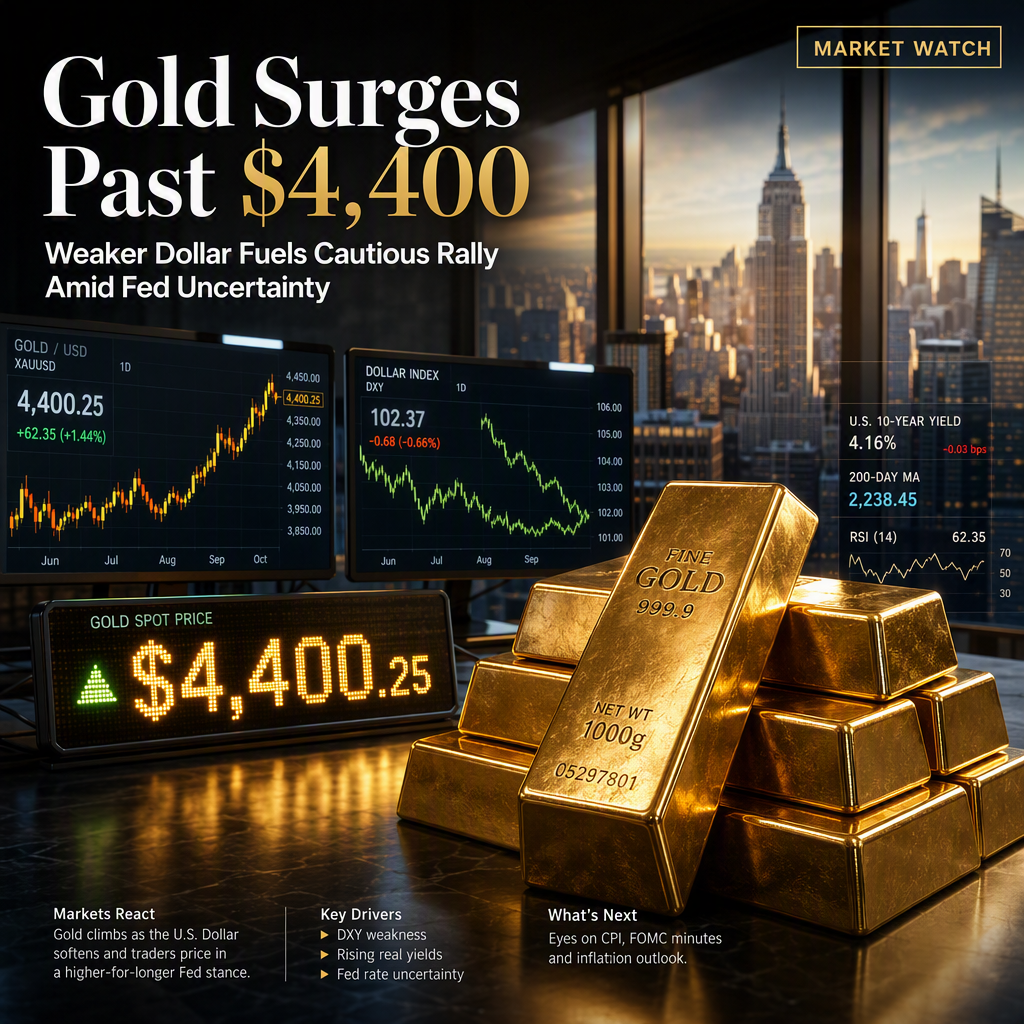
Gold (XAU/USD) rebounded on Thursday, trading above $4,400 after recovering from lows near $4,280–$4,300 reached on Wednesday, which marked a three to four-week low depending on the source [1][2]. The recovery was supported by a weaker US Dollar, driven in part by a sharp rally in the Japanese Yen, which saw USD/JPY fall nearly 1% on Wednesday and about 1.5% at press time, trading near 156.35, its lowest level since August 3 [2]. The US Dollar Index (DXY) also dropped to around 99.26, a one-week low, after peaking at 99.86 on Wednesday [2].
The softer US Dollar followed disappointing US ADP employment data, which showed private employment rising by 38,000 in August, the weakest reading since January and below the expected 47,000 increase [1]. Additionally, New York Federal Reserve President John Williams commented that rising bond yields are due to a solid economy rather than inflation fears, and suggested a 'wait and see' approach before making interest rate decisions, which cooled immediate rate hike expectations [1]. However, both sources note that futures markets are still pricing in a 60% chance of a 25 basis point rate hike at the Fed's September meeting, according to the CME FedWatch Tool [1][2].
Despite the rebound, analysts highlight significant resistance for Gold. XAU/USD faces a key barrier at $4,470, with further resistance at the 200-day Simple Moving Average (SMA) at $4,533 and last week's high at $4,690 [1]. Technical indicators show neutral momentum, with the daily Relative Strength Index (RSI) at 52 and the MACD below zero, suggesting the bullish impulse is fragile [1][2]. Gold is currently holding above the 50-day and 100-day SMAs, which keeps the near-term outlook constructive, but the MACD remains negative, indicating recovery attempts could remain choppy below the 200-day SMA [2].
Market participants remain cautious due to several headwinds, including multi-year highs in government bond yields and elevated oil prices linked to Middle East tensions, which are fueling inflation concerns [2]. The benchmark 10-year US Treasury yield is around 4.78%, just below its recent high of 4.81% [2]. Hawkish Fed expectations and the upcoming US Nonfarm Payrolls (NFP) report on Friday are also contributing to a wait-and-see approach among traders [2].
Looking ahead, buyers may avoid aggressive bullish bets until after the NFP report, which could significantly influence expectations for the Fed’s next policy move [2]. Thursday’s US economic calendar includes Initial Jobless Claims and the August ISM Services PMI [2].
CONCLUSION
Gold's recovery above $4,400 is being driven by a weaker US Dollar and dovish signals from the Fed, but faces strong resistance and headwinds from high yields and hawkish rate expectations. Technical indicators suggest momentum is neutral and further gains may be limited unless key resistance levels are breached. Traders are likely to remain cautious ahead of the US Nonfarm Payrolls report, which could shape the next move for both Gold and Fed policy.