
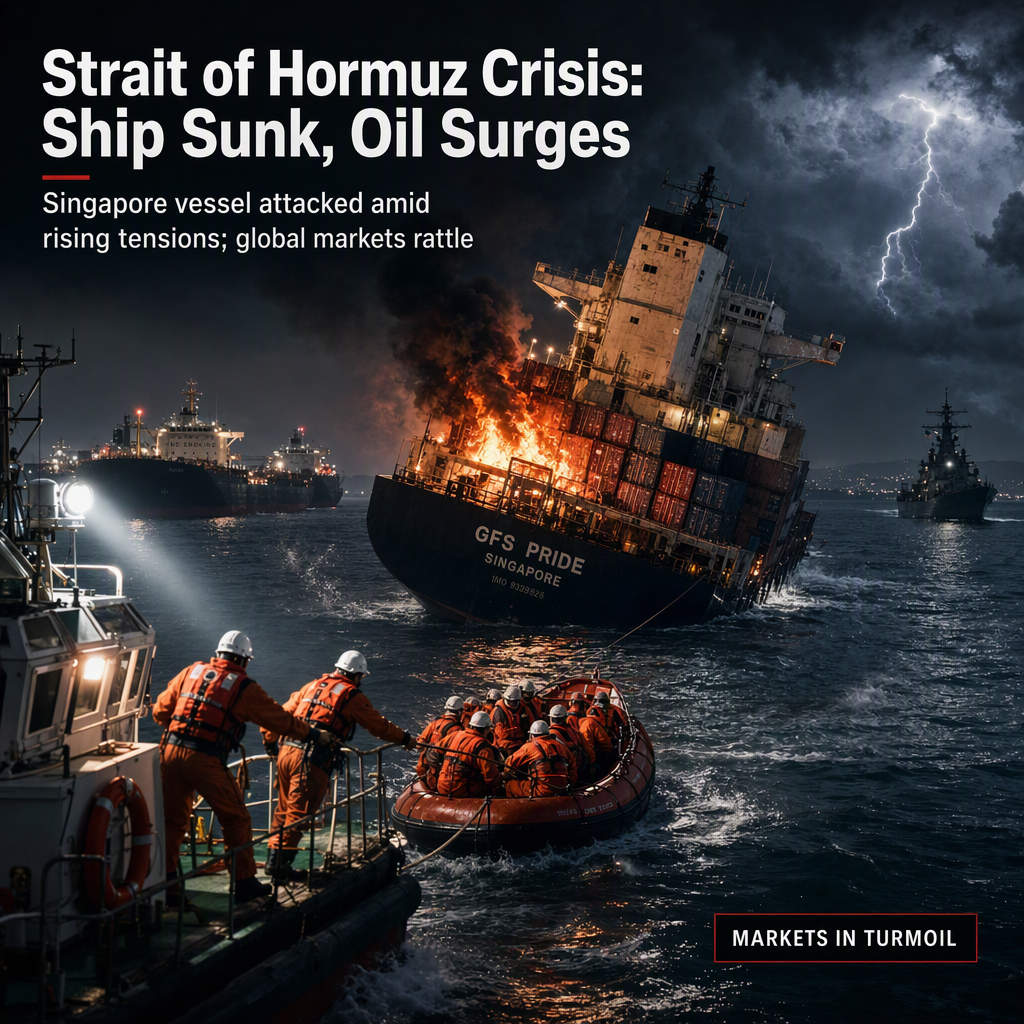
A major escalation occurred in the Strait of Hormuz as the Singapore-registered container ship GFS Pride was sunk after being struck by an unidentified projectile and catching fire. All 21 crew members were safely evacuated with no injuries reported, according to the Maritime and Port Authority of Singapore [1]. The authority condemned the attack as 'unprovoked, unjustifiable and a breach of international law' in a statement released Wednesday [1]. A second vessel, the GFS Giselle, was also hit and sustained hull damage but managed to reach safe anchorage without any crew injuries [1].
Tensions have further intensified as Iran increased its attacks on commercial vessels and issued threats against U.S. warships in the region. Islamic Revolutionary Guard chief Ali Ozmaei stated, 'If the Americans think the Strait of Hormuz is open, let them come closer. We are impatient to sink American warships.' However, U.S. Central Command disputed Iran's claims of control, asserting that 'American forces and regional partners clearly control the Strait of Hormuz' [1].
These developments, combined with additional attacks by Tehran-backed Houthi rebels on Saudi Aramco facilities in Saudi Arabia, have driven oil prices higher. International benchmark Brent crude rose to $106.06 per barrel, while U.S. West Texas Intermediate advanced to $95.09 per barrel [1]. The surge in energy prices contributed to a hotter-than-expected U.S. inflation report for September, with the consumer inflation rate rising 3.7% year-on-year, surpassing expectations of 3.6%. The energy index jumped 5.2%, and core CPI increased 2.6% annually, compared to estimates of 2.5% [1].
Financial markets reacted negatively to the news, with the S&P 500 declining 1.11% and the Nasdaq Composite dropping 1.88%. Asian markets also fell in response to Wall Street's overnight losses. U.S. consumers are feeling the impact, with average gasoline prices at $4.33 per gallon, up from $3.08 a year earlier, according to AAA [1].
CONCLUSION
The sinking of a Singapore-registered ship in the Strait of Hormuz and escalating threats from Iran have heightened geopolitical risks, pushing oil prices sharply higher and fueling inflationary pressures. Financial markets responded with notable declines, reflecting investor concerns over energy costs and regional instability. The situation remains tense, with further market volatility likely as developments unfold.