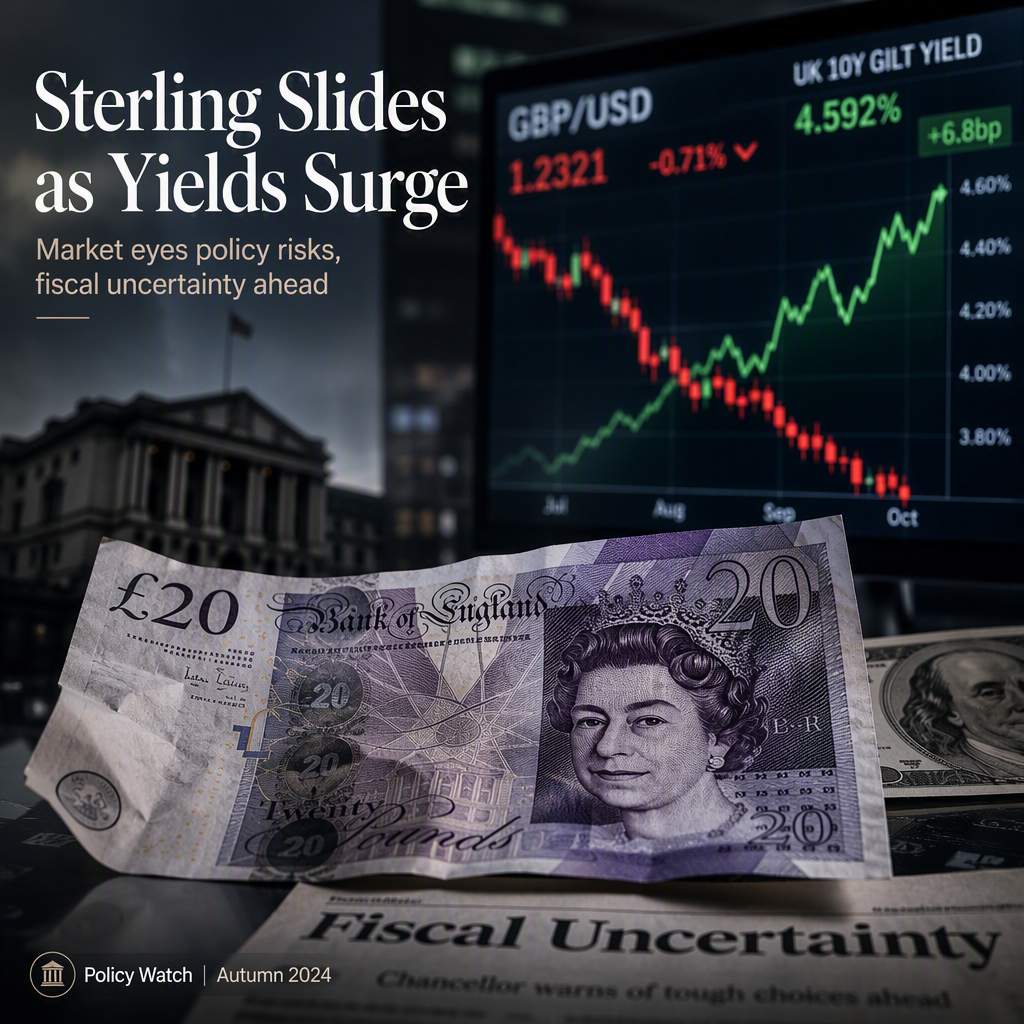
Sterling weakened on Wednesday, with GBP/USD trading just under 1.3500 after hitting a session low slightly below 1.3475. This marks a decline of roughly 1.5% from the late August peak near 1.3700, leaving the currency at its weakest level in three weeks [1]. Notably, this drop occurred even as UK 10-year borrowing costs climbed above 5.20%—the highest since 2008—and long-term yields reached fresh eighteen-year highs [1]. Typically, rising yields would attract foreign investment into the currency, but in this case, the British Pound continued to fall, reflecting market concerns about the reasons behind the yield increase [1].
The upcoming September 17 Monetary Policy Committee meeting is seen as compounding market uncertainty, as it will include both a rate decision and the annual announcement on the pace of gilt sales. This dual event is significant because the long end of the yield curve is sensitive to supply, and additional gilt issuance could further pressure the market [1]. Despite the sharp repricing, there has been little movement in the British rate path: at the July meeting, three out of nine votes favored a 4% rate, and most forecasters expect the Bank Rate to remain unchanged through year-end [1]. Instead, the fiscal outlook has shifted, with the first Budget scheduled for October 28 from a finance minister committed to existing borrowing rules. The market interprets rising yields driven by supply and debt service concerns as a negative for the currency, pricing in a discount rather than a premium [1].
On the US side, the private payrolls survey for August came in at 38K, missing the 47K consensus and the prior 46K, but the Dollar remained resilient. The market's reaction function shifted after the Jackson Hole keynote, where the Federal Reserve chair emphasized that inflation had not slowed meaningfully, leading to a sharp increase in expectations for a rate hike at the September 16 meeting [1]. Additionally, elevated crude oil prices above $90.00, driven by geopolitical tensions, continue to feed into inflation expectations, supporting the Dollar [1].
Looking ahead, the market is awaiting Thursday's services survey at 14:00 GMT, which could provide further direction [1].
CONCLUSION
The British Pound's decline, despite surging gilt yields, highlights market concerns over fiscal policy and upcoming supply events rather than confidence in the UK's economic outlook. With key policy decisions and fiscal announcements on the horizon, volatility is likely to persist. Investors remain cautious, pricing in risk rather than opportunity for Sterling.