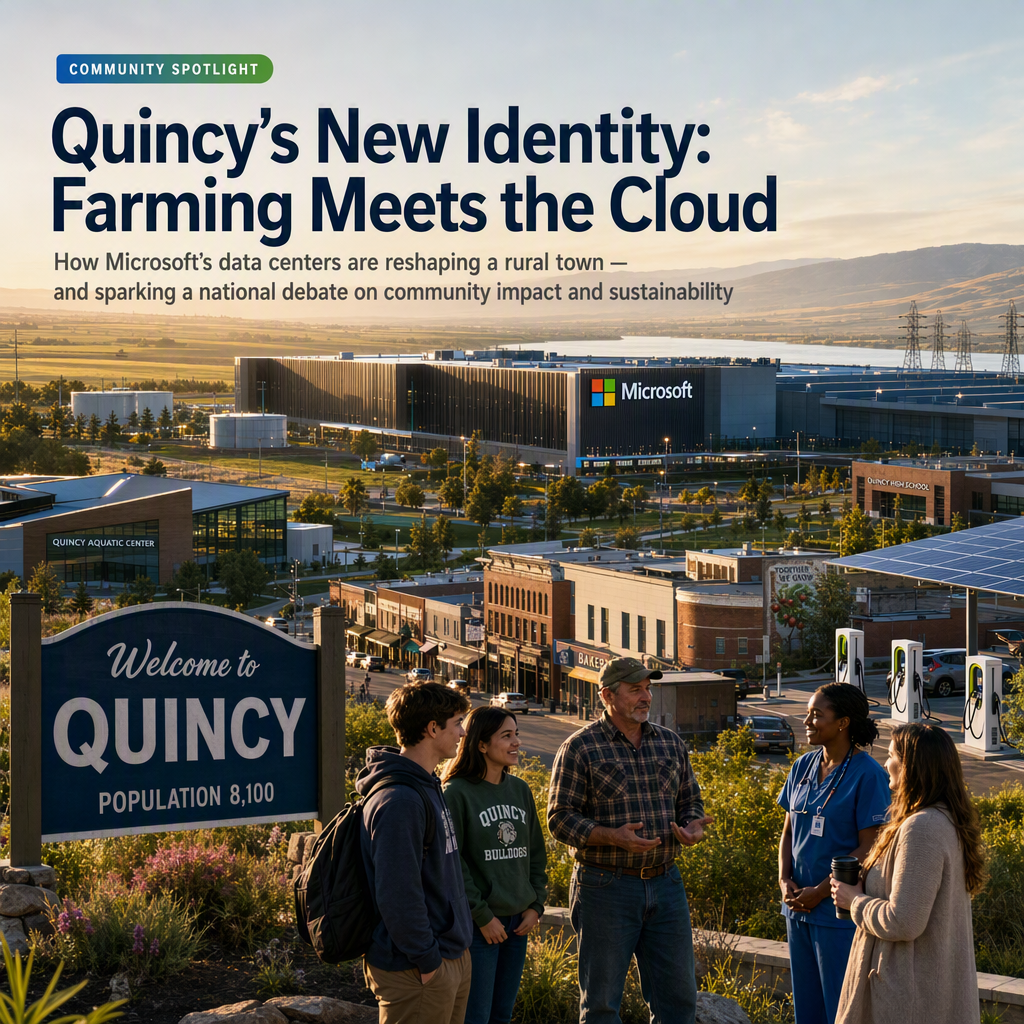
Microsoft has highlighted the small farming town of Quincy, Washington, as a central example in its efforts to address growing national concerns over the impact of data centers on local communities. With a population of roughly 8,100, Quincy has transitioned from an agricultural hub to a showcase for the data-center boom, attracting major technology companies over the past two decades due to its affordable land, cool climate, and abundant hydropower from the Columbia River [1].
Microsoft began building data centers in Quincy about 20 years ago and now points to the town as evidence that such facilities can deliver tangible benefits. The company cites years of data-center tax revenue supporting local infrastructure, including a state-of-the-art high school, hospital, and a recently opened aquatic center, with a new indoor sports complex planned [1]. While individual data centers typically employ 50 or fewer people, the concentration of facilities in Quincy has made the sector a meaningful employer and boosted the city’s broader tax base, supporting construction and service businesses [1].
In response to criticism about data centers’ electricity and water usage, Microsoft has announced a new national approach: it will ask local utilities to set rates high enough to cover data-center energy use and grid upgrades without raising prices for residents. Additionally, future facilities will use closed-loop cooling systems to recycle water. Quincy already features such a system, with Microsoft and the city partnering on a $31 million water-reuse utility that, according to the EPA, saves an estimated 138 million gallons of water annually by reducing reliance on potable groundwater [1].
Despite these benefits, some local skepticism remains. Former Mayor Patty Martin has cautioned that Quincy must consider its long-term water and electricity needs, citing factors such as population growth, electric vehicles, and changing snowpack as potential pressures on the region’s resources [1].
CONCLUSION
Microsoft’s experience in Quincy, Washington, is being used to demonstrate how data centers can positively impact local communities through infrastructure investment and sustainable practices. However, ongoing concerns about long-term resource management highlight the need for careful planning as data center expansion continues.