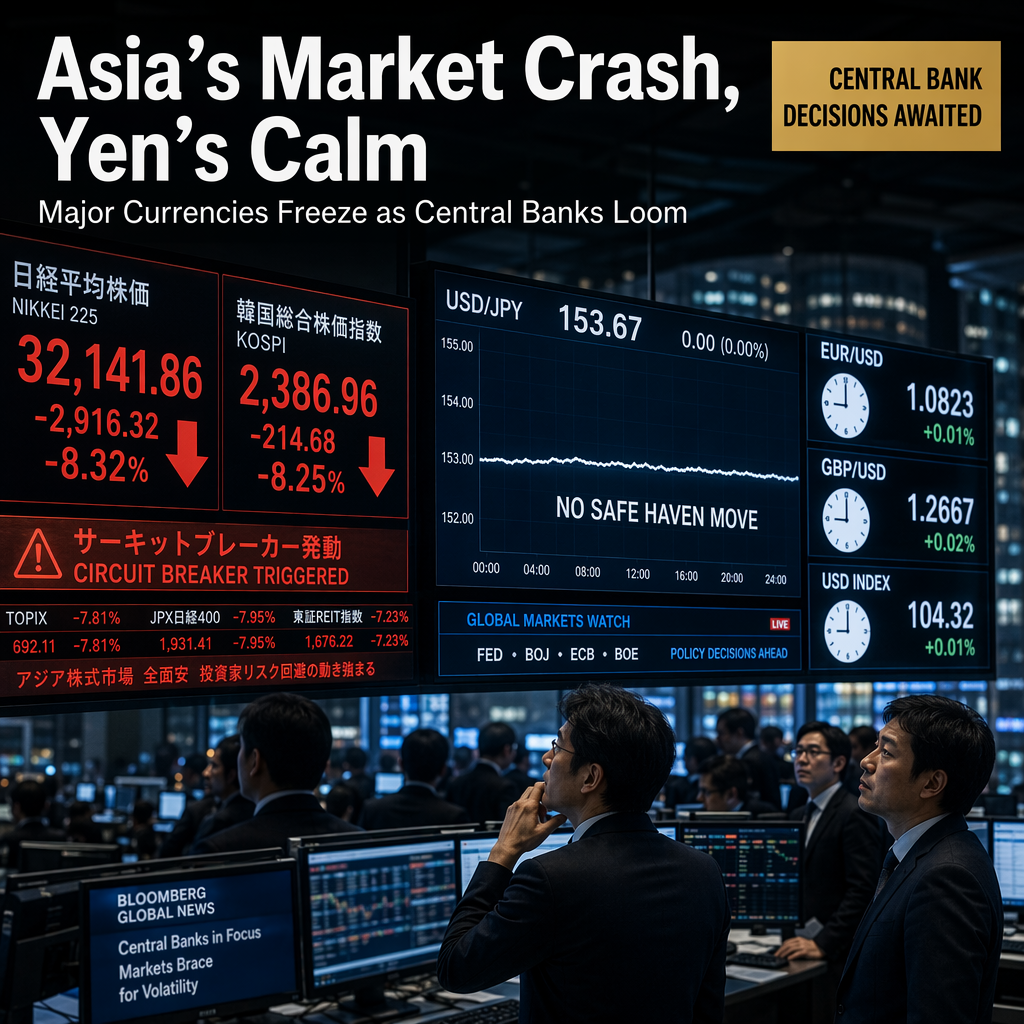
On Tuesday, Asian markets experienced the largest single-session equity shock of the year, with Korea's benchmark index falling close to 11%, triggering its eighth circuit breaker of 2024, and Japan's own benchmark dropping nearly 4% to its weakest since May 22, led by chip-equipment names. Taiwan's index also fell 4.7%, and the artificial-intelligence trade came under pressure across the region [1]. Despite this turmoil, the Japanese Yen remained almost unmoved, trading just below 164.00 against the Dollar, near its weakest level in four decades, and showing no haven response typically expected during such market stress [1].
The Yen's lack of reaction is attributed to its current role as the funding leg of carry trades, supported by a stable implied volatility environment and a policy rate of 1.00%, which is significantly lower than American front-end yields above 4%. This dynamic makes holding Yen-funded positions attractive, even in the face of regional shocks. Japan's Ministry of Finance previously spent approximately 11.7 trillion Yen (about $72 billion) defending the currency between late April and late May, nearly double the previous largest intervention, but the Yen quickly returned to its weakest levels, and the market has largely priced in the intervention as ineffective. The Ministry has since shifted from verbal warnings to unpredictable interventions, but the lack of a clear defense line has encouraged further testing of the Yen's downside [1].
Meanwhile, other major currencies are also in holding patterns ahead of key central bank decisions. The Euro traded just under 1.1400, marginally firmer, benefiting from a third consecutive session of falling crude oil prices, with Brent near $84 and WTI near $79, about 16% below last Thursday's peak. However, cheaper energy is seen as a 'rate cut in disguise' for the Eurozone, as it reduces inflation and the likelihood of further European Central Bank tightening, even as the ECB held its deposit rate at 2.25% last week and markets had priced in a possible September hike. Euro-area inflation was 2.8% YoY in June, down from 3.2% in May, but staff projections for 2026 remain near 3.0%, largely due to energy prices [3].
The British Pound also showed little movement, trading just under 1.3300 in a narrow range, as markets await the Bank of England's decision and quarterly report on Thursday. The market expects little change, as the energy price assumptions underpinning the BOE's forecasts were set before the recent drop in crude oil prices. The Federal Reserve's meeting, with a decision due Wednesday, is also influencing global currency moves, with rate futures showing over 91% odds of at least one hike by December and about 58% odds of two or more hikes, keeping the Dollar strong and limiting rallies in other currencies [4].
In Australia, the Dollar traded just below 0.7000, down about 0.25%, after the Reserve Bank of Australia's Governor's speech failed to provide a clear case for further hikes. The market is now focused on the upcoming second-quarter Consumer Price Index release, which is expected to determine the likelihood of an August rate hike. Forecasts suggest a quarterly trimmed mean near 0.9%, which would push the annual pace toward 3.7%, well above the RBA's 2-3% target band. However, a lower print could validate the market's repricing and reduce the chances of an August hike [2].
CONCLUSION
Despite a major equity selloff in Asia, the Japanese Yen failed to act as a safe haven, highlighting its current role as a funding currency rather than a risk-off asset. Major currencies, including the Euro, Pound, and Australian Dollar, remain range-bound as markets await key central bank decisions and inflation data. The overall market sentiment is cautious, with the Dollar maintaining strength due to persistent expectations of further Federal Reserve tightening.