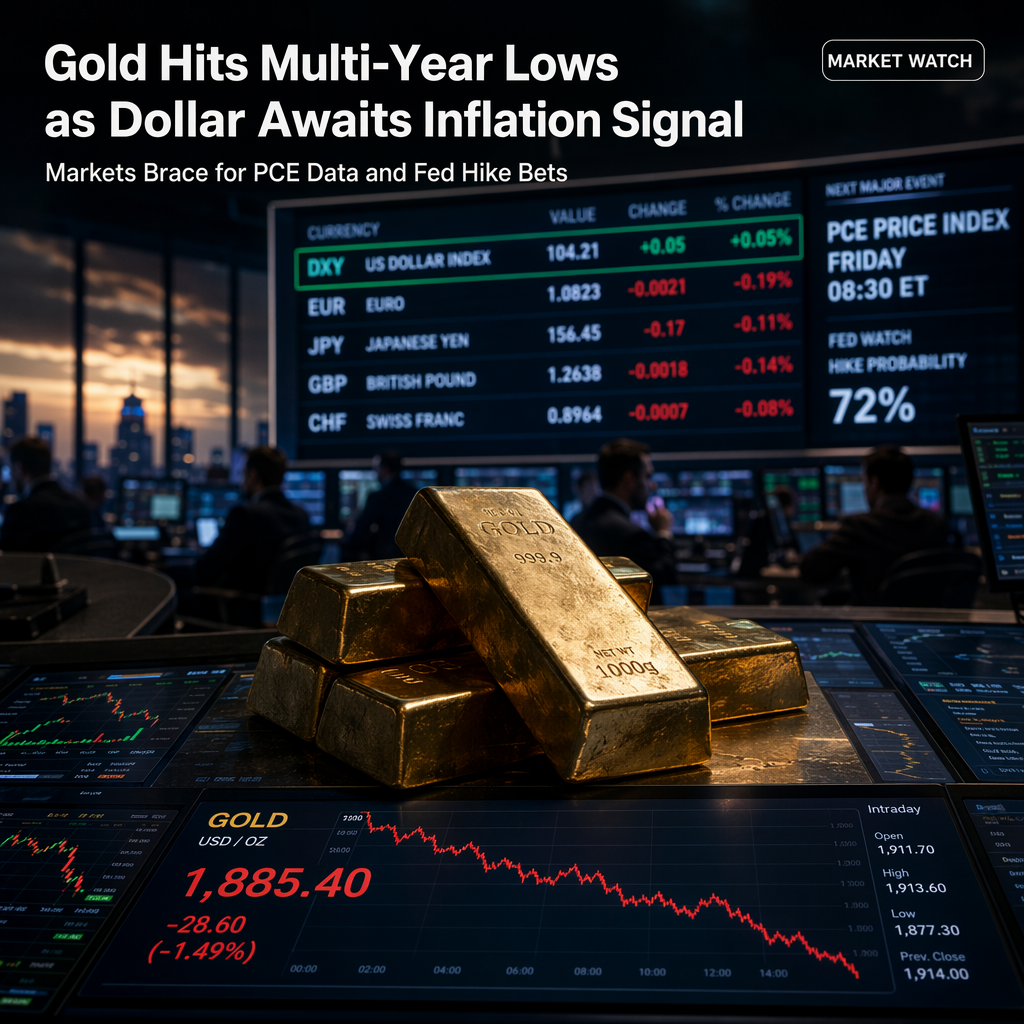
Gold (XAU/USD) continued its bearish trajectory during the Asian session on Thursday, sliding to its lowest level since November 2025, a level set the previous day. This marks the third consecutive day of declines for the precious metal, as traders await the release of the US Personal Consumption Expenditures (PCE) Price Index, which is expected to influence the Federal Reserve's policy path and impact gold's performance as a non-yielding asset [1]. The overnight break below the previous year-to-date low and the $4,000 mark triggered fresh selling, with technical indicators such as the Relative Strength Index (RSI) hovering near oversold territory at 28, suggesting a possible slowdown in the pace of decline. However, the negative Moving Average Convergence Divergence (MACD) reading and continued trading below the 100-period Simple Moving Average (SMA) near $4,258.00 reinforce the bearish outlook, with any recovery attempts likely to attract fresh sellers near the $4,065-$4,070 region and capped around $4,100 [1].
Meanwhile, the US Dollar Index (DXY) is trading marginally lower around 101.52, close to its over-a-year high of 101.80 posted on Wednesday. The USD showed subdued performance against major currencies, being weakest against the Swiss Franc (-0.14%) and strongest against the New Zealand Dollar (+0.16%) today [2]. Investors are closely watching the upcoming US PCE inflation data for May, which is expected to show core PCE inflation rising to 3.4% year-on-year from 3.3% in April. This data is seen as crucial for shaping market expectations regarding the Fed's monetary policy outlook [2].
According to CME Group's FedWatch Tool, market participants are pricing in over an 80% chance that the US central bank will raise borrowing costs by the end of this year, with the possibility of at least two interest rate hikes at 42.2%. This represents a sharp turnaround from earlier projections of two rate cuts before the onset of the Middle East war, which had led to increased inflationary pressures [1][2]. Despite the recent decline in US Treasury bond yields and subdued USD performance, gold has not found respite, as the safe-haven appeal of the Greenback remains supported by a global selloff in technology stocks and receding inflation fears due to falling crude oil prices and the reopening of the Strait of Hormuz [1].
Analysts note that acceptance below the $4,000 psychological mark further validates the negative outlook for gold, and any attempted recovery is likely to be sold into and remain capped unless bulls can clear the $4,100 barrier [1]. The market is expected to remain cautious and volatile ahead of the US PCE inflation release, which will provide fresh cues for both USD and gold traders [1][2].
CONCLUSION
Gold has reached multi-year lows amid persistent bearish sentiment, while the US Dollar Index remains subdued but near recent highs as markets await the US PCE inflation data. Elevated expectations for Fed rate hikes continue to weigh on gold, with technical and fundamental factors suggesting further downside unless key resistance levels are breached. The upcoming inflation report is likely to be a pivotal driver for both gold and USD in the near term.