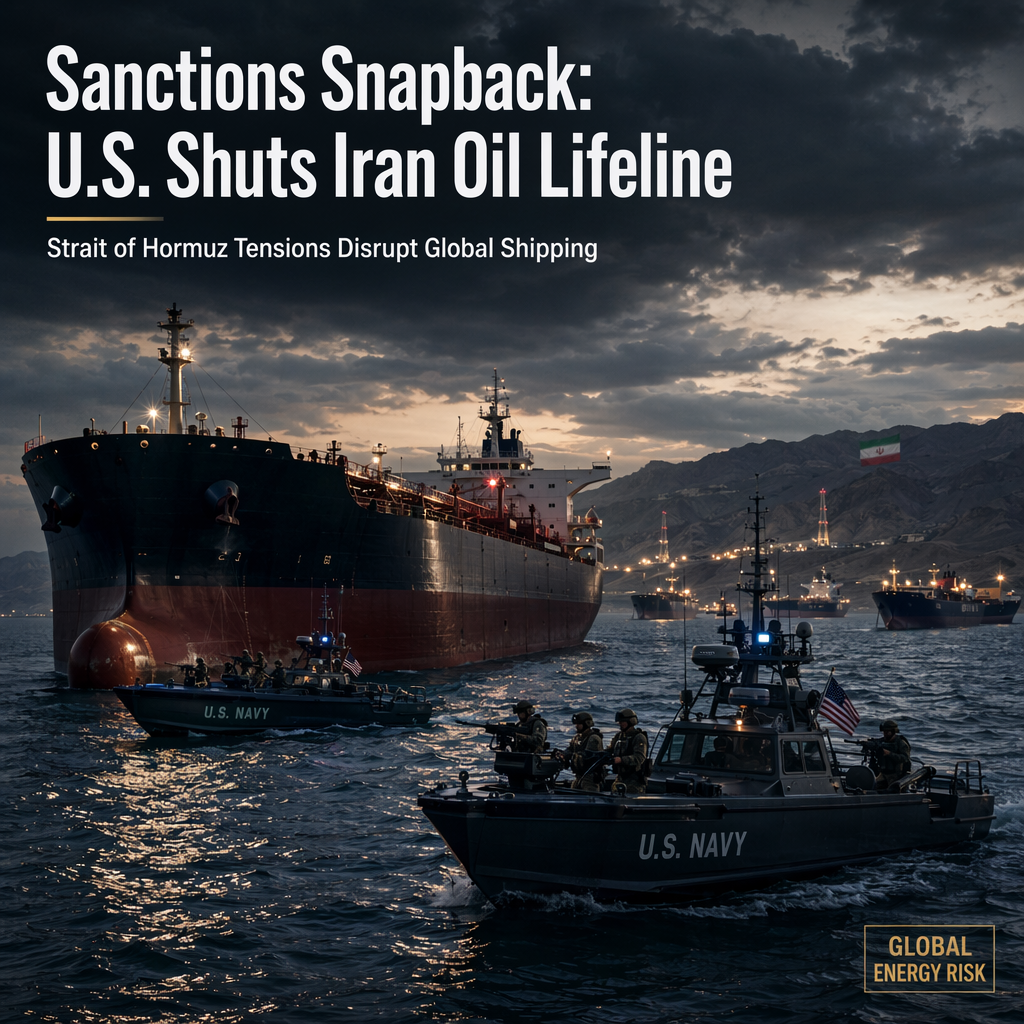
The United States has revoked oil sanctions waivers previously granted to Iran following a series of attacks on commercial vessels in the Strait of Hormuz earlier this week, escalating tensions in one of the world's most critical energy corridors [1][2]. According to U.S. officials, three commercial vessels were struck by Iran in the Strait of Hormuz between Monday and Tuesday, with incidents confirmed by both British maritime authorities and the U.K. Maritime Trade Operations (UKMTO) [1]. The Joint Maritime Operations Center, a U.S.-led naval group in Bahrain, raised its threat assessment in Hormuz to 'severe' after attacks on a liquefied natural gas tanker, an oil supertanker, and a third unspecified tanker [2].
The attacks occurred despite an interim framework deal signed in June, which included a 60-day negotiating period during which both sides agreed to halt military operations and Iran committed to reopening the Strait of Hormuz to commercial shipping in exchange for limited economic relief, including oil sanctions waivers [1]. However, under the terms of the deal, Iran insisted that vessels use a northern route under its control, while the U.S. Navy established a southern route along Oman's coast for Gulf states to export oil and gas, as the traditional route through the middle of Hormuz has been mined by Iran [2]. Iran has targeted ships using the U.S.-protected route, intensifying the standoff over control of the strait [2].
A U.S. official stated, 'Iran will only reap benefits if they exhibit good behavior. Iran’s actions in the Strait were wholly unacceptable to the United States and will be met with consequences,' confirming that the Treasury Department's Office of Foreign Assets Control (OFAC) would revoke the sanctions waivers [1][2]. The attacks have prompted commercial vessels and oil tankers to maintain their wait in the Gulf of Oman as of June 17, 2026, reflecting heightened risk and uncertainty in the region [2].
The incidents have raised concerns about the stability of the fragile truce and the potential impact on global energy markets, as roughly one-fifth of the world's seaborne oil passes through the Strait of Hormuz [1]. The U.S. administration has indicated that negotiators continue to work towards a final deal, but the revocation of sanctions waivers signals a hardening stance in response to Iran's actions [1].
CONCLUSION
The U.S. decision to revoke Iran's oil sanctions waivers marks a significant escalation following attacks on commercial vessels in the Strait of Hormuz. With the threat level raised and shipping activity disrupted, the situation poses a high risk to global energy markets and underscores the fragility of ongoing negotiations between Washington and Tehran.