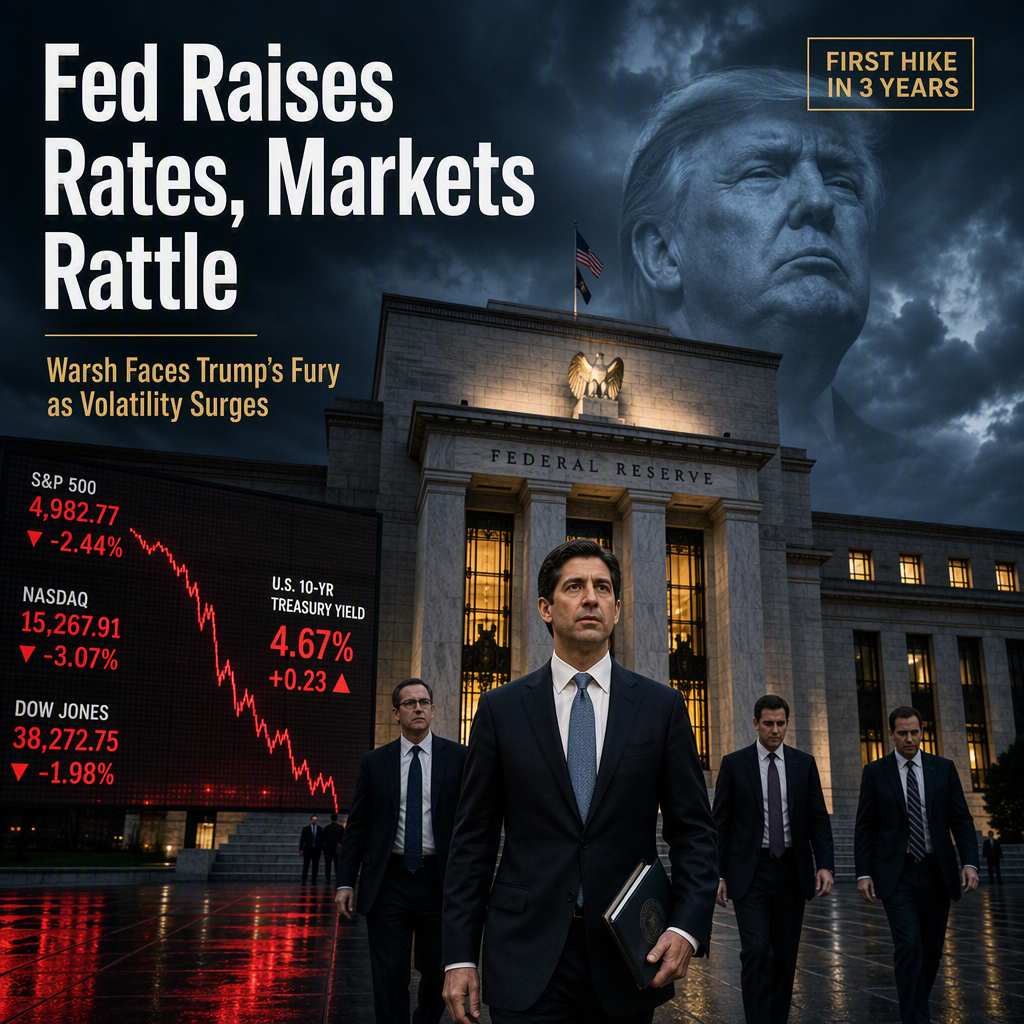
The U.S. Federal Reserve raised interest rates by 25 basis points to a target range of 3.75% to 4.0% on Wednesday, marking its first rate hike in three years. The decision was made unanimously by Fed policymakers, with a 12-0 vote in favor of the increase [1][3]. Fed Chair Kevin Warsh stated that the move was necessary because 'inflation is too high and has been for too long,' describing the decision as 'sober' and 'responsible.' Warsh also signaled that further rate hikes could be possible to address persistent inflation [2][3].
The market reaction was immediate: the US Dollar Index (DXY) edged up 0.03% to 100.35 at the time of reporting [1], while all three major U.S. stock indexes ended their session lower and the benchmark 10-year Treasury yield climbed above 5% [3]. Money markets priced in about a 49.8% chance of another Fed hike in October, according to the CME FedWatch tool [2].
U.S. President Donald Trump responded critically to the Fed's decision, demanding that the central bank slash interest rates to 1% 'or less,' arguing, 'We are "carrying" almost every country in the World, and that cannot go on any longer' [2][3]. Trump also told Fed Chair Kevin Warsh to 'do what you want' ahead of the vote, but expressed skepticism about the Fed's independence, calling the board 'very political' and 'a bunch of politicians' [1].
Analysts weighed in on the Fed's stance, with Michael Gapen, chief US economist for Morgan Stanley, commenting, 'That’s hawkish. If the chair thinks policy is accommodative, then you’ve got more work to do' [2]. The rate hike is part of a broader week of central bank decisions, with the Bank of England and Bank of Japan also set to announce policy moves [3].
Elsewhere, the Australian Dollar held gains near 0.7100 despite the Fed's move, and the IMF urged the Reserve Bank of Australia to remain hawkish due to ongoing inflation risks [2]. Meanwhile, oil prices dropped as U.S. officials indicated that damage to Saudi Arabia's pipeline was temporary, though some analysts warned repairs could take longer [3].
CONCLUSION
The Federal Reserve's first rate hike in three years signals a renewed focus on combating inflation, with policymakers leaving the door open for further increases. The move triggered declines in U.S. equities and a rise in Treasury yields, while drawing sharp criticism from President Trump. Market participants are now closely watching for additional central bank actions and further guidance from the Fed.