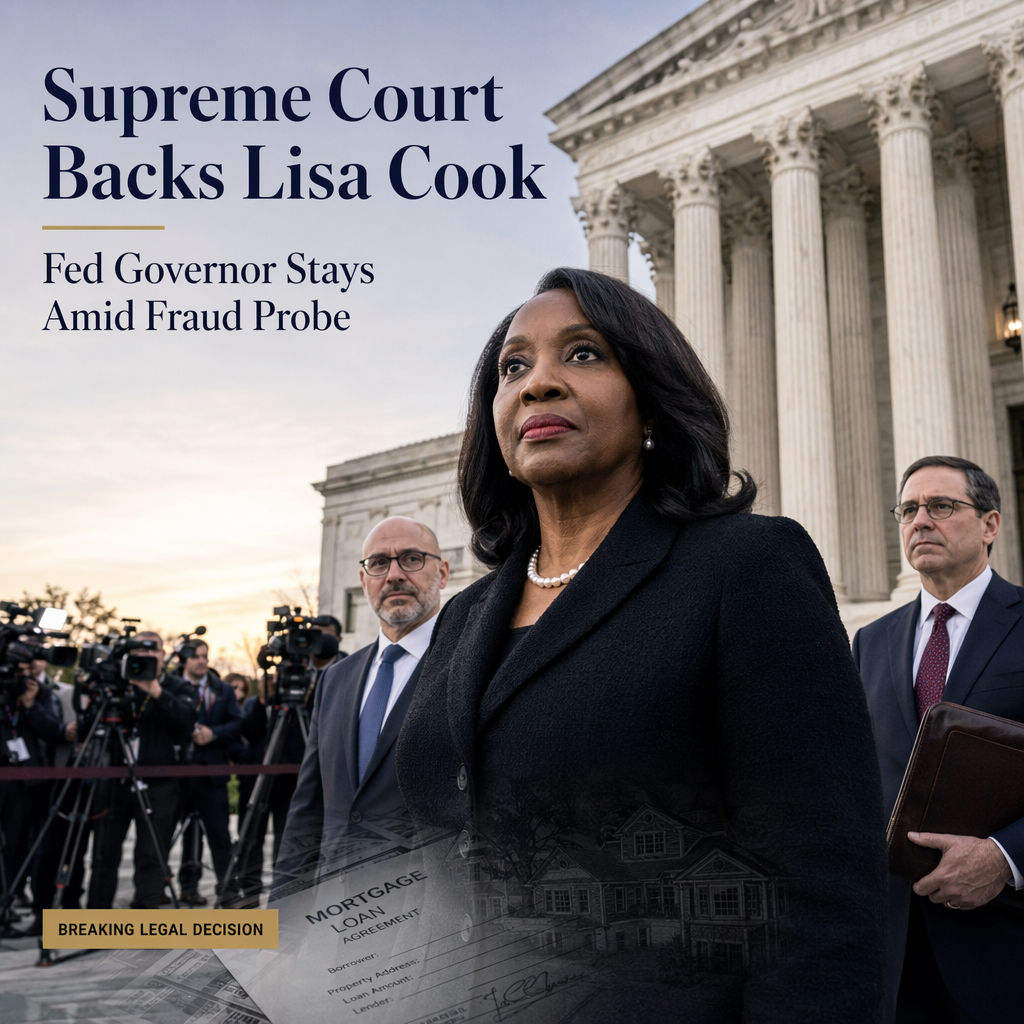
Federal Reserve Governor Lisa Cook is at the center of a legal and political battle after allegations surfaced regarding three mortgages she obtained prior to joining the central bank, with the controversy becoming a focal point in former President Donald Trump's attempt to remove her from the Federal Reserve Board of Governors [1]. The loans, tied to properties in Michigan, Georgia, and Massachusetts, raised questions about whether Cook misrepresented the intended use of the homes—specifically, whether they were to be used as primary residences or otherwise. Trump argued that these allegations constituted cause for her removal from the Board [1].
The Supreme Court ruled 5-4 that Cook can remain on the Federal Reserve Board while her separate lawsuit challenging her firing proceeds [1]. Cook's lawsuit, filed on August 28, contends that Trump's move to oust her was unlawful and threatened the independence of the Federal Reserve. Notably, her lawsuit did not address the allegations regarding the mortgage applications [1].
The allegations originated with Bill Pulte, a Trump appointee and current acting Director of National Intelligence, who referred the matter to the Justice Department. The DOJ subsequently confirmed it had opened a criminal investigation into possible mortgage application fraud related to the three loans, all of which were issued in 2021 before Cook was nominated to the Federal Reserve Board by President Joe Biden [1].
Cook disclosed all three mortgages in a June 2025 financial filing with the U.S. Office of Government Ethics, listing them alongside her income, retirement accounts, and investments. The filing also revealed that Cook earned more than $50,000 a year in rental income from her Cambridge, Massachusetts, condominium. Pulte alleged that Cook misrepresented this property as a second home rather than an investment property, despite reporting rental income from it [1]. The specific mortgage details include a 15-year, $361,000 loan at 2.5% for the Cambridge condo (April 2021), a 15-year, $203,000 loan at 2.87% for an Ann Arbor, Michigan home (June 2021), and a $540,000, 30-year mortgage for a luxury condo in Atlanta, Georgia [1].
The case has drawn attention to the preferential terms associated with primary-residence loans, which are typically considered lower risk by lenders compared to mortgages for vacation or rental properties [1].
CONCLUSION
The Supreme Court's decision allows Lisa Cook to remain on the Federal Reserve Board as legal proceedings continue regarding her removal and the ongoing DOJ investigation into her mortgage applications. The controversy highlights concerns about transparency and ethics at the central bank, with potential implications for the Federal Reserve's independence and public trust.