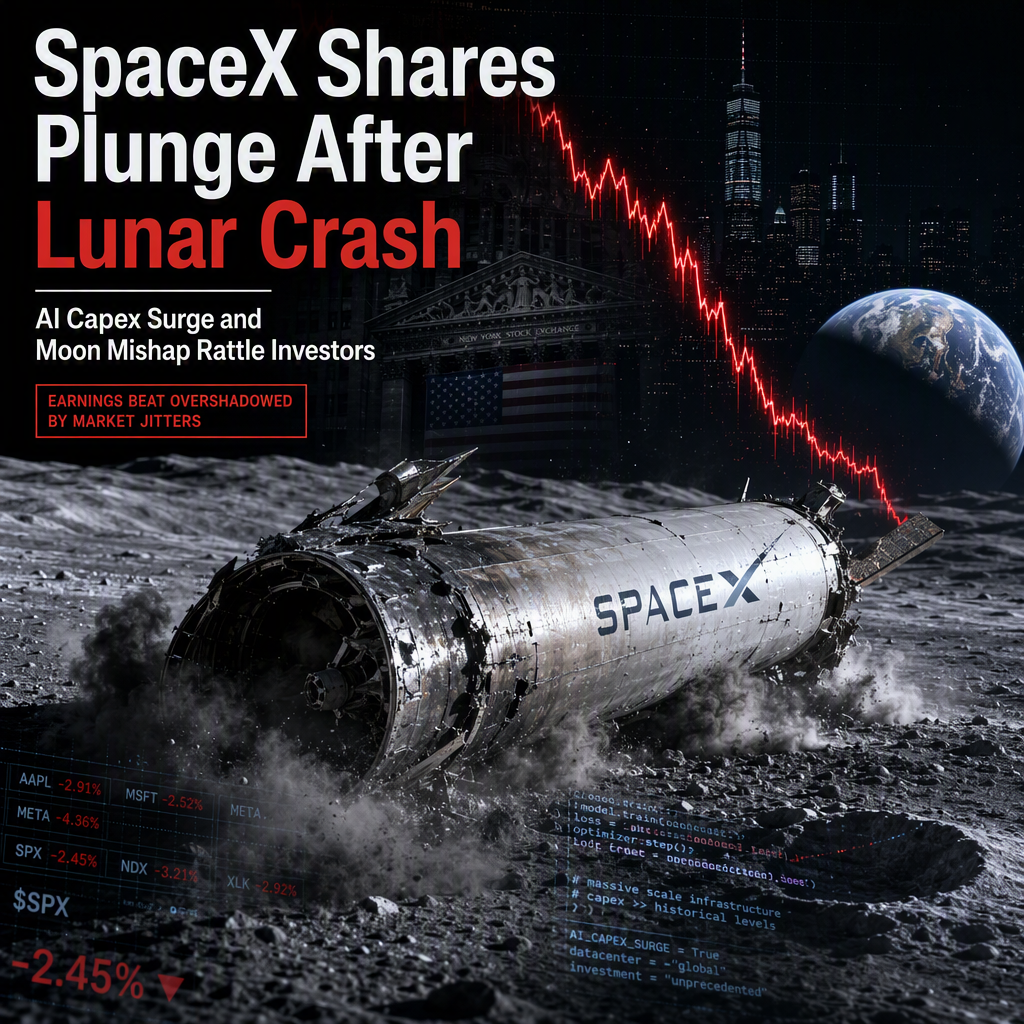
SpaceX shares experienced a sharp decline on Wednesday, falling 13.6%, following the expected crash of a 4-metric-ton section of a Falcon 9 rocket into the moon, an event analysts described as a 'good metaphor' for the company's stock performance [1]. The sell-off coincided with SpaceX's first quarterly earnings report as a public company, which showed revenue soaring 92% to $7.81 billion, surpassing consensus estimates of $6.93 billion, and losses that were narrower than forecast [1]. Despite these strong results, investors were alarmed by a sixfold increase in capital expenditures to $18.4 billion in the second quarter, with most of the spending directed toward artificial intelligence initiatives [1].
The rocket part, traveling at over 5,400 mph, was shed from the reusable lower stage after a January 2025 mission involving U.S. and Japanese lunar landers and reportedly struck the moon at approximately 2:35 a.m. ET on Wednesday, though the impact has not yet been confirmed [1]. Analysts such as Chris Beauchamp of IG and Russ Mould of AJ Bell drew parallels between the lunar crash and SpaceX's share price performance, noting that the company's massive AI capex spend unnerved investors and contributed to the stock's decline, pushing it further below the $135 IPO price [1].
While SpaceX's Starlink satellite internet division remains a key revenue driver, the scale of AI-related expenditures—far exceeding analysts' expectations—was a major factor behind the market backlash [1]. Russ Mould highlighted that, unlike some other companies heavily investing in AI, SpaceX does not yet generate meaningful levels of cash flow, intensifying investor concerns [1]. Additionally, comments from Elon Musk about Starlink's potential expansion into terrestrial networks to compete with established telecoms like T-Mobile, AT&T, and Verizon added to market nervousness [1].
Overall, the combination of an unconfirmed lunar crash, unexpectedly high capital spending, and strategic uncertainty led to a significant negative reaction in SpaceX's share price, despite the company delivering better-than-expected earnings [1].
CONCLUSION
SpaceX's debut as a public company was marred by a dramatic share price drop, driven by investor concerns over soaring AI capex and strategic risks, despite strong revenue growth and narrower losses. The coincidental rocket crash on the moon served as a vivid metaphor for the company's market challenges. The market's reaction underscores the importance of capital discipline and cash flow generation for high-growth tech firms.