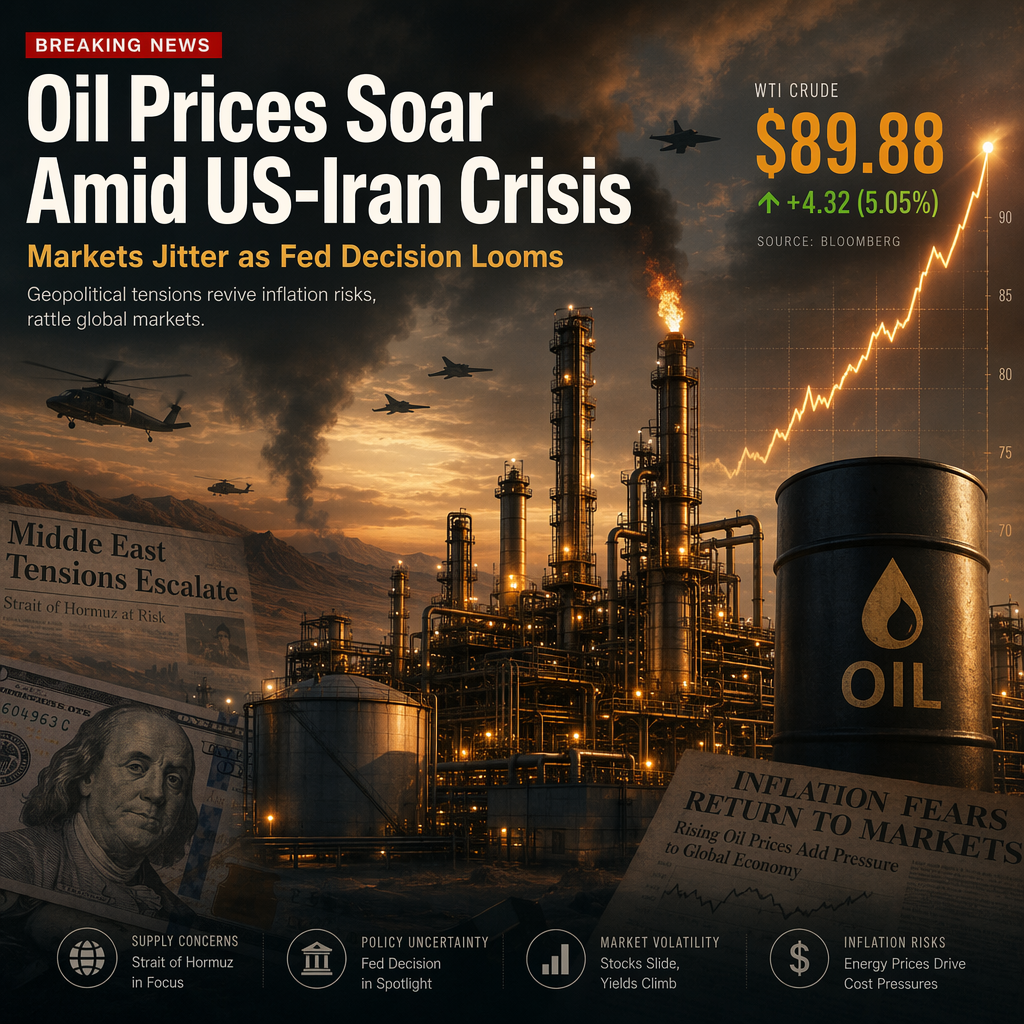
A renewed escalation in hostilities between the United States and Iran has triggered a sharp rally in global oil prices, with both Brent and West Texas Intermediate (WTI) crude benchmarks posting significant gains. According to BNY, Brent crude rose more than 3% following Iranian missile launches toward U.S. forces in Jordan and retaliatory strikes by U.S. and Saudi forces against Iran-backed militias in Iraq, ending a brief pause in hostilities and reviving concerns over inflation through higher energy prices [1]. WTI futures on NYMEX surged 6% on the day, trading slightly above $83.00 during the European session, rebounding after a three-day losing streak amid fears of a prolonged energy supply squeeze [2]. CNBC reported an even sharper move, with WTI crude futures advancing 6.9% to $89.88 a barrel [3].
The immediate catalyst for the price spike was a surprise ballistic missile attack by Iran's Islamic Revolutionary Guard Corps (IRGC) on U.S. forces in the Middle East, all of which were intercepted according to U.S. Central Command [1][3]. In response, U.S. and Saudi forces struck Iran-backed militants in Iraq after a series of drone attacks in the preceding 72 hours [1]. President Donald Trump stated that the U.S. would be "hitting Iran hard" in response to these attacks [3].
Further compounding supply concerns, reports indicated that Yemen's Houthis are considering imposing fees on commercial ships passing through the Bab el-Mandeb Strait, a key chokepoint for nearly 7% of global oil supply, after having hijacked the route last week [2]. While Iran has been prevented from imposing tolls in the Strait of Hormuz—a passage for almost 20% of global energy supply—by the U.S. and other Middle Eastern nations, the Houthis' move could escalate military tensions and disrupt energy flows [2].
The surge in oil prices has had immediate market implications. U.S. Treasury yields rose, with the 10-year note up 2 basis points to 4.624% and the 2-year note up 3 basis points to 4.308%, as investors weighed the inflationary impact of higher energy prices ahead of the Federal Reserve's interest rate decision [3]. Despite the oil-driven inflation risk, BNY and CNBC both note that the Fed is expected to leave rates unchanged at 3.5% to 3.75%, with markets pricing in a 76% chance of a rate hike in September [1][3]. Analysts at Rabobank highlighted that the cycle of attacks and counterattacks is keeping a firm bid under crude benchmarks [2].
While the inflation channel has been revived by the oil price spike, BNY argues that these moves are unlikely to materially affect the Fed's decision today, with policy and risk assets remaining the dominant market drivers [1].
CONCLUSION
The escalation of US-Iran tensions has led to a sharp rally in oil prices and heightened concerns over energy-driven inflation, prompting a rise in Treasury yields as markets await the Federal Reserve's decision. While the immediate impact on Fed policy is expected to be limited, the ongoing cycle of geopolitical conflict and supply risks continues to support elevated crude prices and market volatility.