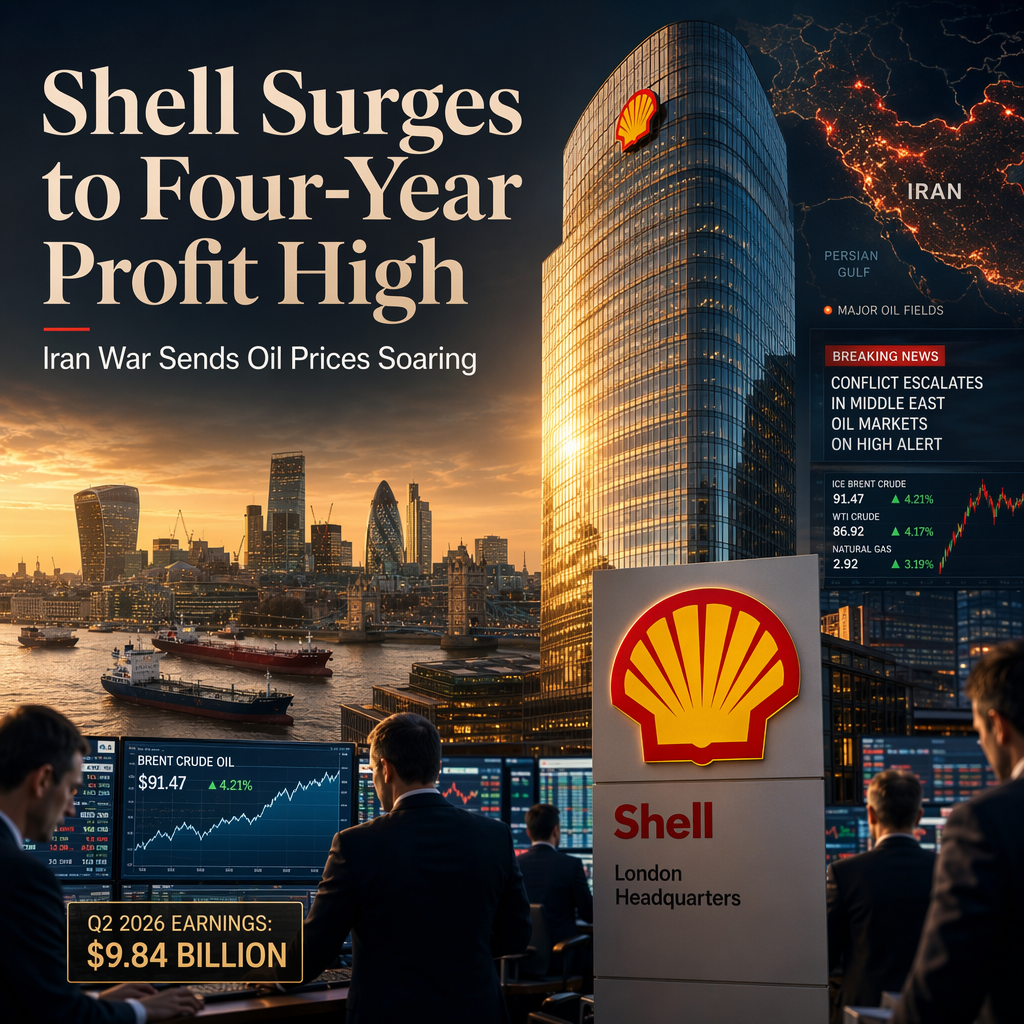
Shell posted adjusted earnings of $9.84 billion for the second quarter of 2026, significantly surpassing analyst expectations of $8.79 billion according to an LSEG-compiled consensus, and $8.92 billion from a company-provided forecast [1]. This marks Shell's best quarterly profit since Q2 2022, when the company reported $11.47 billion in earnings amid the surge in oil and gas prices following Russia's invasion of Ukraine [1]. The strong performance was attributed to higher oil and gas prices resulting from the ongoing Iran war, which has created volatility and a favorable macro environment for commodity prices [1]. CEO Wael Sawan emphasized Shell's ability to thrive through volatility, citing outstanding operational performance and strong trading and optimization as key drivers of the results [1].
Compared to the same period last year, Shell's adjusted earnings more than doubled from $4.26 billion, and were also up from $6.92 billion in the first quarter of 2026 [1]. The company reported cash flow from operations of $21.4 billion, supported by higher realized prices, and reduced its net debt to $41.75 billion from $52.6 billion at the end of the previous quarter [1]. Shell maintained its capital expenditure outlook for 2026 at $24 billion to $26 billion and announced it would keep its share buyback program at $3 billion for the next quarter [1].
The broader market context includes heightened geopolitical tensions, with the U.S. launching its first airstrike in the Middle East since pausing its bombing campaign, in response to attempted Iranian attacks on American forces [1]. This conflict has contributed to the surge in fossil fuel prices, benefiting energy majors like Shell [1].
Shell's London-listed shares have risen approximately 21% year-to-date, though the company still trails peers such as BP, TotalEnergies, Exxon Mobil, and Chevron in share performance [1].
CONCLUSION
Shell delivered its strongest quarterly profit in four years, driven by elevated oil and gas prices amid the Iran war. The company exceeded analyst expectations, improved its financial position, and maintained its capital expenditure and share buyback plans. Market sentiment is positive, reflecting Shell's operational resilience and the ongoing impact of geopolitical tensions on energy prices.