
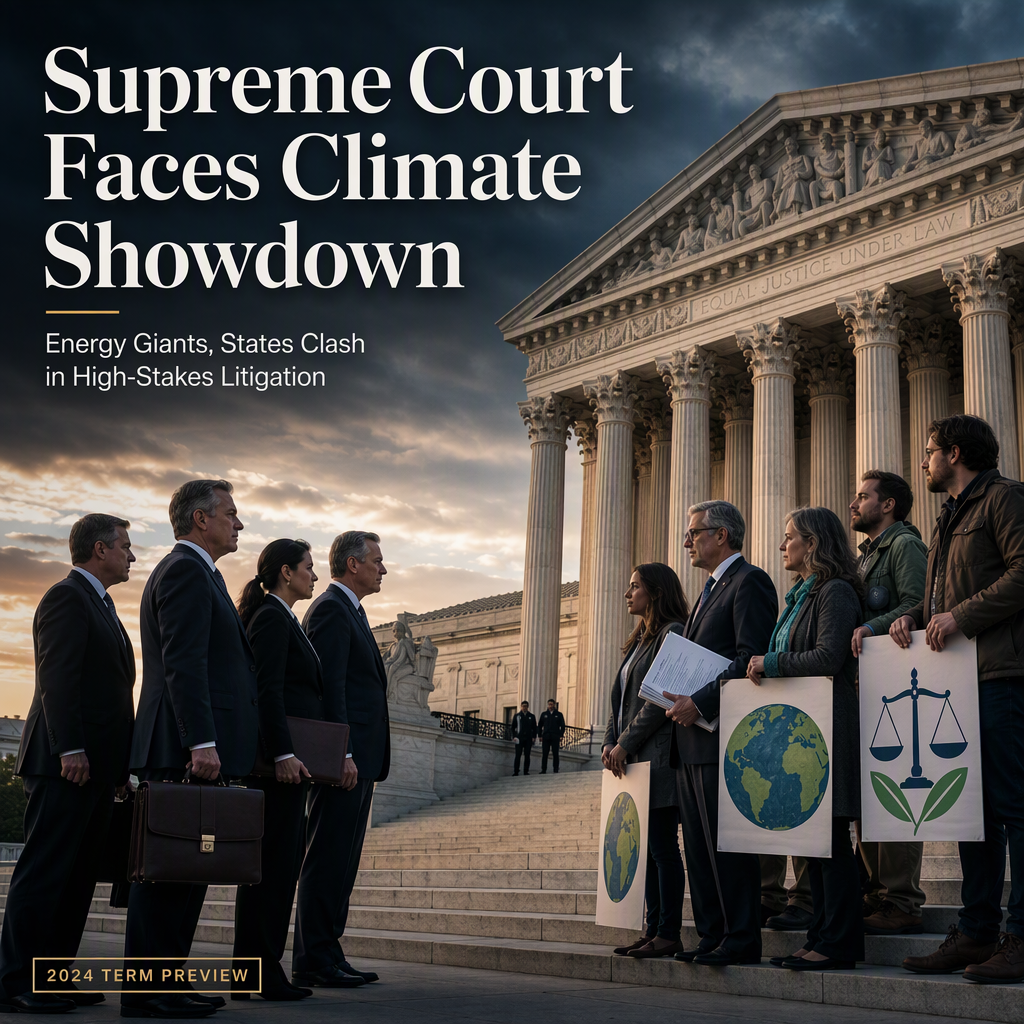
The Supreme Court is commencing its new term with a docket that includes several high-profile cases, notably Suncor Energy v. Commissioners of Boulder County, which could have significant implications for the energy sector and climate litigation in the United States [1]. In this case, Boulder, Colorado, is suing Suncor Energy and ExxonMobil in state court under Colorado tort law, seeking substantial damages for the effects of global climate change. The lawsuit aims to hold these companies accountable for emissions not only in Colorado but also in every state and globally, a strategy mirrored by dozens of other states and cities pursuing similar legal actions [1].
An outside counsel for Boulder’s legal team has publicly described such climate litigation as effectively imposing a 'carbon tax' and acknowledged that it could raise fossil-fuel prices and potentially push energy companies toward bankruptcy [1]. The Supreme Court will consider whether federal law bars these claims and whether it has statutory and Article III jurisdiction to hear the case. The article notes that for over a century, the Court has treated emissions crossing state lines as a federal issue, referencing the Clean Air Act and previous Court decisions on similar matters [1].
The outcome of this case could check the ability of states or municipalities to set national policy on climate issues, potentially impacting the regulatory environment for energy companies like Suncor and ExxonMobil [1]. The article suggests that a clear reversal by the Supreme Court would reinforce the constitutional principle that states cannot govern beyond their borders, which could limit the scope of future climate litigation [1].
Additionally, the Court will hear St. Mary Catholic Parish v. Roy, a case involving Colorado’s preschool program and religious freedom, but the primary market-moving focus remains on the climate litigation against major energy companies [1].
CONCLUSION
The Supreme Court’s decision in Suncor Energy v. Commissioners of Boulder County could reshape the landscape for climate litigation and energy companies in the United States. A ruling that limits state-level lawsuits could provide relief to fossil fuel companies facing similar claims nationwide, while a decision allowing such suits could increase legal and financial risks for the industry.