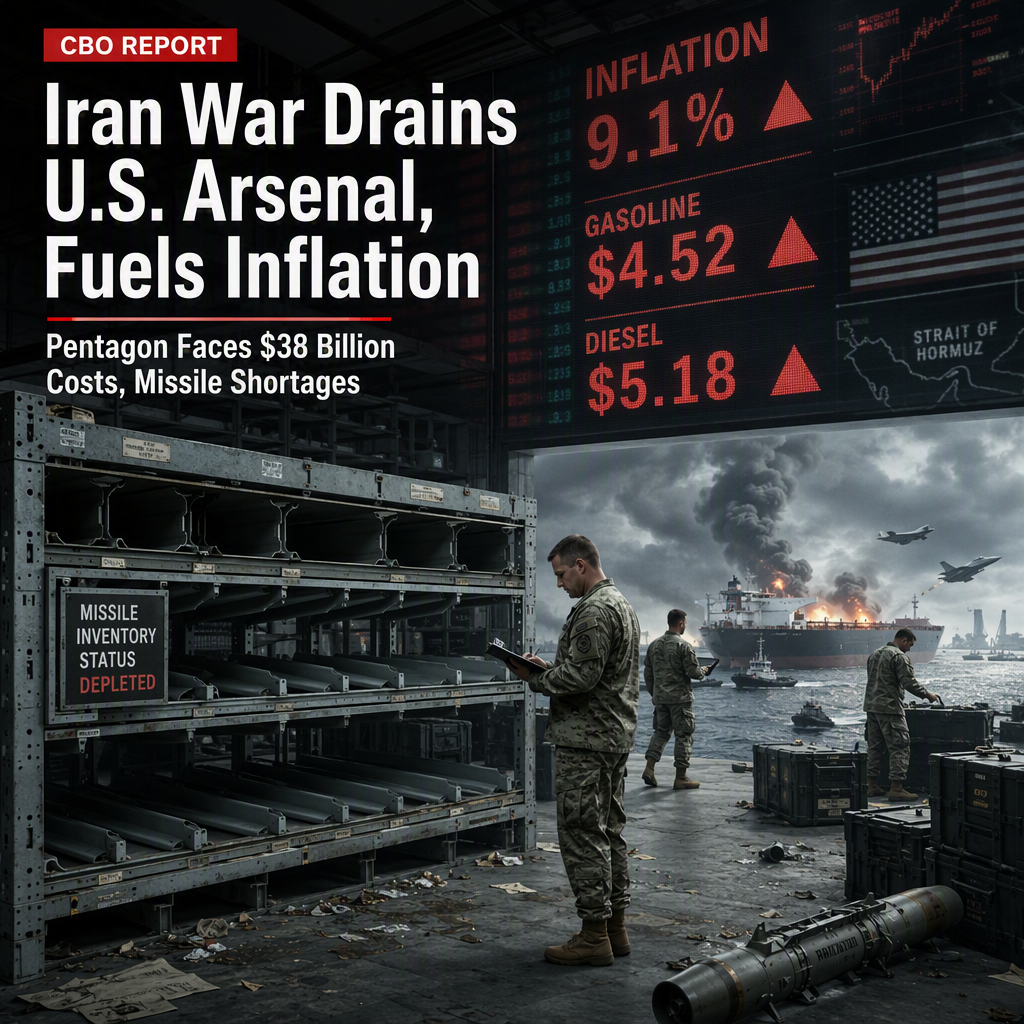
The Congressional Budget Office (CBO) released a report detailing the significant economic and military impacts of the ongoing U.S. war with Iran. According to the CBO, the war is responsible for more than one-third of the increase in inflation this year, with inflation expected to continue rising into the first quarter of next year. The report specifically attributes more than 40% of inflation during the second quarter of 2026 and an estimated half a percentage point increase in the first quarter of 2027 to the conflict, primarily due to reduced oil and natural gas shipments through the Strait of Hormuz and the Red Sea [1]. Interest rates are likely to rise as a result, increasing borrowing costs for Americans [1].
On the military front, the CBO estimates the Pentagon has spent $38.1 billion on the war through August 1, with more than half of this amount allocated to replacing missiles and other munitions. Increased flying hours accounted for $10.4 billion, and higher fuel prices added $2.7 billion to the total cost. The war has led to global fuel price increases since its launch on February 28 by President Donald Trump [2]. The Pentagon estimated the war had cost $33.4 billion as of June 29, including $7.4 billion in incremental operating costs, $22.3 billion for munitions replacement, and $3.7 billion in equipment losses [2].
The conflict has severely depleted U.S. missile-defense inventories, with as much as two-thirds of the nation's interceptors consumed since June 2025, largely due to defending Israel against Iranian attacks. The CBO warns that rebuilding these inventories will take at least five years, even with increased production [2][1]. The report estimates it will cost $13.1 billion to replace missile defense interceptors alone, and $21.7 billion to replace munitions expended through August 1. Maintaining the current level of conflict is projected to cost $2 billion to $3 billion per month, with higher costs if the war escalates [1][2].
Iranian strikes have damaged or destroyed hundreds of buildings and structures at U.S. bases across eight Middle Eastern countries, including dozens of aircraft such as four F-15E fighter jets, an F-35A, seven KC-135 refueling aircraft, seven helicopters, and more than 30 drones. The Pentagon report also noted $79.2 million in State Department costs for evacuations and $184 million in diplomatic site damage across Iraq, Kuwait, Saudi Arabia, and the United Arab Emirates [2]. However, both reports indicate that the Defense Department has not provided estimates for rebuilding plans or funding sources for damaged military bases [1][2].
Sen. Elizabeth Warren called for an end to the war, describing it as "a one-two punch that's burning a hole in Americans’ pockets and burning a hole in our munitions supply, hurting our military readiness" [1]. The CBO cautioned that the missile shortage could be "especially problematic" in a conflict with adversaries possessing large numbers of ballistic and cruise missiles, specifically citing China and a potential conflict over Taiwan [2].
CONCLUSION
The CBO report underscores the Iran war's substantial impact on U.S. inflation, borrowing costs, and military readiness, with depleted missile stockpiles and billions in expenditures. Both economic and defense sectors face ongoing challenges, and the conflict's continuation threatens to further strain resources and inventories. Policymakers and analysts warn that these shortages could pose significant risks in future conflicts.