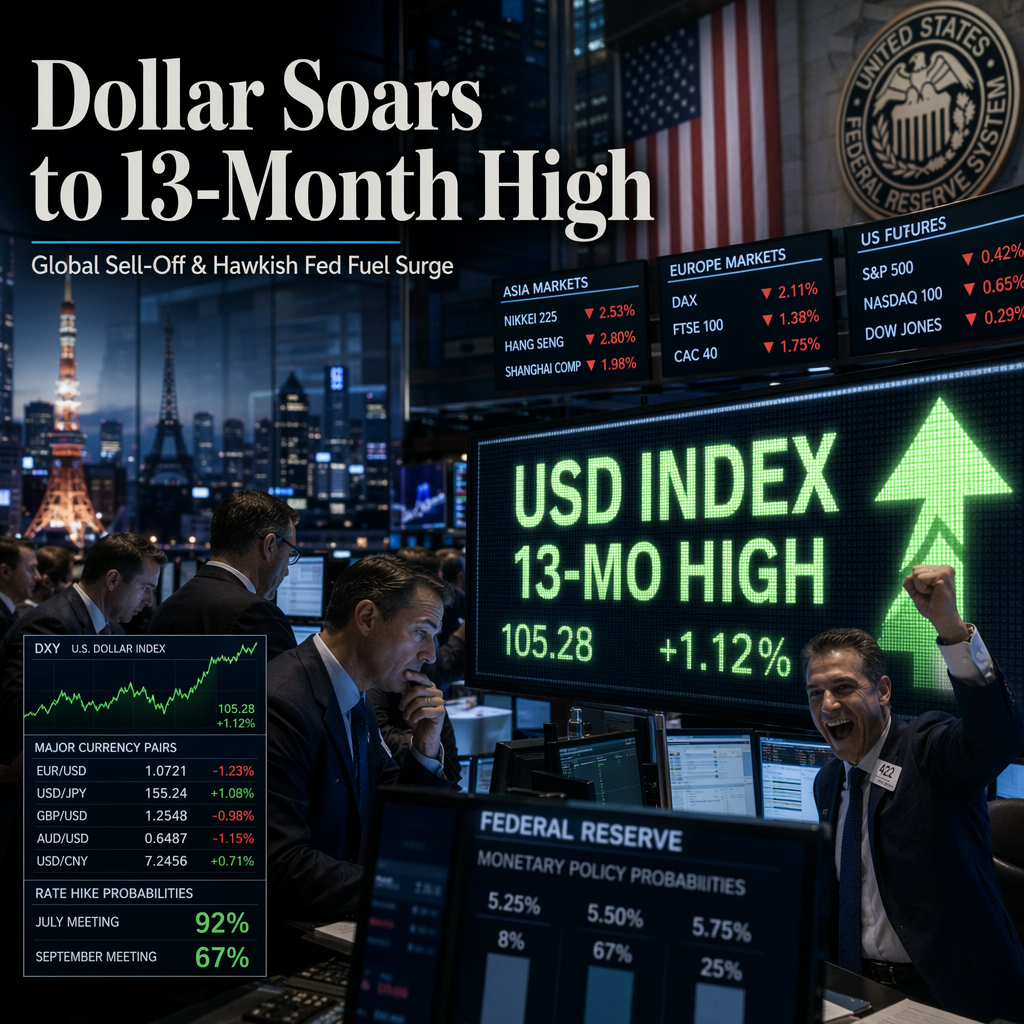
The US Dollar (USD) has extended its rally to a fresh 13-month high, driven by a combination of global equity market turmoil, safe-haven demand, and increasingly hawkish expectations for Federal Reserve (Fed) policy tightening. ING’s Francesco Pesole highlights that the tech-led equity sell-off, originating in Asia and centered on semiconductor stocks, has spilled over into FX markets, with the USD, Japanese Yen (JPY), and Swiss Franc (CHF) benefiting as canonical safe havens. However, only the USD offers an attractive domestic growth and carry story, further reinforcing its outperformance in the current risk-off environment [1].
On Tuesday, the USD Index gained nearly 0.4%, supported by stronger-than-expected US S&P Global Manufacturing PMI (55.7) and Services PMI (51.3) readings for June, both surpassing analyst estimates and signaling robust economic momentum [2][7]. The USD Index held at its highest level since May 2025 near 101.50, rising about 0.15% on Wednesday morning [2]. According to the CME FedWatch Tool, markets are pricing in about a 70% probability of a 25 basis point Fed rate hike by September [2], with some sources noting an even higher 85.5% chance of a hike by December, up from 61% before the last FOMC meeting [7]. FOMC member Austan Goolsbee added to the hawkish tone, stating that inflation remains too high and is moving in the wrong direction [1].
The USD’s strength has been broad-based. It was the strongest against the Australian Dollar (AUD) this week, gaining 1.53%, and also posted notable gains against the New Zealand Dollar (NZD, +1.46%), Euro (EUR, +0.99%), and Swiss Franc (CHF, +0.53%) [2]. The USD/CHF pair extended its rally for a sixth consecutive day, nearing seven-month highs at 0.8125, with technical indicators suggesting overbought conditions but the broader trend remaining bullish [5]. Against the Singapore Dollar (SGD), USD/SGD rose 0.3% to 1.2970, driven by the stronger USD and despite Singapore’s May inflation coming in softer than expected at 1.8% year-on-year [3].
In the case of the Japanese Yen, USD/JPY broke back above 160, but upside was limited by intervention fears and official warnings from Japanese authorities. Japan’s large FX reserves (USD 1.3 trillion) underscore its intervention capacity, but analysts at OCBC argue that a durable reversal lower in USD/JPY would require a clearer hawkish pivot from the Bank of Japan (BoJ) [4].
The Euro also weakened, with EUR/USD dropping below 1.1400 as the USD appreciated across G10 currencies. This move came despite Euro area PMIs surprising on the upside, with the composite PMI rising to 49.5, but the overall risk-off tone and lower global yields weighed on the Euro [6].
Emerging market currencies were not spared: the Indonesian Rupiah (IDR) weakened for a third straight day, with USD/IDR trading around 17,980, as the hawkish Fed tone and robust US data pressured the currency. Rising inflation in Indonesia and concerns over foreign investment flows added to the IDR’s weakness [7].
Geopolitical uncertainty also played a role in supporting the USD. Conflicting statements between the US and Iran regarding nuclear inspections and the future of the Strait of Hormuz contributed to safe-haven flows into the Dollar [2][5][7].
Looking ahead, analysts caution that while near-term USD momentum remains bullish, a dovish repricing of the Fed curve or actual easing could weaken the Dollar in the medium term [1]. Technical indicators for USD/CHF suggest the rally may be stretched, and for USD/JPY, only a shift in BoJ policy could trigger a sustained reversal [4][5]. Key upcoming data releases include US New Home Sales and the Personal Consumption Expenditures (PCE) Price Index, which could further influence market direction [2][5].
CONCLUSION
The US Dollar’s surge is underpinned by risk aversion, strong US economic data, and expectations of further Fed tightening, resulting in broad-based gains against both G10 and emerging market currencies. While near-term momentum remains positive, analysts highlight potential medium-term risks if Fed policy expectations shift. Market participants are closely watching upcoming US data and central bank signals for the next directional cues.