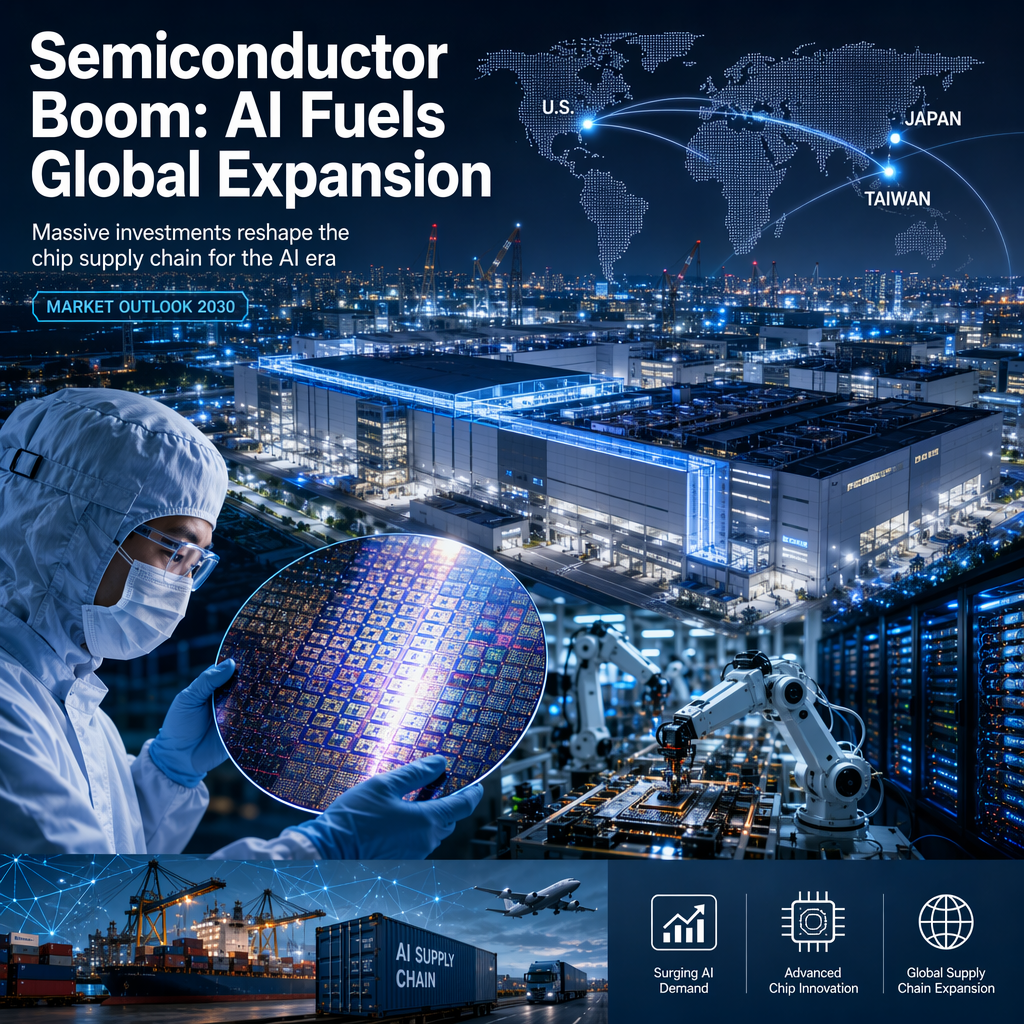
The semiconductor industry is witnessing a surge in investments and capacity expansions driven by robust demand for artificial intelligence applications and advanced chipmaking technologies. Kyocera's President and CEO Shiro Sakushima stated that demand for components used in semiconductor manufacturing equipment is expected to grow at least until around 2030, fueled by the shift toward AI and the expansion of data centers globally. Kyocera is carefully assessing market conditions to decide on expanding production capacity, aiming to balance investment risks with opportunities presented by strong demand. The company is focused on technological innovation and maintaining flexibility in production plans to respond to market changes, including potential supply chain disruptions and economic fluctuations [1].
Japanese chemical maker Ishihara Sangyo Kaisha is doubling its production capacity for titanium dioxide, a key material in ceramic capacitors used in AI servers and advanced electronics. This move is intended to strengthen Ishihara Sangyo's position in the global supply chain for AI server components and support rising demand from semiconductor and electronics manufacturers. The market for chip materials is estimated to reach $73 billion, with Japanese companies such as Toto, Asahi Kasei, and JSR also investing in the sector. Ishihara Sangyo faces growing competition from overseas rivals, particularly from China, and its expansion is seen as a strategic effort to secure market share and ensure a stable supply of high-quality materials [2].
TSMC is accelerating the build-out of its Arizona factory, committing an additional $100 billion to expand its U.S. chipmaking footprint, raising its total investment pipeline in Arizona to $265 billion. This expansion is in response to a "multi-year demand mega trend" for AI chips, with TSMC optimizing its leading-edge capacities and converting its 5-nanometer capacity to the advanced 3-nanometer node. Phase one of the U.S. expansion, using 4-nanometer technology, is already operational, and the company expects its 2-nanometer technology to become a major revenue driver in the third quarter. Despite higher construction costs in the U.S., TSMC believes the expansion will foster the development of the U.S. semiconductor ecosystem. TSMC's stock ended Thursday up 1.23% but closed down 7.29% on Friday, though it remains up around 48% year-to-date. CFO Wendell Huang emphasized that TSMC is committed to delivering profitable growth to shareholders amid the AI megatrend [3].
Across all sources, the semiconductor supply chain is undergoing significant expansion and investment, with companies responding to strong AI-driven demand and intensifying global competition. The focus is on technological innovation, capacity optimization, and securing market share in a rapidly evolving industry.
CONCLUSION
The semiconductor industry is experiencing high-impact growth as companies like Kyocera, Ishihara Sangyo, and TSMC ramp up investments and production to meet surging AI-driven demand. Strategic expansions and capacity increases are shaping the global supply chain, with market leaders positioning themselves for continued growth through 2030. Despite short-term stock volatility, the long-term outlook remains positive, supported by robust demand and ongoing innovation.